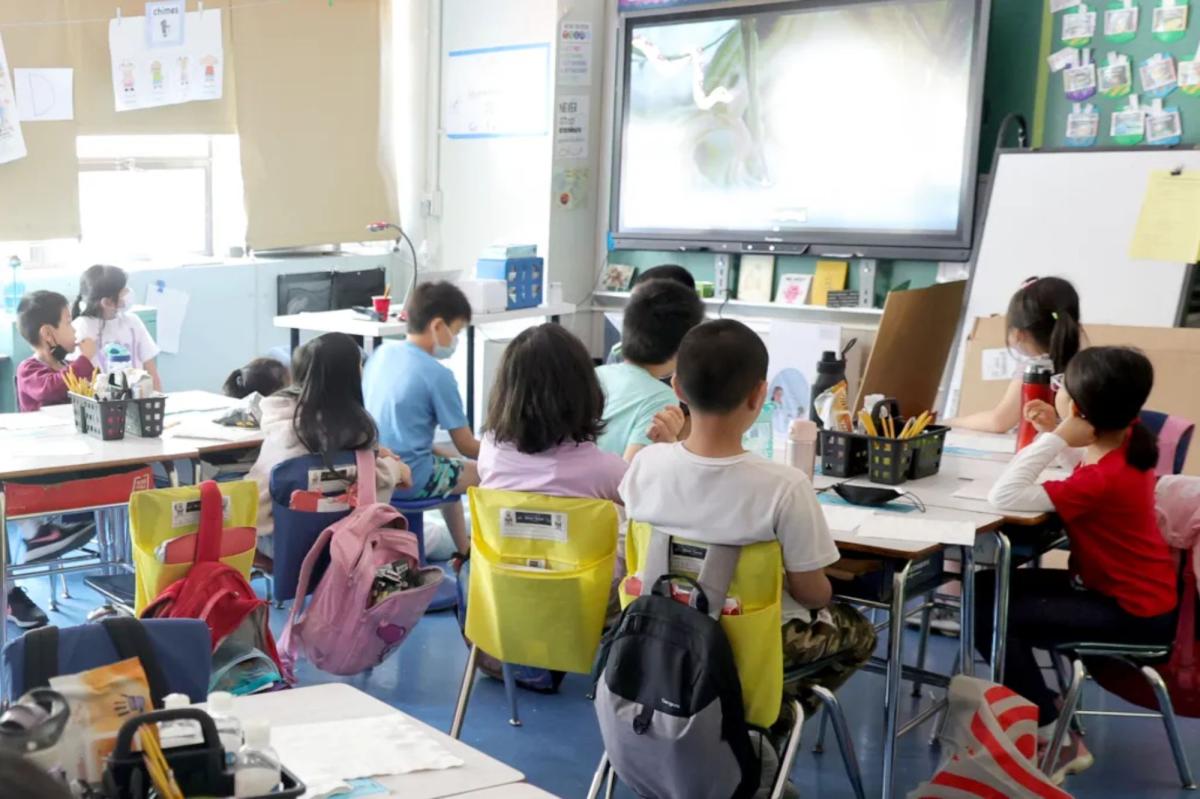

New York City students are about to spend a lot less of the school day glued to screens.
Under a broad new policy described as the toughest of its kind in the country, the city’s public elementary and middle school students will face tighter limits on generative AI and excessive screen time during class.
“We’re putting guardrails in place to protect the critical human connection, curiosity, and creativity that helps children grow,” Schools Chancellor Kamar Samuels said in a statement.
The rules, set to take effect this month, bar children from preschool through eighth grade from using any form of generative AI. High school students, meanwhile, will be allowed to use AI only in limited, supervised settings. The policy also draws clearer boundaries for educators, prohibiting the use of AI to grade work, track student behavior or draft special education plans.
Parents, teachers and students should welcome the shift. It is a promising, if long overdue, move toward loosening Big Tech’s grip on childhood and restoring more human-centered learning in New York City schools.
For years, school districts nationwide have rushed to put laptops, tablets and other devices into classrooms, often under the banner of preparing children for a digital future.
But in many cases, those tools did something else: they brought a fresh wave of distractions into the classroom and left students less equipped for the world beyond it.
I saw that shift firsthand in my own elementary and middle school in the early 2000s, when educators believed they were modernizing learning by replacing the blackboard with “Smart Boards” that uploaded notes online and handing every fifth grader a MacBook.
But all that did was unleash cyberbullying, teach us to pretend to pay attention in class while we were scrolling the internet, and condition us for a life lived behind screens — precisely during the school hours when kids are supposed to be learning, socializing, and living in the real world with one another.
In 2026 it has become clear, children need to learn to think for themselves before they get in the habit of outsourcing to a computer.
School districts who were sold over the past several decades on the idea of being “tech-forward” are realizing that was a massive mistake.
Massive pluralities of students with device access from across the world report being frequently distracted during lessons. Reading comprehension is measurably better when text is encountered on a paper. Plus, the weakest students improve the most when devices are removed from the classroom, according to researchers.
The fact that companies were eager to give devices to schools for free should have been a warning of their ulterior motive: hardwiring them to become lifelong customers.
Already, AI companies are courting schools making promises about how their technology will augment education. Google is pushing to integrate Gemini AI into platforms schools already use, and OpenAI has been partnering with schools across the country.
But it seems like New York City has already learned its lesson, and it won’t be falling for the techno-utopianism again.
“The tech industry wants us to believe that AI-powered early education is not only inevitable, but necessary,” Mayor Zohran Mamdani said in a statement. “We do not see it that way.”
His approach is correct. Yes, AI seems destined to become a larger and larger part of our lives, both personally and professionally. But we don’t need to surrender our children to that inevitability.
What kids deserve — and need — is a childhood protected from the influence of Big Tech, where they can learn to formulate their own ideas, solve their own problems, and interact with the world without a virtual intermediary.