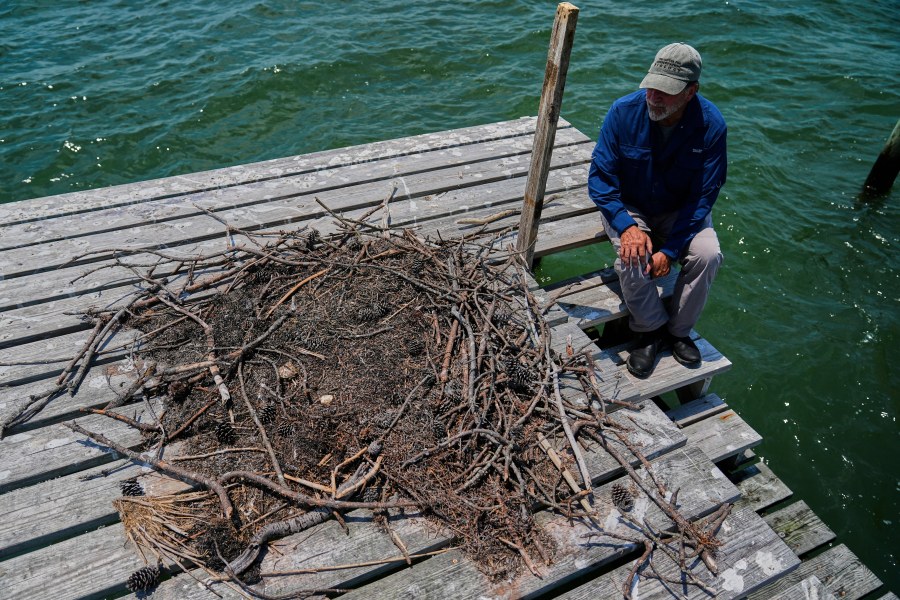


In GLOUCESTER POINT, Va. (AP) — Standing on an aging wooden duck blind located in the York River, Bryan Watts examines a ring of sticks and pine cones set on the worn, guano-covered platform. It’s an unsuccessful osprey nest, now occupied by diving terns.
“This year, the birds didn’t lay eggs here,” mentioned Watts, near the entrance of Virginia’s Chesapeake Bay. “And that’s a trend we’ve observed over the past few years.”
Watts shares a closer bond with ospreys than most, having climbed to their nests to release them from plastic wraps, hand-fed them, and observed their eggs using telescopic mirrors.
The fish-eating raptor known for gymnastic dives and whistle-like chirps is an American conservation success story. After pesticides and other hazards nearly eliminated the species from much of the country, the hawk-like bird rebounded after the banning of DDT in 1972 and now numbers in the thousands in the U.S.
But Watts has documented an alarming trend. The birds, which breed in many parts of the U.S., are failing to successfully fledge enough chicks around their key population center of the Chesapeake Bay. The longtime biologist blames the decline of menhaden, a small schooling fish critical to the osprey diet. Without menhaden to eat, chicks are starving and dying in nests, Watts said.
Osprey are an environmental indicator
Watts’s claim has put him and environmental groups at odds with the fishing industry, trade unions and sometimes government regulators. Menhaden is valuable for fish oil, fish meal and agricultural food as well as bait.
U.S. fishermen have caught at least 1.1 billion pounds of menhaden every year since 1951. Members of the industry tout its sustainability and said the decline in osprey may have nothing to do with fishing.
But without help, the osprey population could tumble to levels not seen since the dark days of DDT, said Watts, director of the Center for Conservation Biology at The College of William & Mary in Williamsburg, Virginia.
“The osprey are yelling pretty loudly that, hey, there’s not enough menhaden for us to reproduce successfully,” Watts said. “And we should be listening to them to be more informed fully on the fisheries side, and we should take precaution on the fisheries management side. But that hasn’t won the day at this point.”
Decline linked to menhaden in studies
Watts, who has studied osprey on the Chesapeake for decades, has backed his claims of population decline by publishing studies in scientific journals. He said it boils down to a simple statistic — to maintain population, osprey pairs need to average 1.15 chicks per year.
Osprey were reproducing at that level in the 1980s, but today in some areas around the main stem of the Chesapeake, it’s less than half of that, Watts said. In particularly distressed areas, they aren’t even reproducing at one-tenth that level, he said. And the decline in available menhaden matches the areas of nesting failure, Watts said.
Also called pogies or bunkers, the oily menhaden are especially important for young birds because they are more nutritious than other fish in the sea. Osprey “reproductive performance is inextricably linked to the availability and abundance” of menhaden, Watts wrote in a 2023 study published in Frontiers in Marine Science.
Conservationists have been concerned for years, saying too many menhaden have been removed to maintain their crucial role in the ocean food chain. Historian H. Bruce Franklin went so far as to title his 2007 book on menhaden “The Most Important Fish In The Sea.”
Fishing industry pushes back
Menhaden help sustain one of the world’s largest fisheries, worth more than $200 million at the docks in 2023. Used as bait, the fish are critical for valuable commercial targets such as Maine lobster. They’re also beloved by sportfishermen.
The modern industry is dominated by Omega Protein, a Reedville, Virginia, company that is a subsidiary of Canadian aquaculture giant Cooke. The company pushed back at the idea that fishing is the cause of osprey decline, although it did acknowledge that fewer menhaden are showing up in some parts of the bay.
Federal data show osprey breeding is in decline in many parts of the country, including where menhaden is not harvested at all, said Ben Landry, an Omega spokesperson. Climate change, pollution and development could be playing a role, said Landry and others with the company.
Blaming fishing “just reeks of environmental special interest groups having an influence over the process,” Landry said.
New rules could be on the way
The menhaden fishery is managed by the Atlantic States Marine Fisheries Commission, an interstate body that crafts rules and sets fishing quotas. Prompted by questions about ospreys, it created a work group to address precautionary management of the species in the Chesapeake Bay.
In April, this group proposed several potential management approaches, including seasonal closures, restrictions on quotas or days at sea, and limitations on kinds of fishing gear. The process of creating new rules could begin this summer, said James Boyle, fishery management plan coordinator with the commission.
The osprey population has indeed shown declines in some areas since 2012, but it’s important to remember the bird’s population is much larger than it was before DDT was banned, Boyle said.
“There are big increases in osprey population since the DDT era,” Boyle said, citing federal data showing a six-fold increase in osprey populations along the Atlantic Coast since the 1960s.
Environmentalists says bird’s decline could worsen
To a number of environmental groups, any decline is too much. This irritates some labor leaders who worry about losing more jobs as the fishing industry declines.
Kenny Pinkard, retired vice president of UFCW Local 400’s executive board and a longtime Virginia fishermen, said he feels the industry is being scapegoated.
“There are some people who just don’t want to see us in business at all,” he said.
But Chris Moore, Virginia executive director for Chesapeake Bay Foundation, said the country risks losing an iconic bird if no action is taken. He said Watts’s studies show that the osprey will fail without access to menhaden.
“Osprey have been a success story,” Moore said. “We’re in a situation where they’re not replacing their numbers. We’ll actually be in a situation where we’re in a steep decline.”
___
Whittle reported from Portland, Maine.
___ This story was supported by funding from the Walton Family Foundation. The AP is solely responsible for all content.