
Share this @internewscast.com

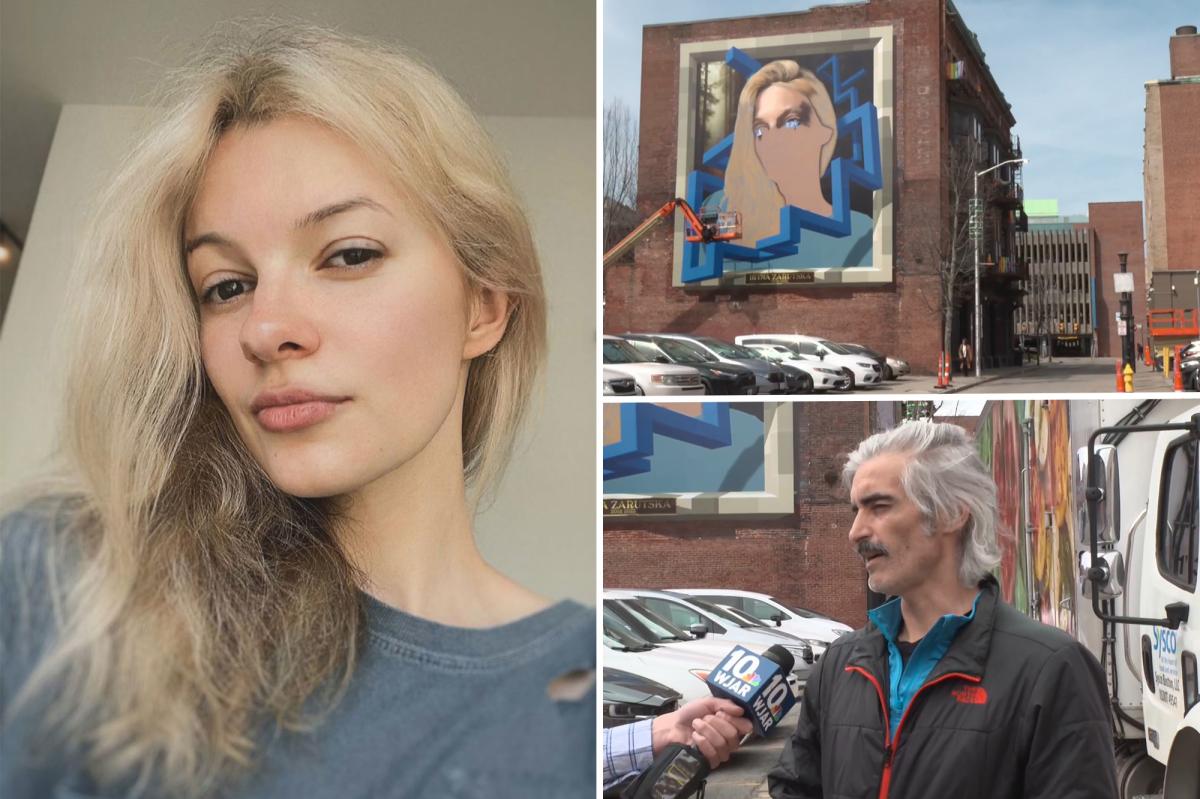
In Providence, Rhode Island, an artist tasked with creating a mural in memory of Iryna Zarutska, a Ukrainian refugee who was tragically killed, expressed disappointment after the project was halted due to criticism from left-wing groups. The artist believes this has restricted his creative expression.
Ian Gaudreau, who was leading the mural project, explained to Fox News Digital, “We began installing the mural, but as it progressed, there was significant backlash from the LGBTQ+ community because Elon Musk had donated to the initiative. This backlash grew intense, and ultimately, the business owners decided to remove the mural.”
“It’s disheartening that the mayor called for the work’s removal before I could finish it,” Gaudreau lamented. “This feels like an infringement on my freedom of expression and speech, which is quite unfortunate.”
On August 22, Zarutska was tragically killed during an unprovoked stabbing on a light rail train in Charlotte, North Carolina. Disturbing surveillance footage captured the moment when Decarlos Brown Jr. allegedly attacked Zarutska, stabbing her in the neck before casually leaving the scene as she succumbed to her injuries.
The case ignited intense political discussions about the criminal justice system, given Brown’s history. Over a decade, he had been arrested 14 times and had served five years in prison.
Elon Musk had contributed $1 million to support a nationwide campaign to create public murals honoring Zarutska’s memory.
Gaudreau explained that he wasn’t taking sides politically when he took the job painting the mural.
“I think that some people are not able to view the work for what it is — for the work that I have done — because they’re allowing their disdain for Elon to cloud their judgment of the work as itself, because the work as itself is a response to the entire conversation,” he said.
He said he was incorporating symbolism into his work that was itself a critique of the political flashpoint caused by Zarutska’s death that he thinks overshadowed her memory.
“And in the painting, she sort of shines through that, despite this strangling effort. And that’s what I want to symbolize here, is that Iryna was a human being with a mother and father who are still with us and are still grieving.”
Gaudreau also said his work was a response to how works of art depicting Zarutska, and their artists, have been treated. In early March, a mural of the young woman was defaced in Chicago.
“I’m making this work in reaction, post all of the conversation,” he said. “I have the benefit of being on the tail end of this project, in a sense, because I’ve seen how these murals have been treated in the past. I’ve seen that they’ve been defaced, I’ve seen my fellow artists get dragged through the mud for making the choice to paint her, and my work is a reaction to all of that.”
The mural was set to be displayed on the exterior of The Dark Lady, an LGBT bar in Providence.
When the bar received blowback, it first defended itself from criticism, noting on Instagram that “Any of you who know us personally—even just for five minutes—realize the illicit intentions being portrayed here are completely false.”
As pressure mounted, the bar paused the project, and then later canceled it completely.
Amid the scrutiny, Providence’s Democrat Mayor Brett Smiley slammed the mural.
“The murder of the individual depicted in this mural was a devastating tragedy, but the misguided, isolating intent of those funding murals like the one across the country is divisive and does not represent Providence,” he said in a statement, later adding that he wants to “encourage our community to support local artists whose work brings us closer together rather than divide us.”
He later doubled down in an interview with WPRI.
“I regret the state of where we are in politics today where absolutely everything is political and controversial and hard,” he said in the interview. “There’s nothing we should be doing to take away from the tragedy of the loss of life represented here, but then it was distorted by an erroneous tweet by our president and then a movement was funded by some right-wing billionaires, and it found its way to our community.”
“A private owner of a building decided to put a mural up that I don’t think he understood the full context of, and I was asked whether I thought it should come down, and I thought it should,” said Smiley. “I didn’t stifle anyone’s speech, it was his decision whether to continue with it or to take it down, but it certainly wasn’t bringing us together as a community. There was really angry protests on both sides, a lot of hate speech online, and so I don’t think we’re a stronger, more united community because of this mural, and so I thought the best thing to do was just to take it down.”