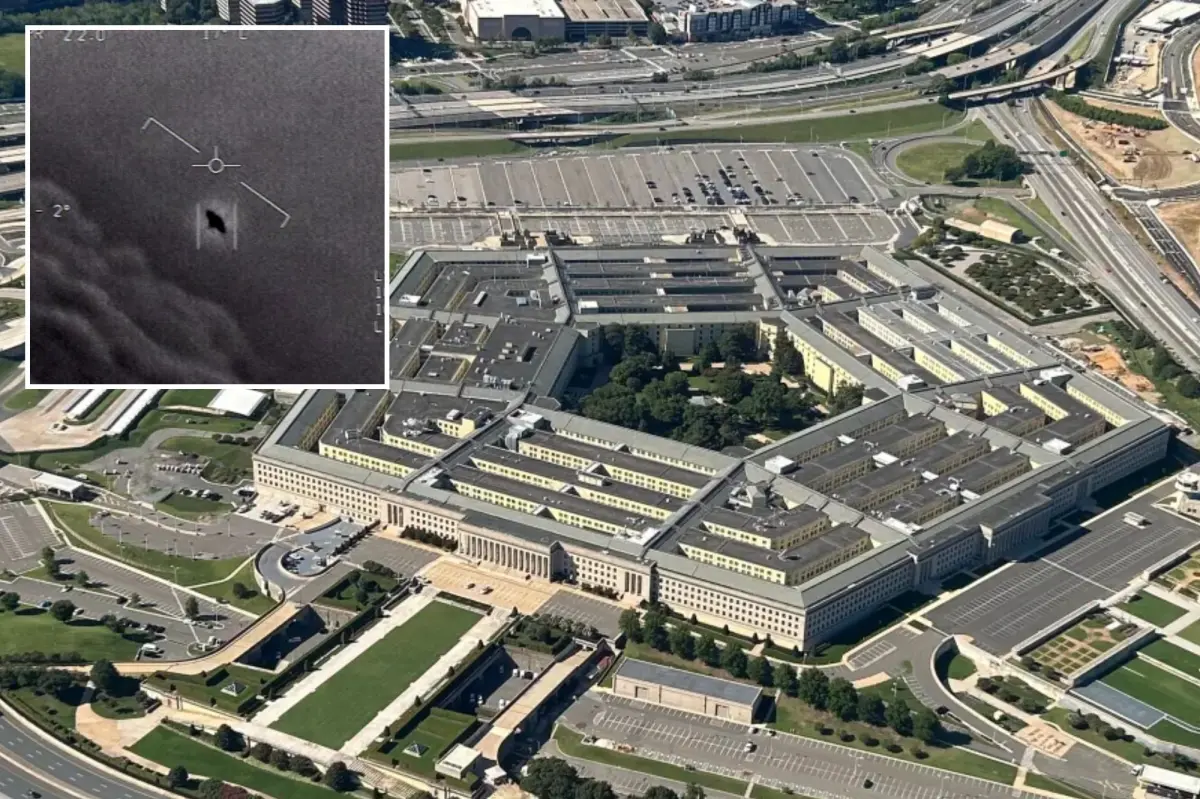

The Pentagon has authorized current and former personnel bound by secrecy agreements over Unidentified Anomalous Phenomena (UAP) to disclose related information directly to the government.
The Department of War said Monday that a new legal waiver will allow former and current military personnel, civilian employees and contractors to share UAP-related national defense information with authorized representatives of PURSUE — the Presidential Unsealing and Reporting System for UAP Encounters, which serves as the Trump administration’s UAP task force.
The waiver applies even when the information is covered by existing nondisclosure agreements or Special Access Program Indoctrination Agreements, provided the disclosure is made through the approved PURSUE channel.
Officials say the policy is intended to establish a formal process for reviewing UAP records and potentially releasing them to the public. It also advances President Trump’s directive calling for broad transparency on unexplained aerial phenomena.
The decision builds on a July order directing the Department of War and the intelligence community to give former employees with UAP-related knowledge a way to report what they know to either the All-domain Anomaly Resolution Office (AARO) or PURSUE.
Until Monday’s announcement, anyone with access to classified UAP material remained bound by the same nondisclosure agreements and Special Access Program Indoctrination Agreements, commonly referred to as SAPIAs.
For years, concerns about criminal or civil liability — as well as the possibility of losing a security clearance — discouraged people with UAP information from speaking publicly or to officials. The new policy is designed to change that.
Under the waiver, individuals who report information to PURSUE cannot be penalized, lose their clearances or face legal and administrative consequences for violating the confidentiality agreements covered by the authorization.
“This waiver removes those barriers by explicitly authorizing covered disclosures to PURSUE representatives without triggering breach-of-agreement penalties or standard NDA violations,” the Department of War said.
Trump has repeatedly expressed doubt about alien life, yet he ordered greater transparency on UFOs after former President Barack Obama said in a February interview, “They’re real, but I haven’t seen them.”
The administration’s latest release of UFO records said government employees reported seeing a triangular object near Colorado Springs in 2023.
The waiver gives current and former government personnel a protected route for reporting UAP activity. However, it does not clarify whether the Pentagon intends to examine the far larger volume of sightings submitted by members of the public.
Earlier this month, television host Dr. Phil McGraw accused the Pentagon of ignoring more than 1,800 credible UAP reports filed by civilians.
For now, members of the public can submit UFO and unexplained-encounter reports through two private, nongovernmental databases: the National UFO Reporting Center (NUFORC) and the Mutual UFO Network (MUFON).
McGraw cited NUFORC’s database, which identifies more than 1,800 reports as “Tier 1,” a designation reserved for what it considers the most credible sightings on record.
The AARO — the Pentagon division responsible for examining UFO sightings — has repeatedly promised to begin accepting public reports, but has yet to do so.
AARO said on its website that “reporting is limited at this time to current or former US Government employees, military personnel, or contractor personnel with direct knowledge of US Government programs or activities related to UAP dating back to 1945.”


