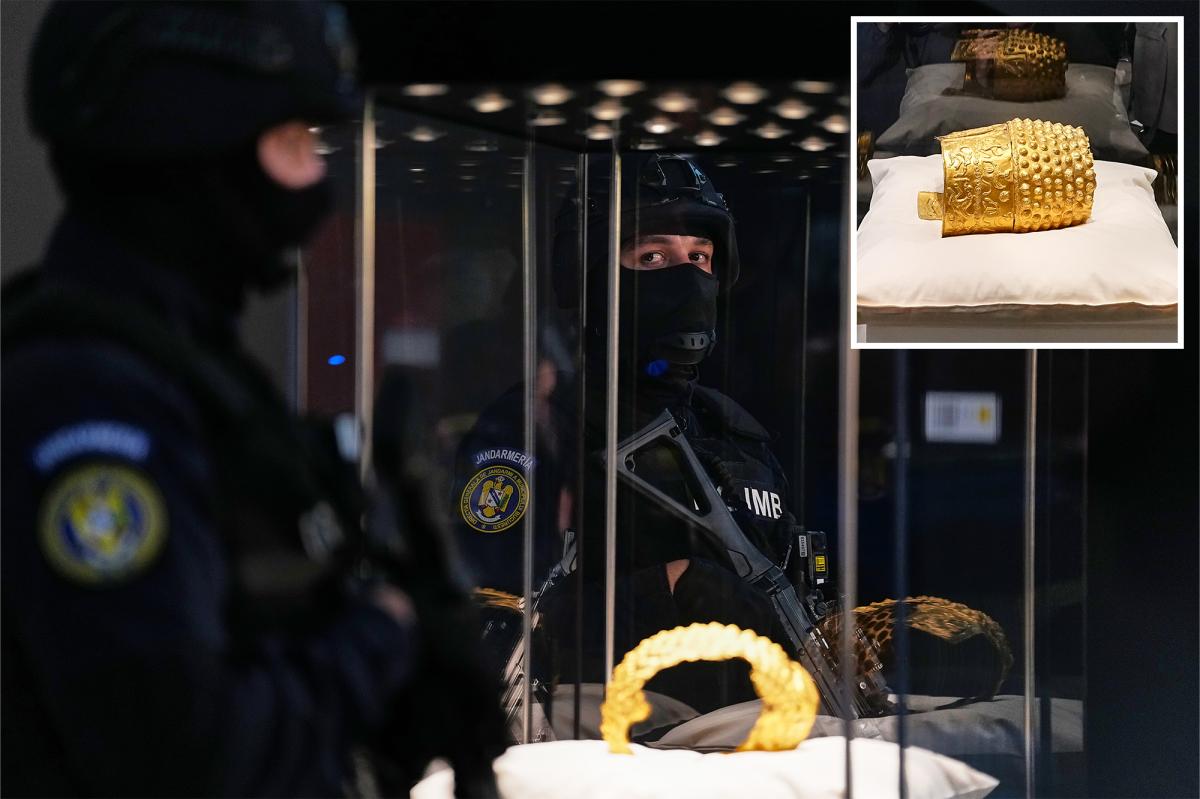


A golden helmet, dating back 2,500 years and considered invaluable, was returned to Romania on Tuesday. This national heirloom had been stolen from a Dutch museum where it was on display last year.
The intricately designed Cotofenesti helmet, along with three golden bracelets, represents some of Romania’s most cherished artifacts from the ancient Dacia civilization. These items were stolen from the Drents Museum during a January 2025 heist, leaving the art community in shock and Romanian authorities in dismay.
After 14 months filled with investigations, diplomatic negotiations, and a trial involving three suspects, most of the stolen artifacts made their way back to Romania. They arrived at Bucharest Henri Coanda International Airport and were securely transported to the National History Museum in Bucharest. There, they were displayed in a glass case, guarded by masked, armed personnel.
Cornel Constantin Ilie, the museum’s interim director, expressed that these items were returned not merely as artifacts, but as vital parts of the nation’s historical identity, representing a civilization that still shapes Romania today.
“This is a moment not only of happiness but also reflection,” he remarked. “For months, we feared losing a part of our past forever. Today, we can celebrate the return of a significant piece of our heritage.”
Robert van Langh, director of the Drents Museum, called the recovery and return of these relics an “emotional moment for everyone involved.” He recognized that the feelings of grief, anger, and now relief have been considerably more intense in Romania than in the Netherlands.
“Romanian national heritage has returned home,” he said. “The impact of this robbery was already significant in the Netherlands, but here it must have been truly unparalleled … The police and judicial authorities of both countries have done extraordinary work.”
Dutch prosecutors unveiled the recovered items at a news conference in the eastern Dutch city of Assen earlier this month. The whereabouts of the third golden bracelet remains unknown, but van Langh vowed the search would continue and that a judicial verdict is expected in the coming weeks.
During its disappearance, the golden helmet was slightly dented, while the recovered bracelets were in perfect condition.
Romania’s Minister of Culture Demeter Andras Istvan said the return of the artifacts had shown “how strong the connection between heritage and collective consciousness can be.”
“This entire episode reminds us at the same time how exposed heritage can be. It can be exposed to violence, illegal trafficking, negligence, oblivion,” he said.
After the raid, Dutch authorities were left with grainy security footage of three people wrenching open a museum door with a crowbar, after which an explosion was seen. Before its recovery, there were fears the helmet may have been melted down because its fame and distinctive appearance made it virtually unsellable.
The artifacts will be exhibited to the public in Bucharest before undergoing some restoration work, the museum’s interim director said.
“We believe that the public has the pleasure of celebrating them … not only as splendid objects, but as a witness to an ordeal, an almost irreparable loss, and a return that we owe to the operation between institutions and the perseverance of the authorities,” he said. “Today, these treasures returned home.”