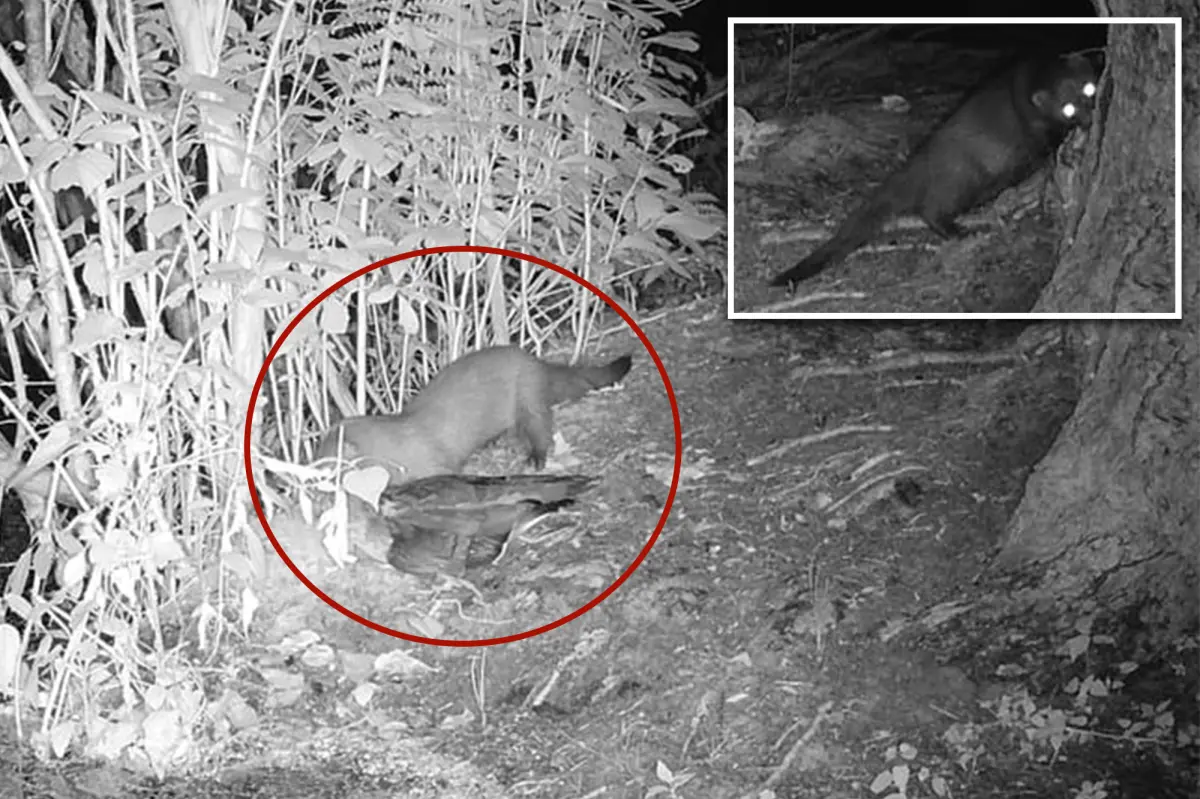

A trail camera in Suffolk County may have recorded an exceptionally uncommon visitor: an American mink, a small and elusive member of the weasel family rarely documented on Long Island.
Long Island naturalist Peter Janow said the footage came from a camera he placed in Northport, along the North Shore, shortly after midnight on Aug. 4, according to News 12 Long Island. Janow believes the animal captured in the image is an American mink.
In the trail camera photo, the sleek semi-aquatic mammal appears to be moving through the area with a bird clenched in its mouth.
Janow told the outlet the possible sighting would be the first confirmed appearance of an American mink on Long Island in 31 years.
American minks are small carnivores closely related to otters and ferrets. Typically weighing between 1.5 and 3.5 pounds, they live around waterways such as rivers, lakes and wetlands, where they prey on fish, frogs, crayfish and small mammals, according to the National Wildlife Federation.
Janow, a retired Marine Corps pilot who founded Long Island Nature Corps, has been using trail cameras for roughly eight years to monitor wildlife across Northport and the Greater Huntington region, he told Greater Long Island.
His search for the elusive mink began about three winters ago, he said, after he went looking for river otter tracks in fresh snow and found a set of prints he suspected may have been left by a mink.
“I thought it was just a matter of time before I captured a mink on one of my trail cameras,” he told Greater Long Island.
After reviewing a memory card from a trail camera that had not been checked in months, Janow spent two to three hours going through the files individually before making a stunning discovery — two photographs and an approximately 15-second video that appeared to depict a mink.
Janow immediately sent the findings to Seatuck Environmental Association wildlife biologist Mike Bottini for confirmation.
“He came back quickly and said, ‘Hey, yeah, that’s 100 percent an American mink,’” the naturalist recalled.
The animal was last reported on Long Island in 1996, though no photographic evidence exists from that sighting, Bottini told Greater Long Island.
Bottini said colleagues studying river otters elsewhere routinely catch mink on trail cameras at otter latrine sites — but when he ran a yearlong study at 10 such sites on Long Island in 2013, not a single mink showed up.
“The mink situation is a shock,” Bottini told Greater Long Island.
Bottini said much of the mink’s preferred habitat — wetlands and salt marshes — still exists and is protected on Long Island, though the reason for their apparent decline remains unknown.
He also flagged trapping as a possible complicating factor, noting that the New York State Department of Environmental Conservation currently permits the trapping of mink, gray fox, striped skunk and long-tailed weasel on Long Island.
The semi-aquatic animal’s appearance came within the same month as the world’s largest manta ray was caught lurking in Long Island waters in another rare appearance.
The majestic manta ray — which inhabits tropical, subtropical and temperate regions — was spotted feeding in the waters of Jones Beach State Park in August.
The magnificent sea creature can live up to 40 years and grow to more than 4,000 pounds, according to the NYS Department of Environmental Conservation.