
Share this @internewscast.com

By ANDREW DAMPF and STEVE DOUGLAS
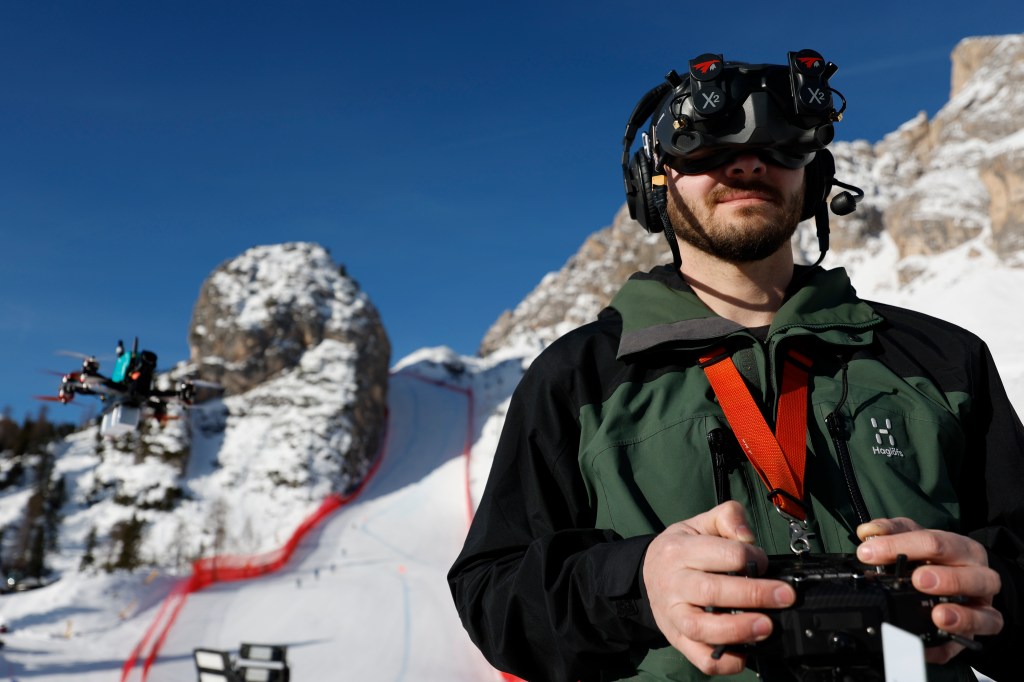
CORTINA D’AMPEZZO, Italy — Perched atop a tower overlooking the dramatic cliffs of the Cortina downhill course, there is an individual whose presence is as crucial to the Winter Olympics as that of athletes like Mikaela Shiffrin and Breezy Johnson. This man is Martin Bochatay, the skilled drone cam pilot responsible for capturing the breathtaking shots within the iconic Tofana schuss, a narrow chute flanked by towering walls of Dolomite rock.
Bochatay is an integral part of the team managing the fleet of drones that trail closely behind Olympians as they vie for gold during the Milan Cortina Games. These drones provide captivating, high-speed visuals that bring the excitement of the slopes directly into the homes of television viewers worldwide.
“In my mind, I’m not flying a drone. I’m flying with the skiers,” Bochatay shared with The Associated Press prior to the Olympics. “It’s an immersive thing. … The skiers don’t see us. But I’m right there with them. You become the drone.”
Drone cameras have become a staple in the visual storytelling of the Winter Olympics, offering unique perspectives on the speed and skill of skiers, lugers, snowboarders, ski jumpers, and other athletes competing on the world stage. These technological marvels enhance the viewing experience, allowing fans to feel as if they are part of the action.
Drone cams have become ubiquitous in showcasing the speeds and angles of skiers, lugers, snowboarders, ski jumpers and other Winter Olympians at these Games.
“The skill of those drone pilots is just phenomenal,” U.S. bobsledder and flag bearer Frank Del Duca said. “It gets a really unique perspective.”
Viewers have noted the humming noise coming from the machines, sparking the question: Is it putting off the Olympians in the biggest moment of their lives? Norwegian downhiller Kajsa Vickhoff Lie says that’s not an issue.
“No, you just maybe hear them on the start, but you don’t hear them when you ski,” she said.
The drones are tiny and zoom beyond 100 mph
Drone cams made in inauspicious impact on Alpine skiing 11 years ago when a primitive, massive machine came crashing down from the sky and nearly smashed into Austrian great Marcel Hirscher during a slalom race.
These days, the drones are agile, tiny — they weigh around half a pound (250 grams) — and can easily accelerate to speeds beyond 100 mph (more than 170 kph).
In all the sports, there are rules preventing the drones from overtaking the athletes, and they must keep a safe distance behind the competitors.
Pitch, roll and yaw: how to fly a drone
The drones actually contain two cameras. There’s a high-quality camera for broadcast purposes that is actually controlled by the TV production unit in a truck below the course.
“They can adjust whether it’s too bright, the balance, without us doing anything,” Bochatay said.
Then there’s a lower-quality camera that the pilots use to see where they are going. Those are the images that the pilots see in the goggles they wear to fly the drones.
The pilots have a remote control that requires two hands to hold, and contains two main switches to input the flying commands of pitch (front-to-back), roll (side-to-side) and yaw (vertical axis); plus throttle (up/down or altitude control).
“There’s always these four,” Bochatay said. “It’s not like you move one then the other. It’s everything at the same time.”
There’s also a low-tech issue: the batteries for the drones need to be changed constantly — and kept in warming cases due to the cold temperatures — requiring a “pit stop crew” to quickly sub in new batteries between runs.
Flying footage can be ‘nauseating’ but beautiful
Two things were important to Olympic broadcasting officials: Showing off both the beauty of the venues and the point of view of the athlete.
And the International Olympic Committee is delighted with the results as they look to bring viewers closer to the action. Maybe too close.
“Looking at the screen in the downhill, I almost feel motion sickness,” said Pierre Ducrey, the IOC’s sports director. “That’s how much we are able to project ourselves thanks to this new way of broadcasting the sport.”
U.S. bobsledder Elana Meyers Taylor agreed.
“I’m not concerned about the drone or anything like that,” she said, “but I will say I was watching the luge footage the other day and I was like, ‘This is slightly nauseating.’ I don’t know if I could watch this all the way down the run.”
Lie, the Norwegian skier, likes how the drones showcase a key aspect of skiing: “It’s cool to see the speed a little bit more for the spectators.”
AP Sports Writer Tim Reynolds contributed to this report.