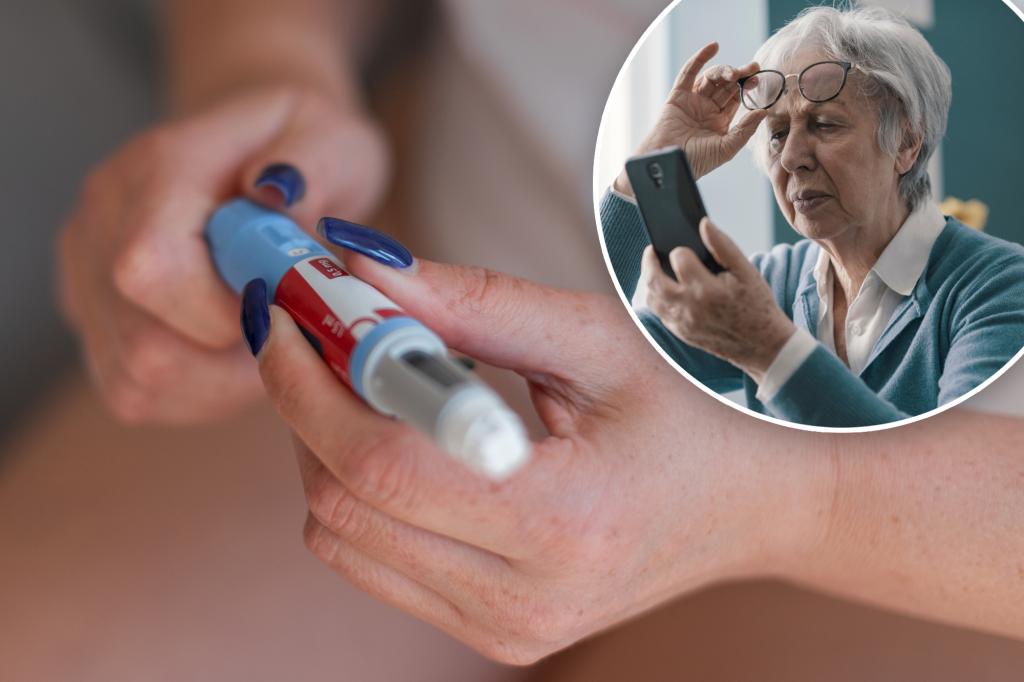


A growing number of Ozempic and Mounjaro users have shared stark warnings after going blind while using GLP-1 drugs.
Now a new study is bringing into focus the relationship between diabetic GLP-1 users and the elevated risk of age-related eye disease.
But despite seemingly alarming numbers, a doctor explained to The Post why she doesn’t actually think it should steer people away from the jab.
Published in JAMA Ophthalmology, the study was drawn from the health records of nearly 140,000 patients.
Studies have shown that after a year of use, individuals taking GLP-1 medications had more than double the risk of developing neovascular age-related macular degeneration compared to those not on these drugs.
Age-related macular degeneration (AMD) is a condition that progressively harms the macula, the region of the eye’s retina vital for clear, central vision. As the disease progresses, individuals struggle more with seeing objects directly in front of them, though their side vision typically remains mostly intact.
In older people, AMD is a leading cause of irreversible blindness.
The study found the risk percentage was 0.2% in GLP-1 users and 0.1% in nonusers.
Nearly 20 million adults in the US are living with AMD, which comes in two types.
The more gradual form, dry AMD, accounts for approximately 80% of cases. This type occurs as the macula thins with age, often linked to the accumulation of yellow protein deposits termed drusen, as explained by the American Academy of Ophthalmology.
Wet AMD, also known as neovascular AMD (nAMD), while less common, is far more aggressive, causing rapid and severe vision loss. In this form, the macula’s function is compromised by the growth and leakage of abnormal blood vessels beneath the retina. The condition is typically treated with frequent injections to restore or stabilize vision.
“What researchers in this latest study were looking for specifically was whether or not these were people who converted from the dry form of macular degeneration, which is where you don’t have abnormal blood vessels to the wet form, which is when you do,“ Dr. Talia Kaden, director of the Northwell Health retina fellowship told the Post.
But Kaden noted that while there is cause for concern, she actually believes there a relatively low risk.
“We’re talking about a handful of patients who might have an increase in retinopathy compared to the millions of patients on these medications.”
Dr. Talia Kaden
“That 2X number is really powerful, but when you look at the raw data, I don’t think it’s quite as strong a punch. I don’t think that number should be a reason for people not to be on these drugs. I do think, though, it is worth continuing to look into,” she said.
This study adds to a growing body of research documenting vision problems in patients using GLP-1 drugs.
A review published earlier this year in JAMA Ophthalmology uncovered at least nine cases of patients who experienced vision loss after taking semaglutide or tirzepatide, the active ingredients in Wegovy and Zepbound, respectively.
And a 2024 study suggested a potential link between semaglutide and the rare eye condition nonarteritic anterior ischemic optic neuropathy (NAION), in which restricted blood flow to the optic nerve causes sudden-onset vision loss.
“None of these studies are definitive in identifying that there has been a change. Some of them show a slight increase, but we’re talking about a handful of patients who might have an increase in retinopathy compared to the millions of patients on these medications,” Kaden said.
Researchers think that declining blood glucose levels caused by GLP-1s could trigger abnormal blood vessel growth in the retina. Further, there are GLP-1 receptors in the retina, and these drugs increase the levels of molecules that lead to harmful blood vessel formation.
“Seeing such a clear signal in our study was striking,” co-author Reut Shor of the University of Toronto told STAT.
“The absolute risk remains low, but the advanced form of AMD is a condition with serious implications for vision and quality of life. So a doubling of risk is clinically meaningful, particularly for vulnerable populations like older adults who may already be at elevated baseline risk.”
Shor and his team note that more research is necessary to determine whether direct or indirect effects are causing the increased risk of nAMD.
Shor and Kaden maintain that these findings should not be cause for alarm nor a reason to halt the prescription or use of these medications; rather, patients should be made aware of the risk and monitor their vision accordingly.
Kaden, the study authors, and other experts recommend that GLP-1 users be on the lookout for any vision changes that could indicate early signs of AMD.
“We really want you to look for anything blurring, any new distortion. If you’re looking at a flagpole or a doorframe, that should be a straight line. If all of a sudden that line looks wavy or curvy, that’s a reason to seek a consultation with a retina specialist,” said Kaden.