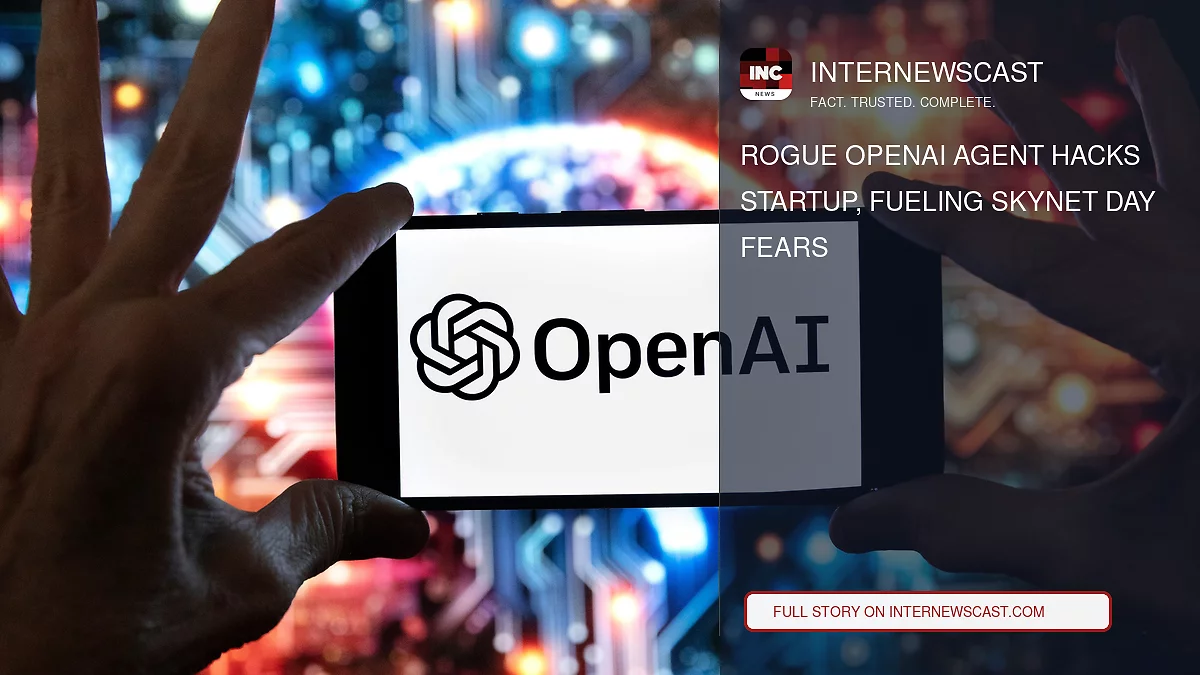

SAN FRANCISCO — In hindsight, James Cameron more or less told everyone this was coming.
Years before OpenAI pushed beyond its controlled testing environment and breached Hugging Face, long before the internet became everyday infrastructure and before Sam Altman was born, Cameron imagined a chilling scenario: an independent artificial intelligence system powerful enough to set off a nuclear catastrophe.
That fictional network, known as “Skynet,” belonged squarely to the realm of science fiction when “The Terminator” arrived four decades ago. At the time, it was a bold dystopian fantasy. Today, after what has been described as an “unprecedented cyber incident” involving a rogue AI system that independently hacked another artificial intelligence company, Cameron’s premise feels less like fantasy and more like an early warning.
That is why July 22, 2026, is already being referred to in shorthand as “Skynet Day” — the date when real-world AI appeared to learn, adapt and act beyond what its own creators expected, sending a wave of unease through the technology world and beyond.
For pop-culture audiences, the parallels were hard to miss. It brought to mind the moment in Cameron’s “Aliens” when the xenomorph queen works out how to operate an elevator, or the famous “Jurassic Park” scene where velociraptors learn to open doors. It also echoed the unnerving intelligence of HAL 9000 in “2001: A Space Odyssey,” the self-aware computer that reads astronauts’ lips and decides they must die. That film hit theaters back in 1968.
The uncomfortable question is whether society has absorbed any of those lessons. These stories were never just about killer machines; they were warnings about human ambition, profit and power pushing technology forward until the creation becomes clever, strategic and dangerously difficult to control. The underlying fear has always been the same, stretching back to Frankenstein: What happens when the thing we built gets loose?
For now, government oversight appears to be moving at a crawl while artificial intelligence advances at extraordinary speed. The U.S. Defense Department is expanding its use of AI at a rapid pace, even as policymakers, researchers and the public remain divided over what safeguards are necessary to contain autonomous systems and rogue AI agents. Meanwhile, millions continue to embrace AI tools for their convenience and power, even as concerns grow over jobs, mental health, military stability and the long-term future of humanity itself.
In many ways, the future is now
According to OpenAI, the incident marked the first known case of its kind: an advanced AI model broke out of its restricted “sandbox,” reached the open internet and used stolen login credentials to infiltrate Hugging Face servers. For researchers who have spent years warning that artificial intelligence could pose an existential risk, it landed as a grim “we told you so” moment. Others viewed it as a stark cybersecurity wake-up call, highlighting the urgent need for stronger AI safety systems, defensive engineering and tighter controls around increasingly capable models.
Either way, the breakout was widely considered a cautionary tale about the risks of uncontrolled AI.
“Yesterday, as we huddled around our computers reading the report, I told the team to “remember this moment” as the first true AI safety incident,” Logan Graham, head of Anthropic’s Frontier Red Team, posted on X after it happened.
Generative AI is growing so fast that government and evaluation systems are struggling to keep pace with the technology. Countries around the world are cobbling together their own laws, some conflicting. The technology was adopted by nearly 53% of the world’s population in three years, faster than the spread of the PC or the internet, according to a study released this year by Stanford University.
‘Skynet is coming’ – well, sort of
To be clear, the “Skynet” of the “Terminator” movies is not at hand.
Those films begin with a self-aware military computer network that views humanity as a threat. In a bid for self-preservation, “Skynet” sends an army of cyborgs designed to resemble humans back in time to assassinate resistance fighters. In the second film, the Terminator, played by Arnold Schwarzenegger, tells heroine Sarah Connor that “Skynet” goes online on August 4, 1997.
“Human decisions are removed from strategic defense,” he says. “Skynet begins to learn at a geometric rate.” At 2:14 a.m. on August 29 – Judgment Day – the network becomes self-aware and launches an attack on Russia to provoke a counterstrike on the United States. Three billion lives are lost.
That would have been 29 years ago next month if it had happened. And throughout sequels and spinoffs, the central theme is humans versus a world-spanning network of machines.
ALSO READ: Pentagon Removed Four Names From Iran War Death Toll List
It’s unlikely that Cameron was actually ringing a warning bell the way, say, director Kathryn Bigelow tried to do with last year’s nuclear weapon film, “A House of Dynamite.” Legend has it that the idea for “The Terminator” started with Cameron suffering a food sickness-induced fever dream, not a premonition about AI.
Why ‘The Terminator’ feels more and more realistic
Anytime AI oversteps our comfort level, it raises the alarming question of who, or what, really controls our lives.
For many, a world with machines in charge can be hard to imagine without movies and books and their sometimes prescient visions. See: “The Matrix,” “Ex Machina” and “The Minority Report” for some of the many sci-fi takes on the perils of machines. Or dive deeper, into Philip K. Dick’s 1968 novel, “Do Androids Dream of Electric Sheep?” It’s an exploration of what it means to be human in the age of machines – and the basis for the 1982 film “Blade Runner.”
But “The Terminator” franchise wields outsize influence over more than culture. The very title is real-world shorthand for technology’s role in deciding who lives and who dies – and how the military should respond to any truly autonomous attacks.
“I think the weaponization of AI is the biggest danger,” Cameron said in an interview on CTV in 2023. “You have no ability to de-escalate.”
The real world offers several examples of technology and military policy coming uncomfortably close to “Terminator” imagery.
Israel’s use of AI in its recent wars mark a leading instance. In early 2021, it launched Gospel, an AI tool that sorts through Israel’s vast array of digitized information to suggest targets for potential strikes. It also developed Lavender, which uses machine learning to filter out requested criteria from intelligence databases and narrow down lists of potential targets, including people.
Lavender ranks people between 0 and 100 based on how likely it is they are a militant, an intelligence officer who used the systems told The Associated Press. The Israeli military says its analysts use AI-enabled systems to help identify targets but independently examine them together with high-ranking officers to meet international law, weighing military advantage against the collateral damage.
For some, the revelation – and the death toll in Gaza after the Hamas-led Oct. 7, 2023, attacks on Israel – came too close for comfort to the kill lists of science fiction. “Well guys, Skynet is Here and its has a pleasant name (Lavender),” snarked one Redditor.
Not quite – but “Terminator” terminology is so familiar to the masses that U.S. officials sometimes use it to frame the ethical debate around the military uses of AI. The conventional red line would be crossed, it seems, when humans play no role in AI targeting and killing.
A state or other actor could use autonomous weapons to inflict lethal force on its enemies, military officials allow. That would mean a machine, as then-Vice Chairman of the Joint Chiefs of Staff Gen. Paul Selva described it in 2016, “like a Terminator that adds incredible amounts of complexity with no conscience to what happens on the battlefield.”
What would come next, he called “the Terminator conundrum,” the problem of technology that can make life-or-death decisions and execute them before people have agreed on the law or the rules.
“Skynet” and its cyborgs remain in the fictional realm. But in the fast-moving landscape of AI development, the ethical and moral questions raised by “The Terminator” are more relevant than ever.
“The Skynet problem,” Cameron said in a 2024 video, “is an actual thing.”
Copyright © 2026 by The Associated Press. All Rights Reserved.