

Chicago’s Lake Michigan is often hailed as a natural marvel, offering residents and visitors alike a breathtaking backdrop of the city’s iconic skyline.
This majestic body of water is not just for show; it’s a bustling hub for leisure activities. From swimming and boating to cycling, running, and leisurely strolls, the Lakefront Trail offers endless opportunities for enjoyment.
Beyond its aesthetic appeal, Lake Michigan plays a crucial role as a resource. As the third-largest of the Great Lakes by surface area, it provides drinking water for over six million people, underscoring its importance to the region.
However, this vital resource faces significant threats.
State of the Great Lakes
Challenges such as invasive species, pollution, and the growing impacts of climate change are putting Lake Michigan and its fellow Great Lakes under considerable strain.
In response, scientists and environmentalists in Chicago are at the forefront of efforts to combat these issues. Their work is a race against time to protect this invaluable natural resource for future generations.
One Chicago-based group has been fighting to protect the Lakes since the 1970s.
ABC7 Chicago meteorologist Cheryl Scott talked to the president and CEO of the Alliance for the Great Lakes, Joel Brammeier, about how they’re inspiring action and change.
“Everybody relies on our freshwater. The challenges facing the lakes are going to differ from place to place,” Brammeier said.
But the lakes are now facing a new collective threat – water usage.
“Data centers, agriculture and farming, mining industries that require a lot of water for various reasons are starting to grow again here in the Great Lakes. And that means more demands on our water here at home,” Brammeier said.
A new report by the alliance found the region is unprepared for these increasing water demands.
“There are more than 800 data centers active or being built here in the Great Lakes,” Brammier said. “So if you think about a town of maybe 50,000 people, that’s about the equivalent to a hyperscale data center’s water use. So amplify that by 100, by 500, by 800-plus, which is where we are now.”
Unsung Heroes of the Great Lakes
The Great Lakes are home to more than 50 species of migratory fishes. But ironically, we know the least about the most abundant group called suckers.
Anglers are known to consider suckers as “trash fish.” They hold out for the more desirable trout or bass. But these historically underappreciated and understudied fish play a key role in the ecosystem.
The Shedd Aquarium has a migratory fish research program in the Great Lakes Basin. It’s led by Dr. Karen Murchie. And as ABC7 meteorologist Tracy Butler found out, Dr. Murchie is making it a point to give suckers the respect they deserve in the underwater kingdom.
“I think truly they are unsung heroes of the Great Lakes,” Murchie said. “They’re just serving so many functions from being a prey source for a lot of animals. And they’re like little gardeners fertilizing the creeks and rivers in the springtime, and that kick start the food web that the rest of the environment relies on.”
In the spring, white suckers and long nose suckers will move by the tens of thousands from the lakes to tributaries to spawn or reproduce.
Through the help of citizen scientists, Murchie has discovered the suckers’ preferred water temperature.
“The temperature and flow are two really big cues that a lot of migratory fish use to know when it’s time to move into a creek,” Murchie said. “We found a very strong predictor that a water temperature of 43.3 Fahrenheit is the cue that the suckers are using to say, ‘Yep, it’s go time. It’s time to go into the creek and reproduce.’”
Lake Invaders
The Great Lakes were under ice up until about 10,000 years ago. But in just the last 40 years, they’ve been invaded.
A series of non-native species are dramatically changing the habitat of the lakes. From the rusty crayfish and red swamp crayfish, to the zebra mussel, to the sea lamprey, they’ve all made their way into the lake in different ways.
ABC7 meteorologist Greg Dutra visited Loyola University Chicago Dr. Rueben Keller, and his team of grad students are studying how these invasive species are taking a toll on our local ecosystem.
“I think the worst we’re dealing with is the zebra and then the quagga mussels,” Keller said. “They arrived in the late 1980s and 1990s respectively. And they have had by far, I think, the biggest impact on the Great Lakes.”
Their abundance is a problem because they’re filter feeders. And each zebra mussel can filter up to a liter of a water day, Keller said.
The rusty crayfish started moving into the Great Lakes in the 1990s. And they’ve since taken over.
“They’ve out completed the natives. We find the natives in some places, but we will find a thousand of these guys for every native crayfish that we find,” Keller said.
Keller and the students also have their eye on the red swamp crayfish. It has yet to make it to the Great Lakes but it’s already in two Chicago harbors and the Chicago River.
The concern is the crayfish are omnivores.
“So they will eat anything. Particularly like a dead fish or any other sort of dead animal. They will eat living aquatic plants and they’re very messy eaters,” Keller said. “When you’re a crayfish, the part of the plant that you can access is that tiny little bit at the bottom. They will snip the plant. The rest of the plant will go away, and they’ll get one little taste.”
Shipwrecks: Sunken History
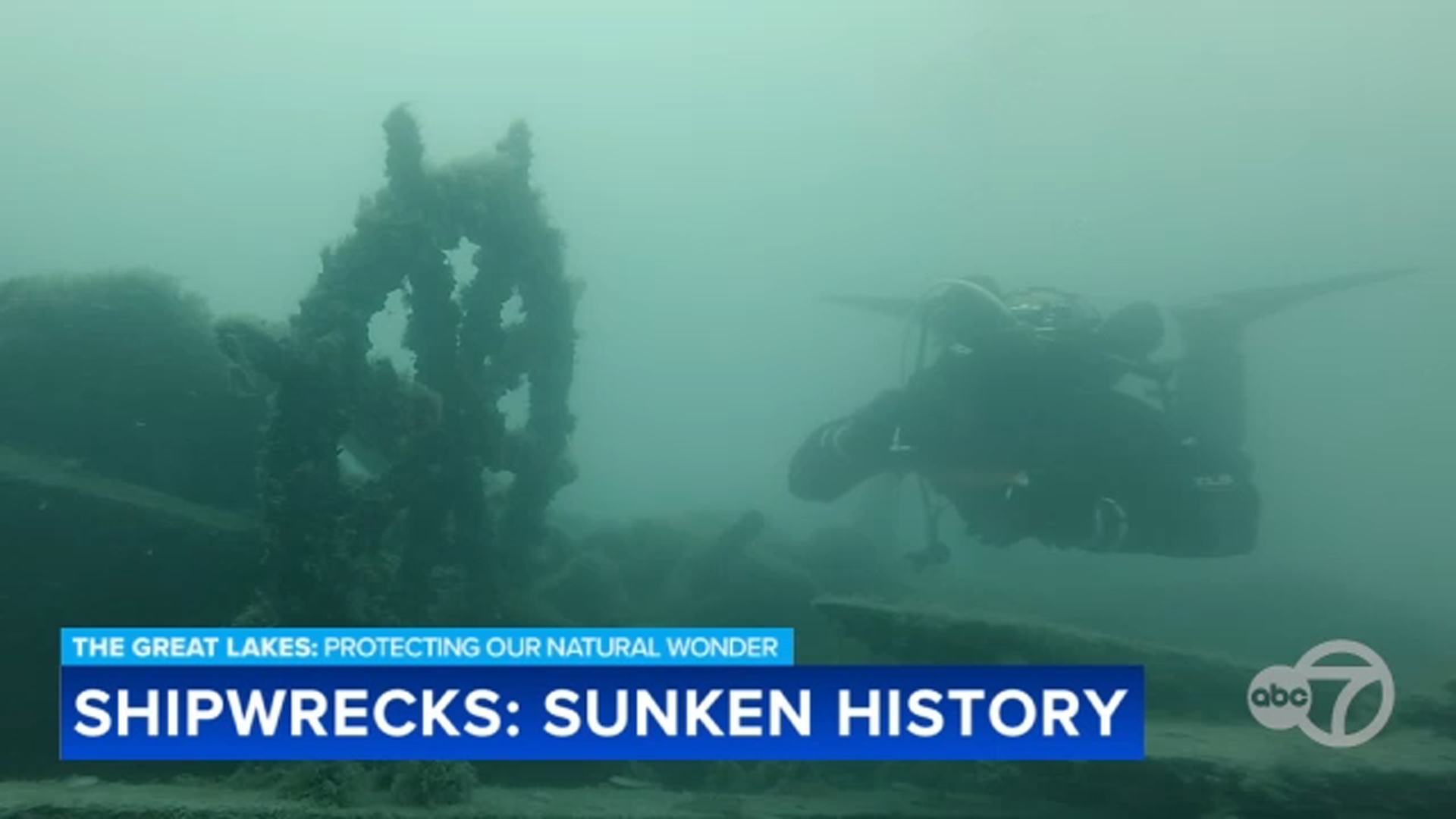
Beneath the waves of the Great Lakes, an unexpected and remarkable treasure lies hidden.
Along with a diverse array of fish and other marine life, these lakes are the final resting place for thousands of shipwrecks.
The frigid, freshwater conditions have acted as a natural preservative, safeguarding many of these vessels for centuries.
With many wrecks still waiting to be discovered, these underwater historical sites have become popular dive sites for scuba divers, including ABC7’s own colleague and editor, Casey Klaus. Klaus has been wreck diving for more than 20 years.
Klaus shared his story with ABC7 meteorologist Larry Mowry.
Battle Against the Plastic Tide
Every year, an estimated 22 million pounds of plastic waste enter the lakes. As the waste breaks down, it creates tiny, microscopic particles that are making their way into drinking water and the fish we eat.
Now, graduate students at Loyola University Chicago are dissecting the problem, and what they’re finding inside the animals is alarming.
“We’re finding, sometimes even hundreds of particles inside of their stomachs,” Loyola grad student Tava Oosterbaan said.
Osterbaan is talking about plastic fiber balls that they’re finding inside the digestive tract of a red swamp crayfish. The invasive species has made its way to the Chicago River.
“Bass, in particular, like to eat red swamp crayfish, versus the other species. So, if the crayfish have plastic in them, it’s safe to say that it goes up to the food chain. And we eat fish; so, that’s kind of important for us,” Osterbaan said.
Plastic pollution on the Great Lakes could seem like a daunting problem, but passionate lake enthusiasts like members of the Surfrider Foundation are tackling plastic trash head-on.
The Chicago chapter’s surfers regularly trade their surfboards for trash buckets to clean up the beaches in the area. ABC7 meteorologist Jaisol Martinez rolled up her own sleeves and joined them in their effort.
Pending Legislation
Preserving the future of the lakes might sound like a huge undertaking. But there are several bills being considered by Illinois lawmakers that would keep plastic out of waterways.
SB1531
The Foam Ban Bill would ban the use of Styrofoam containers by January 2030.
HB 3278
The Plastic Pellet Free Waters bill would require the Environmental Protection Agency to develop a plan to control plastic pellets and other pre-production plastic materials, from entering the environment and contaminating our drinking water.
HB1370/SB30
And the Microfiber Filter bill would add a microfiber filter to new washing machines by 2030, much like lint filters in dryers. That would help to prevent millions of microfibers from becoming pollution.
Find a beach or park cleanup near you:
Adopt-a-Beach
Chicago Surfriders
Shedd Action Days