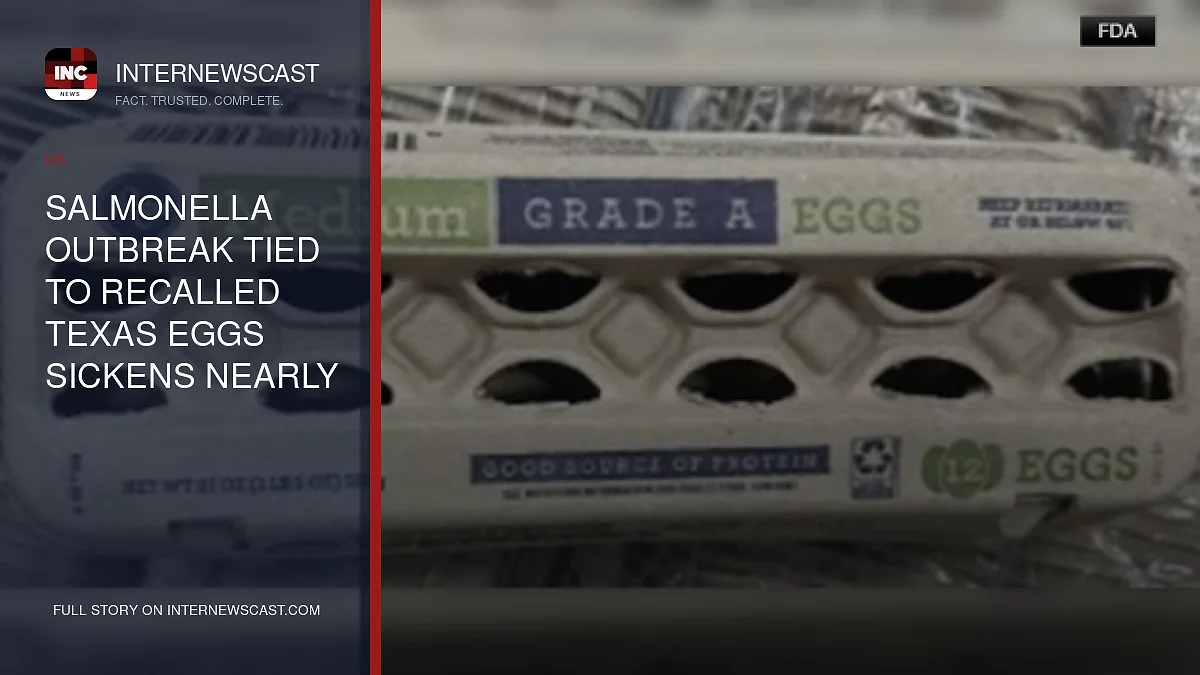

A salmonella outbreak tied in part to recalled eggs has sickened nearly 100 people in 17 states, according to a new update from the U.S. Food and Drug Administration.
The FDA said Friday that 98 confirmed infections have been reported so far, with 26 people requiring hospitalization. No deaths have been linked to the outbreak, the agency said.
Investigators have connected at least some of the illnesses to shell eggs recalled by Midwest Poultry Services, L.P. The FDA said laboratory testing, epidemiological findings and traceback work indicate the company’s eggs are a likely source, though they do not explain every case in the multistate salmonella outbreak.
Federal health officials said they are continuing to investigate whether additional food sources may be contributing to the illnesses.
The FDA update follows a voluntary recall by Midwest Poultry Services of nearly 1.6 million dozen eggs — roughly 19 million individual eggs — because of possible salmonella contamination, according to a company notice posted Wednesday on the agency’s website.
The recall covers white shell eggs and brown cage-free shell eggs produced in Texas with “sell by” or “best by” dates ranging from July 20, 2026, through Aug. 17, 2026, Midwest Poultry Services said.
According to the company, the recalled eggs were sold at Kroger stores in Texas and Louisiana, Brookshire Grocery locations in Texas, Oklahoma, Arkansas, Louisiana, New Mexico and Mississippi, as well as at other smaller retailers.
The recall notice also said the eggs were distributed to foodservice customers in Texas, Oklahoma and Louisiana.
Midwest Poultry Services has advised customers not to consume the recalled eggs and to return the product to its original place of purchase for a full refund.
The recalled eggs can be identified by a code number — P-1950 or 0840962 with a Julian Date between 157 and 184 — printed in date-coding ink on the left or right sides of the carton, according to the company.
A full list of impacted products, including UPC and identifying codes, product descriptions, photos, and “best by” dates, can be found on the FDA website.
“No other Midwest Poultry Services, L.P. products are part of this recall,” the company said.
Midwest Poultry Services told ABC News in a statement Thursday that it initiated the recall “as a precautionary measure” and was not aware of any illnesses linked to its products.
“At Midwest Poultry Services, a family-owned and led business, we believe in the power of safe, nutritious eggs to make a real difference in people’s lives. The work our team does is in service of that, and nothing supports it more directly than the practices that keep every egg we produce safe,” the company said. “These practices are rooted in our values and built into how we operate on every farm, every day.”
“When we learned of a possible issue with egg safety, we began diverting eggs to a breaking plant where they would be pasteurized to kill any foodborne pathogens,” it continued. “We also began a robust internal investigation and initiated testing protocols to identify potential sources of [salmonella].”
The company added, “Producing safe, quality food for those who eat our eggs is our highest priority, and this voluntary investigation and recall demonstrates that commitment.”
Salmonella are bacteria that cause about 1.35 million infections in the U.S. every year, with contaminated food as the source of most of these illnesses, according to the Centers for Disease Control and Prevention.
People can become infected with salmonella after unknowingly swallowing the bacteria, or after touching infected animals, animal feces, and “places animals live and roam,” according to the agency.
Symptoms of salmonella — including abdominal pain, fever, headache, watery diarrhea that may also have blood or mucus, loss of appetite, nausea, and vomiting — usually begin six hours to six days after swallowing the bacteria, according to the CDC.
Most people recover from salmonella without treatment after four to seven days.
Some people, particularly children under the age of 5 and adults 65 and older, or those with weakened immune systems, may experience “more severe illnesses that require medical treatment or hospitalization,” the CDC says.
Copyright © 2026 ABC News Internet Ventures.