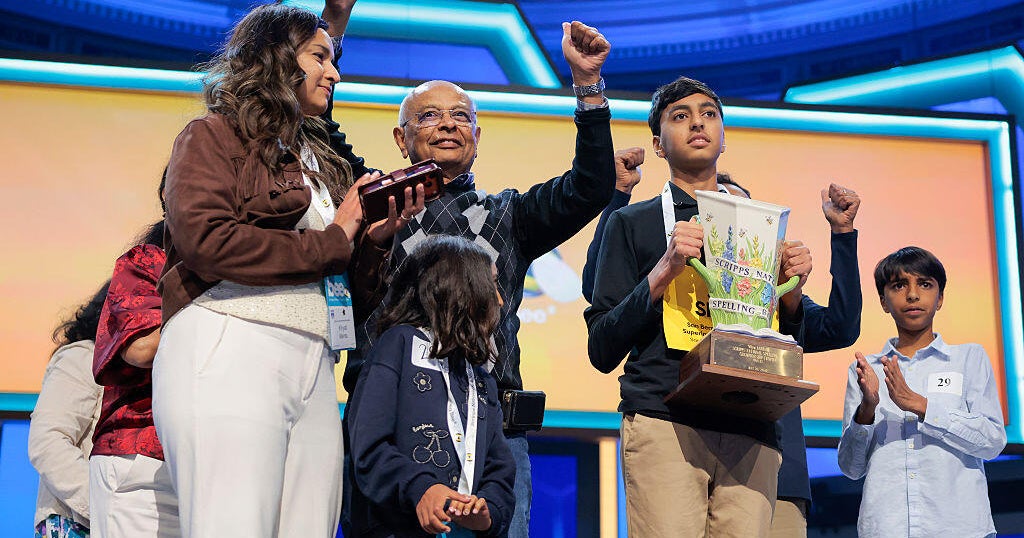

On Thursday, Shrey Parikh claimed victory at the 98th annual Scripps National Spelling Bee, showcasing a remarkable talent in an event known for its challenging competition. The 14-year-old from Rancho Cucamonga, California, stood out among the final eight competitors, ultimately securing the top spot.
The intense showdown concluded with Shrey and 12-year-old Ishaan Gupta from Jersey City, New Jersey, as the last two spellers vying for the championship. This nail-biting finale was decided through a spell-off, where each participant had 90 seconds to correctly spell as many words as they could.
In a display of linguistic prowess, Shrey managed to spell 32 words correctly, surpassing Ishaan’s commendable 25. The rapid pace of the spell-off made it difficult to pinpoint the decisive word, but Scripps later revealed that “bromocriptine,” a term describing a polypeptide alkaloid that mimics dopamine, was the clincher for Shrey’s win.
Shrey’s triumph comes with significant rewards. He will receive a $52,500 cash prize, reference works from Encyclopaedia Britannica and Merriam-Webster, a custom trophy and commemorative medal, and $1,000 in flight credits from Delta Air Lines, a testament to his spelling brilliance.
While this marks the 98th iteration of the storied bee, Shrey is the 111th champion due to historical ties, including a remarkable eight-way tie in 2019. His achievement adds another chapter to the prestigious history of the Scripps National Spelling Bee.
Heather Diehl / Getty Images
Shrey will take home a cash prize of $52,500, along with the reference works from Encyclopaedia Britannica and Merriam-Webster, a custom trophy and commemorative medal, and $1,000 in flight credits from Delta Air Lines.
Although this was the 98th bee, Shrey is the 111th champion because the bee ended in a two-way tie several times, and an eight-way tie in 2019.
Shrey finished third in 2024 but lost his school bee last year when he was battling a fever. He has dominated the bee circuit since, winning several online competitions against many of the same kids he outlasted this week in the nation’s capital.
“Right now I’m probably the happiest I’ve ever been. I’m just so happy and relieved, and just such a flood of emotions,” Shrey said. “At my school bee last year, I was really dejected and just very upset. It didn’t even sink in until the next day. I had a really tough time, but I’m glad I was able to bounce back.”
Spellers qualified for Thursday’s finals by advancing through regional bees hosted by sponsors around the country. In order to compete, spellers must not have advanced beyond the eighth grade or be older than 15.
Competitors must get through two preliminary rounds, where they are quizzed on words from a list provided in advance. There is one spelling round and one multiple-choice vocabulary round.
Those who make it through the preliminaries sit for a written spelling and vocabulary test, with the top 100 or so finishers advancing to the quarterfinals. The words for the test, and for all subsequent rounds, are taken from the Merriam-Webster Unabridged dictionary.
Throughout the quarterfinals and semifinals, spellers are eliminated at the microphone through oral spelling or vocabulary questions.
This year’s bee had 247 spellers representing all 50 states, the District of Columbia, three U.S. territories and five other countries: the Bahamas, Canada, Ghana, Nigeria and the United Arab Emirates. After the preliminary rounds, 167 were left, and that field was cut to 95 quarterfinalists after the written spelling and vocabulary test.
The first bee was held in 1925, when the Louisville Courier-Journal invited other newspapers to host spelling bees and send their champions to Washington. After a long run at a convention center in suburban Maryland, the bee returned to the nation’s capital this year at Constitution Hall, a few blocks from the White House.
The bee was canceled from 1943 to 1945 because of World War II and again in 2020 because of the COVID-19 pandemic.