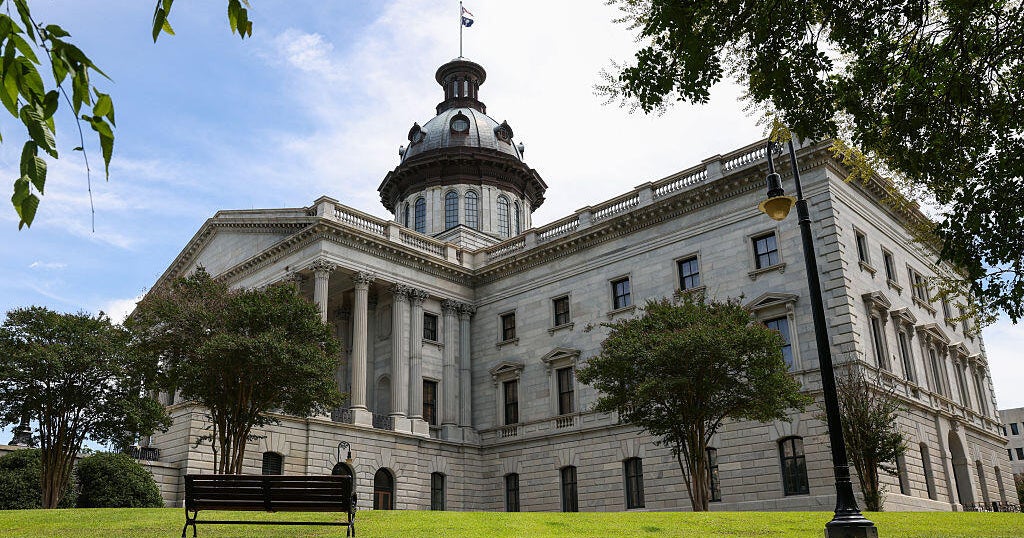

As early in-person voting kicked off on Tuesday for South Carolina’s primaries, the state Senate dismissed a Republican proposal to halt those congressional elections. Instead, the plan aimed to reschedule a new primary with redrawn districts to favor the GOP in unseating a veteran Democrat.
Several senators argued that implementing such a change at this stage was impractical.
“Voters in South Carolina are already heading to the polls today. Neither my conscience nor common sense will allow me to interrupt an election that has commenced,” stated GOP state Senator Richard Cash.
Rep. Jim Clyburn, a Democrat whose seat was targeted by Republicans for redistricting, was among the first to vote early in the small town of Orangeburg. Despite the GOP’s efforts to modify his district’s lines, Clyburn vowed to seek reelection regardless of the new boundaries.
“Even if it’s a district with a Trump plus 20 advantage, I’ll still run,” Clyburn declared, emphasizing his commitment to his current residence.
This political maneuvering in South Carolina forms part of a broader Republican initiative, driven by former President Trump, to redraw voting districts to benefit the GOP, aiming to maintain a narrow majority in the House during the midterm elections. Republicans have been acting swiftly to capitalize on a recent Supreme Court decision that diminished minority protections specified in the federal Voting Rights Act.
Sam Wolfe / Bloomberg via Getty Images 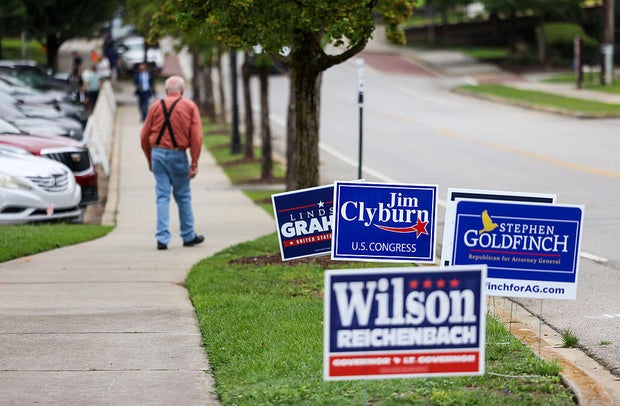
But the GOP also suffered a setback Tuesday in Alabama, where a three-judge federal panel issued a preliminary injunction blocking the state from using a Republican-drawn congressional map that could help the GOP win an additional seat. The court said the Republican plan “intentionally discriminated based on race” by including only one Black-majority district and ordered the continued use of a court-imposed map that includes two districts with a significant proportion of Black residents.
Alabama Attorney General Steve Marshall, a Republican, vowed a quick appeal to the U.S. Supreme Court and predicted an eventual victory.
Democrats, who have suffered their own share of setbacks in the national redistricting battle, praised the turn of events in Alabama.
The “fight for justice is far from over in states across the country where politicians are enacting gerrymanders on top of gerrymanders to erase equal representation for communities of color,” said Marina Jenkins, executive director of the National Redistricting Foundation, a nonprofit affiliate of the National Democratic Redistricting Committee.
Trump’s redistricting push
Voting districts typically are redrawn after a census at the start of a decade. But Mr. Trump has urged Republican-led states to redistrict ahead of the November elections to try to rebuff political headwinds, which typically result in lost congressional seats for the president’s party in midterms.
Since Mr. Trump first urged Texas to redraw its voting districts last summer, Republicans also have enacted new House districts in Missouri, North Carolina, Ohio, Florida and Tennessee. Meanwhile, voters in California adopted new Democratic-drawn districts, and a court imposed a favorable map for Democrats in Utah. Democrats suffered a setback in Virginia, where the state Supreme Court invalidated a voter-approved redistricting plan that could have helped Democrats win additional seats.
Redistricting discussions are ongoing in Louisiana following an April high court ruling that struck down a majority-Black congressional district as an illegal partisan gerrymander. The Louisiana House could vote later this week on a new map that could eliminate a seat held by Democratic U.S. Rep. Cleo Fields and improve Republicans’ chances of winning six out of the state’s seven seats.
The Congressional Black Caucus on Tuesday called on major corporations across the U.S., including those that previously expressed support for voting rights and racial justice, to oppose redistricting efforts by Republican-led states that seek to eliminate majority-Black U.S. House districts. That comes after the caucus last week called for Black athletes to boycott public universities in states that are gerrymandering congressional maps to eliminate districts held by Black lawmakers.
More than 26,000 votes were cast in South Carolina by noon Tuesday on the first day of early voting for the June 9 primary after Democrats called for people against a proposed new map to turn out in force. In 2022, about 125,000 early votes were cast over the entire two weeks.
The Republican-led House already had passed a plan that would reconfigure Clyburn’s district, void the results of current congressional primaries and instead hold new U.S. House primaries in August.
Mr. Trump has lobbied for the plan, making at least two phone calls to Republican state Senate Majority Leader Shane Massey and also phoning in to a private meeting of Republican senators earlier this month. He also has maintained the pressure on social media.
Democrats were staunchly opposed, and some GOP lawmakers in the Senate had concerns that an aggressive redistricting could backfire by making some Republican-held seats susceptible to losses because of the addition of Democratic voters.
Clyburn noted that when state lawmakers last redrew congressional districts, after the 2020 census, they spent months holding meetings across the state to gather public suggestions. Although that map resulted in a 6-1 seat advantage for Republicans over Democrats, the process was orderly and fair, he said.
“When the map was challenged, the U.S. Supreme Court said, yes, this is constitutional,” Clyburn said. But now, “this White House says, to hell with the process, to hell with the Constitution, just do what we want done.”


