
A 50-year-old man was reportedly tortured, while a 55-year-old woman was allegedly beaten to death.
In exclusive comments to News Outlet, a State Department spokesperson said that “the lives and property of Afrikaners have been endangered by politicians who incite race-based violence against them.”
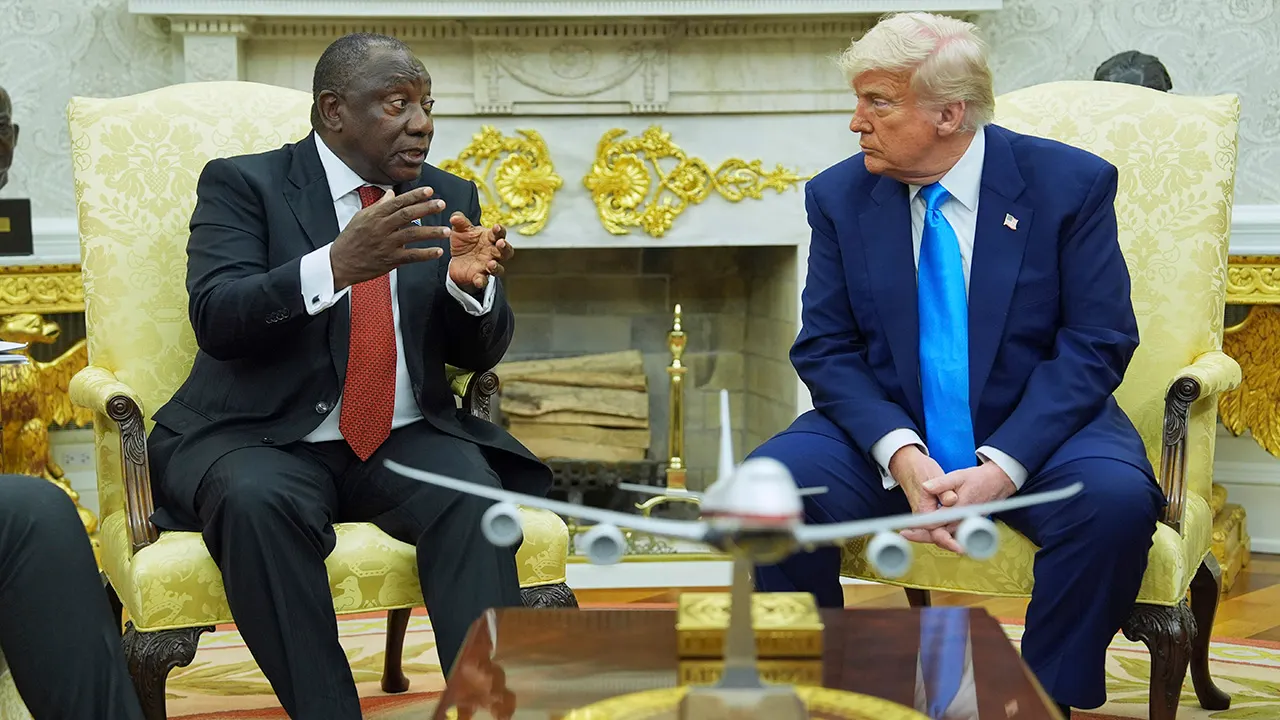
U.S. President Donald Trump, right, meets with South African President Cyril Ramaphosa in the Oval Office at the White House in Washington, D.C., on Wednesday, May 21, 2025. (Jim Lo Scalzo/EPA/Bloomberg via Getty Images)
The statement represents the latest escalation in an increasingly bitter dispute that first erupted in the Oval Office last year during a tense exchange between Trump and Ramaphosa over several South African policies and issues, including concerns about the safety of the Afrikaner community.
Ian Cameron, chair of South Africa’s Portfolio Committee on Police and a member of Parliament with the opposition Democratic Alliance, described this month’s attacks as “appalling.”
Cameron detailed the incidents, beginning with an attack on Donovan Marx, a 50-year-old man at his farm roughly 80 miles from Johannesburg.
Cameron told News Outlet that reports indicated Marx was shot, stabbed and had his ears cut off. He characterized the assault as an act of “extraordinary cruelty.”
He said that in a separate attack earlier this month in the same North West Province, 55-year-old farmer Hannetjie van Zyl was beaten to death while she was opening a gate.

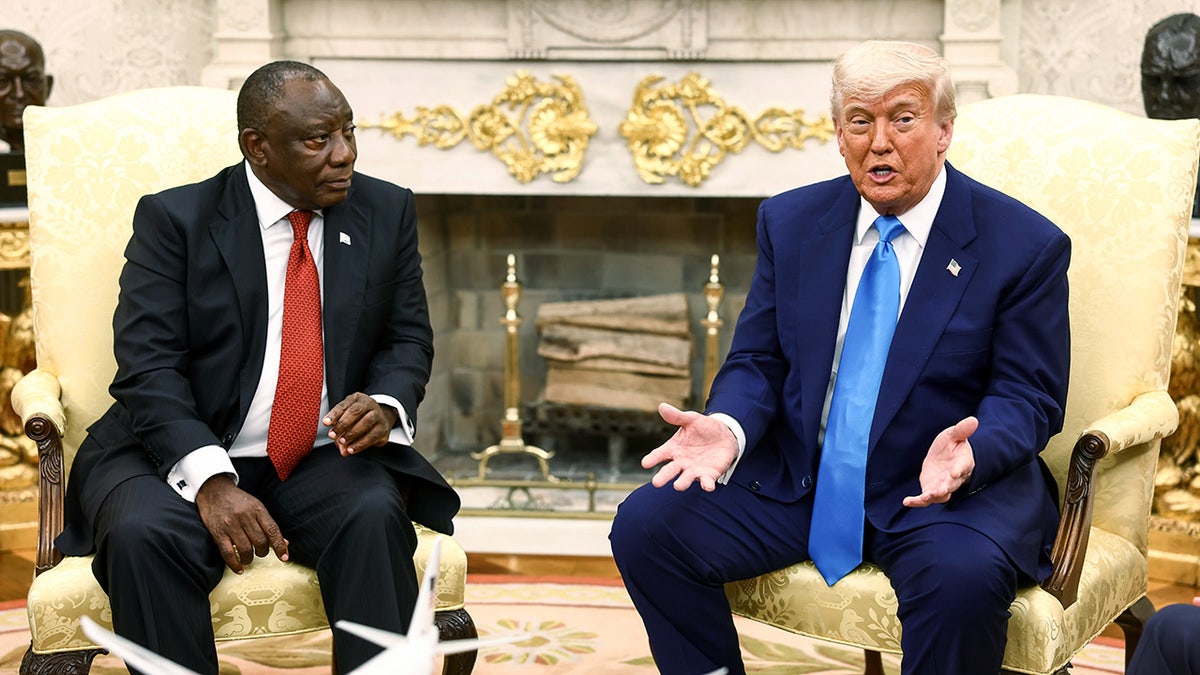
President Donald Trump displays documents during a meeting with South African President Cyril Ramaphosa at the White House on Wednesday, May 21, in Washington. (AP/Evan Vucci)
Eyewitnesses said Van Zyl was attacked from behind and struck repeatedly on the head with an iron bar.
The victims’ vehicles and belongings were reportedly stolen in both incidents. However, Corné Mulder, leader of the opposition Freedom Front Plus, said the alleged torture of Marx went far beyond a conventional burglary.
“Safety and farm attacks in South Africa remain a huge problem,” Mulder told News Outlet. “Donovan Marx was attacked this week. He’s fighting for his life in hospital at the moment. The perpetrators not only attacked him, they tried to castrate him.”
Although both victims were White, public figures have not accused the attackers of acting out of racial motivations.
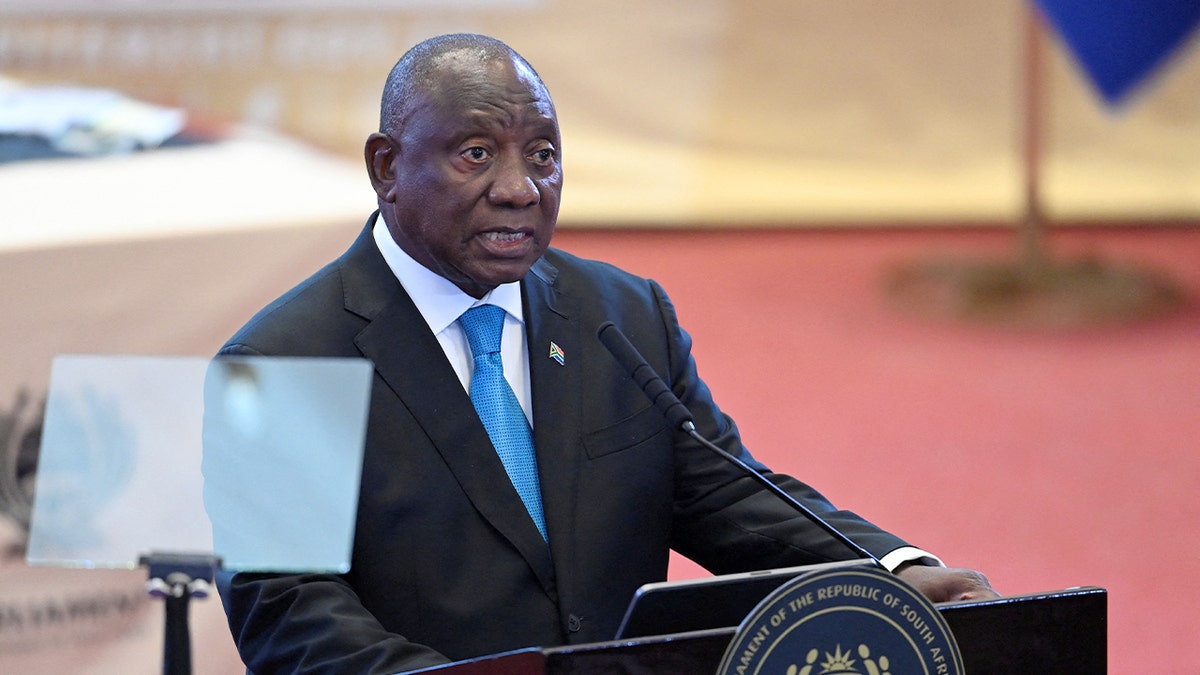
South African President Cyril Ramaphosa delivers the State of the Nation address in Cape Town on Feb. 12, 2026. (Rodger Bosch/Pool via Reuters)
Cameron said the attacks were part of a broader pattern, recalling that he had “personally attended farm-attack scenes where people were tortured with boiling water, burnt with clothing irons and subjected to other horrific abuse.”
“SAPS [South African Police Service] must put experienced investigators, forensic support and crime intelligence behind these cases,” Cameron said. “Nobody should have to accept this level of violence as a normal part of life.”
READ MORE: US Delegation Set to Join High-Stakes Iran Talks in Qatar
Mulder called the reported torture of farmers “unthinkable” and criticized Ramaphosa for not publicly expressing sympathy or acknowledging the incidents.
“We have been pleading with [the] government to prioritize rural crime and farm attacks as a priority crime. They are not prepared to do so,” he said.
News Outlet contacted the South African government for comment but was referred to police, who did not immediately respond.

South African President Cyril Ramaphosa speaks during the opening session of the G20 leaders’ summit in Johannesburg on Saturday, Nov. 22, 2025. (Misper Apawu/ AP Phot/Pool)
Mulder said the recent farm attacks were encouraged by Ramaphosa’s refusal last year to heed Trump’s demand to stop performances of the song “Kill the Boer, Kill the Farmer.” Merriam-Webster defines “Boer” as a South African of Dutch or Huguenot descent.
Ramaphosa said he could not prevent crowds of up to 90,000 from chanting the song in stadiums because South Africa’s highest court had ruled that its lyrics did not constitute hate speech.
“As long as [President Ramaphosa] does not stop the incitement to attack farmers with the singing of the song ‘Kill the Boer,’ the attacks will continue,” Mulder wrote in a statement. “We see the practical reality when these things play out, as happened with the last two farm attacks that we’ve seen.”
Last month, U.S. Ambassador to South Africa Brent Bozell III told News Outlet that Ramaphosa could still ban the song despite the court ruling that it did not amount to hate speech.
“So, to say, well, you can’t do it because the court said it’s not, you know, that’s poppycock,” Bozell said. “If President Ramaphosa, if he wants to, he can do it. It’s just as simple as that.”
The State Department reiterated the administration’s call for the song to be banned. A spokesperson told News Outlet on Friday that “the United States asked senior government officials to condemn incitement to race-based violence, particularly the singing of ‘Kill the Farmer! Kill the Boer!’”
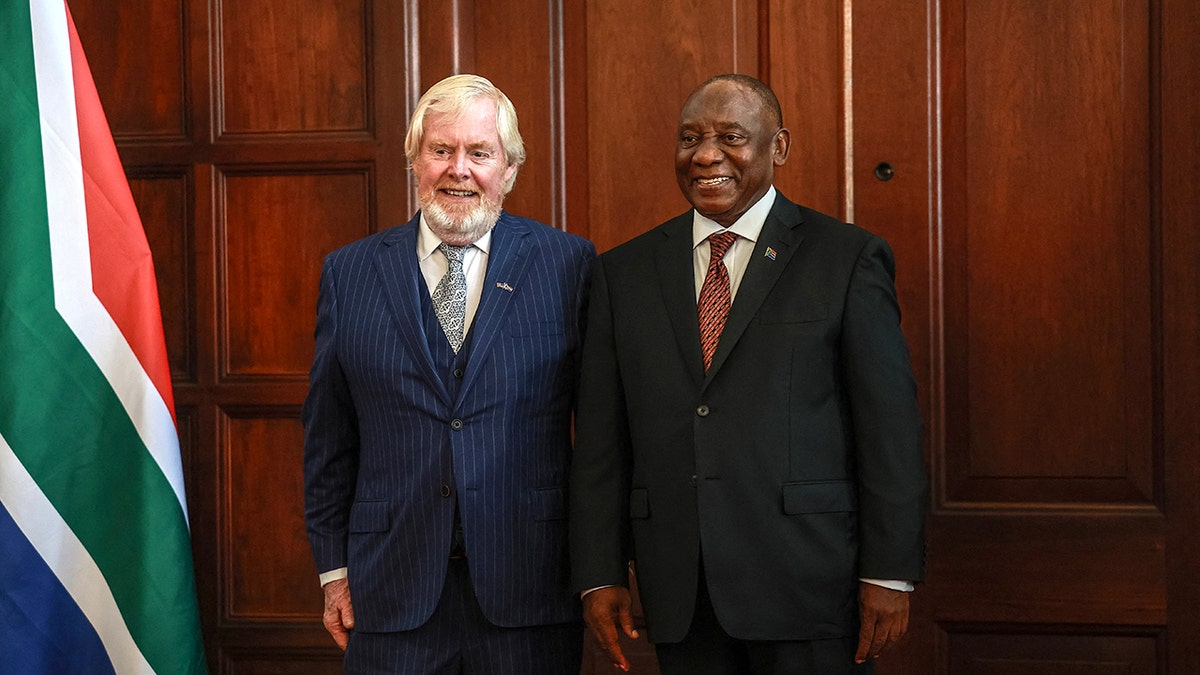
U.S. Ambassador to South Africa Brent Bozell III, left, poses after presenting his credentials to South African President Cyril Ramaphosa, right, at the Sefako Makgatho Presidential Guest House in Pretoria on April 8, 2026. (Phill Magakoe / AFP via Getty Images)
The spokesperson also said Trump had demanded that South Africa formally classify rural crime as a priority crime and “expand alternatives to the Broad-Based Black Economic Empowerment ownership requirements, such as equity equivalent investment programs.”
On the issue of farmers, the State Department spokesperson said South African politicians “threaten to confiscate their farms without compensation and support a corrupt, race-based scoring system that discriminates against Afrikaners and other minorities in employment.”
“The lack of a meaningful response to these requests made clear that the South African government does not want a constructive relationship with the United States and is willing to continue pursuing oppressive policies that disadvantage all South Africans,” the spokesperson said.
Nearly 13,000 South African refugees, most of them Afrikaners, were flown to the United States during fiscal year 2026. That figure is expected to rise by another 17,500 refugees in fiscal year 2027.
“As directed by President Trump, we are prioritizing the resettlement of Afrikaners in South Africa escaping government-sponsored race-based discrimination,” the State Department spokesperson said.