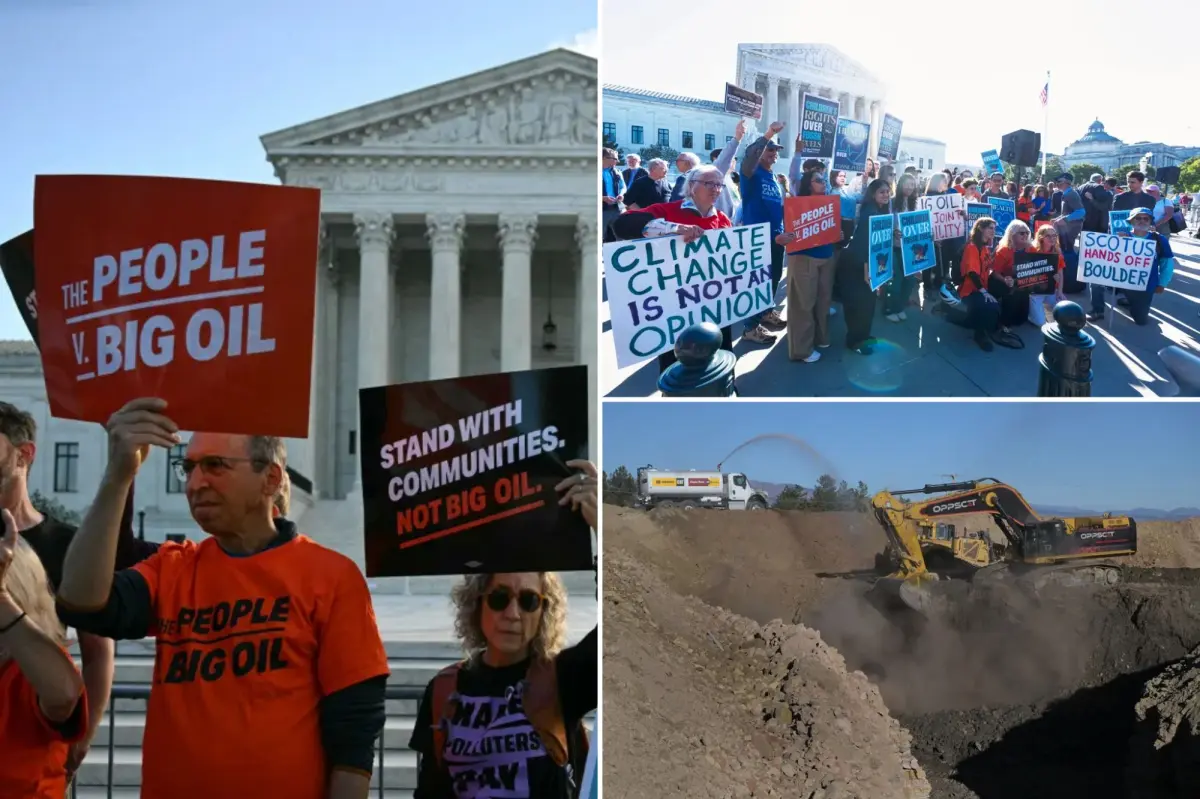
WASHINGTON — The Supreme Court opened its 2026-27 term Monday by hearing a major climate liability case, and the justices appeared doubtful that Colorado officials should be permitted to pursue fossil fuel companies in state court over the consequences of climate change. The outcome could have broad consequences for the US energy industry.
Chief Justice John Roberts questioned whether a victory for Boulder County would trigger a wave of similar lawsuits nationwide. “Presumably if you prevail, the next day a municipality in every single state will file a lawsuit, copy your pleadings and then there’ll be at least 50 …. causes of action filed. How do you think that will work out?” he asked an attorney representing the Boulder County Board of Commissioners.
“There’s always going to be greenhouse gas emissions affecting every state,” Roberts added.
The court heard the dispute with only eight justices on the bench. Conservative Justice Samuel Alito recused himself after facing scrutiny over his investments in oil and gas companies.
The legal battle began in 2018, when Boulder sued Exxon Mobil and Canada-based Suncor. The county is seeking to make the companies “share a portion of the financial burden their communities must bear in coping with an altered climate brought about in part by petitioners’ tortious conduct.”
Exxon and Suncor argued that federal law barred the case from moving forward. But the Colorado Supreme Court ruled last year that Boulder’s claims could proceed in state court.
The justices are considering whether the Colorado Supreme Court’s decision can be reviewed and, more significantly, whether the Constitution and the federal Clean Air Act prevent Boulder from bringing its climate damages claims under state law.
Justice Brett Kavanaugh pointed to four earlier decisions that he said supported Suncor’s argument. Those rulings, he suggested, “make crystal-clear that interstate air and water pollution are matters for federal law unless Congress specifically preserves state law.”
Kavanaugh urged Suncor’s lawyer to center the argument on the Clean Air Act, rather than relying on claims that Boulder’s lawsuit interferes with federal authority over foreign policy and interstate commerce.
READ MORE: Former Royal Navy Chief Stripped of Knighthood Over Affair Scandal
The energy companies are seeking a sweeping ruling from the court. Their claims could potentially survive under the Clean Air Act, however, a point one of the liberal justices raised during the arguments.
Justice Elena Kagan noted that the attorneys had devoted relatively little attention to the statute. “We’ve been talking a lot about these constitutional principles,” she told Boulder’s lawyer. “Your friends have indeed relegated the Clean Air Act to a couple of pages.”
“But I’m wondering if that isn’t a more natural and simpler route towards their view of what should happen here,” Kagan continued. “The Clean Air Act sets up an extremely complicated scheme of how regulations of emissions should operate.”
Roberts and Justice Amy Coney Barrett, both conservatives, also questioned Boulder’s decision to sue fuel producers instead of companies that directly emit fossil fuel pollution, such as industrial manufacturers. Roberts observed that “the fuel production itself doesn’t have the universal harm that we’re talking about.”
Kevin Russell, representing the Boulder commissioners, countered that no legal principle justified blocking the state lawsuit through federal preemption.
“Since the founding, states have had the power to provide tort remedies for injuries occurring within their borders, even when the conduct causing those injuries occurred elsewhere,” Russell argued.
He said Suncor was asking the court to declare certain issues inherently federal and therefore beyond state authority—not because Congress had expressly said so, but because lawmakers had remained silent.
A 4-4 split among the justices would leave the lower court’s ruling intact, allowing Boulder’s case to continue.
The Supreme Court is expected to issue its decision in Suncor Energy Inc. v. Commissioners of Boulder County by the end of June.


