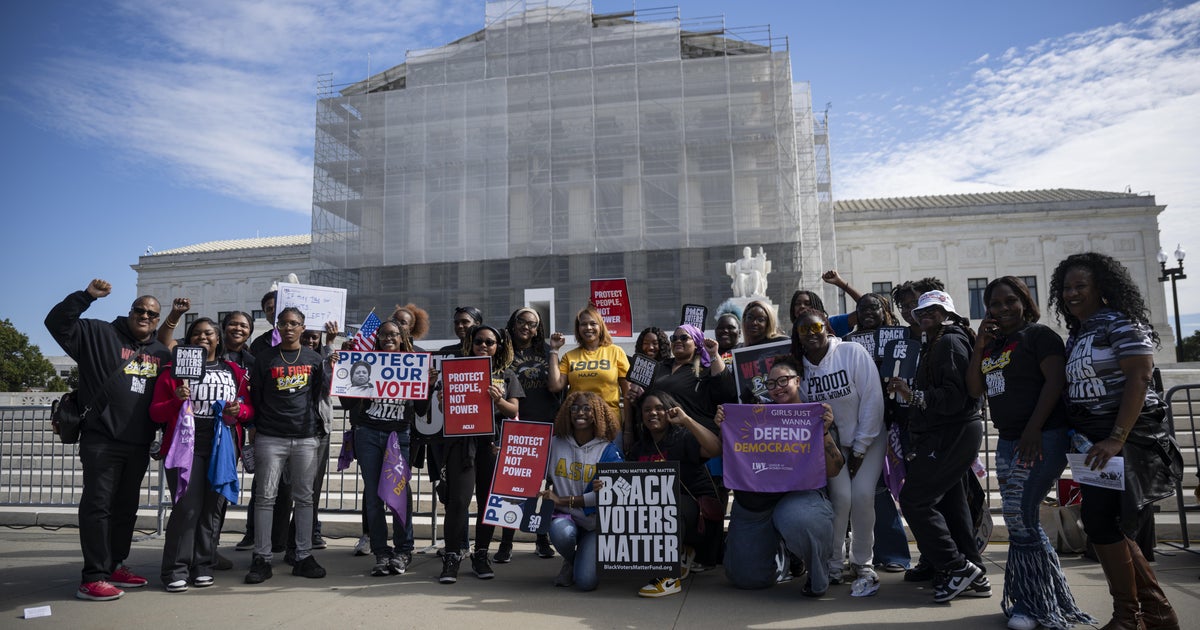

Washington — The Supreme Court has given Alabama the green light to implement a new congressional map in time for the 2026 midterm elections.
In a decision marked by division over Alabama’s 2023 House district layout, the Supreme Court overturned lower court decisions that had previously blocked the use of the Republican-designed map, which features only one majority-Black district. The high court has now sent these cases back for further consideration, following its recent landmark ruling that diminished the power of the Voting Rights Act.
The justices ruled 6-3, with dissent from Justices Sonia Sotomayor, Elena Kagan, and Ketanji Brown Jackson.
In her dissent, Sotomayor, supported by her fellow liberal justices, criticized the Supreme Court’s decision to discard the lower court’s rulings. She argued that this move is “inappropriate” and will create confusion as Alabama voters prepare for upcoming elections.
Alabama’s 2023 map, which consists of one majority-Black district among seven, was drawn by state legislators following a surprising ruling by the Supreme Court earlier that year. The court had indicated that the 2021 redistricting plan likely breached Section 2 of the Voting Rights Act.
The map currently in use for the 2024 elections was chosen by a panel of three district court judges and includes two majority-Black districts. At present, Alabama’s congressional delegation is made up of five Republicans and two Democrats.
Alabama had asked the Supreme Court to move quickly on the appeals following its landmark ruling last month that undermined Section 2 of the Voting Rights Act. On the heels of that 6-3 decision, which involved Louisiana’s congressional map, Republicans in some Southern states are scrambling to redraw their congressional maps and reconfigure districts held by Democrats.
In Alabama, where the primary is set for May 19, GOP Gov. Kay Ivey signed into law a measure that authorizes a special election for congressional districts whose current boundaries would change if the state were given the green light to revert back to its 2023 map.
The court fight over Alabama’s congressional map has spanned more than half the decade and has been before the Supreme Court numerous times across various stages of litigation.
After the state’s Republican-controlled Legislature adopted new House district lines in 2021, the high court agreed with a lower court that Alabama’s congressional map likely violated Section 2 by diluting the votes of Black residents. The lower court had said the state should have two House districts where Black voters have the opportunity to elect their preferred candidates.
Following that decision, state lawmakers enacted in July 2023 a new House map, which, like the 2021 plan, included a single majority-Black district. State officials said the congressional districts were drawn to minimize county splits, including in the so-called Black Belt, a rural region named for its fertile soil, and to adhere to traditional redistricting principles.
But that 2023 map drew another challenge and again, a three-judge district court panel blocked those congressional districts from being used in the 2024 elections. The Supreme Court declined to let Alabama use those House boundaries, and 2024 congressional elections were held under a remedial map drawn by the district court.
Alabama officials went on to appeal the district court rulings last year, but the Supreme Court had not yet acted on them while it was considering the Voting Rights Act dispute involving Louisiana’s map.
Separately, Alabama Republicans asked the Supreme Court to grant it emergency relief that would allow the state to return to its 2023 map for this election cycle.
“Plaintiffs would have Alabama hold elections under a map that was erroneously ordered at best and unconstitutional at worst. Nothing requires that result,” Alabama Solicitor General Barrett Bowdre wrote in its request. “Americans, no less in Alabama, deserve a republic free of racial sorting now, and state officials deserve an opportunity to give it to them.”