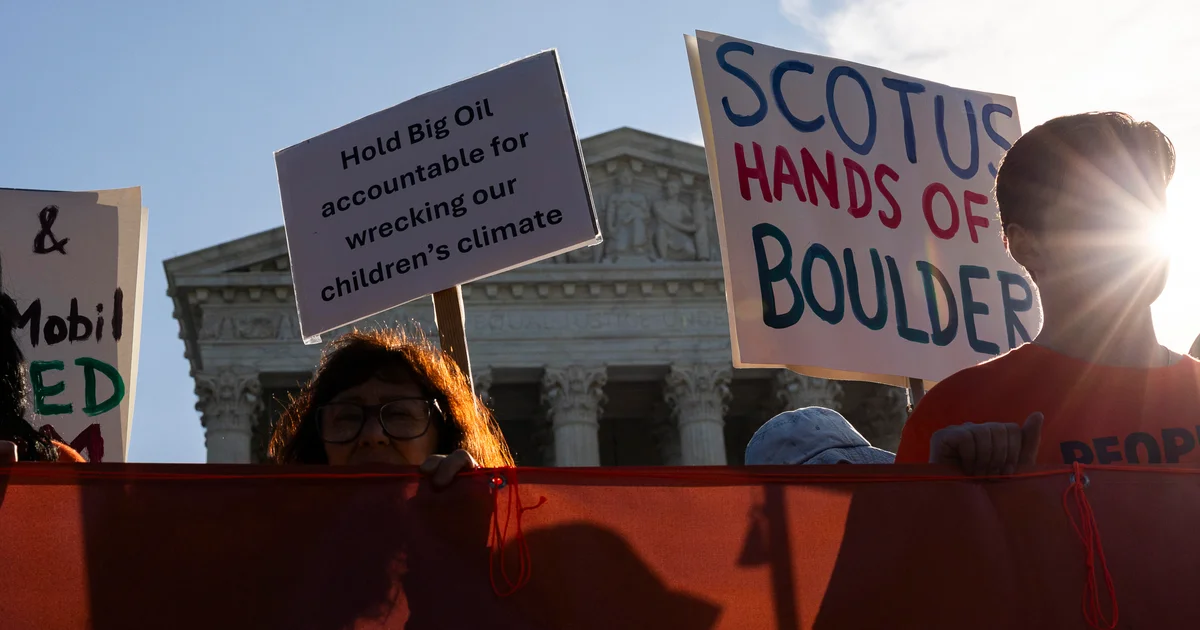

Washington — The Supreme Court on Monday wrestled with a complex legal battle over Boulder, Colorado’s effort to make energy companies pay for damages linked to global climate change.
Eight of the court’s nine justices heard nearly two hours of oral arguments in Suncor Energy v. Commissioners of Boulder County. The Supreme Court said last week that Justice Samuel Alito had recused himself from the case.
The court did not explain Alito’s decision. His 2025 financial disclosure shows individual holdings in two energy companies, ConocoPhillips and Phillips 66. He did not report owning individual shares of Exxon Mobil or Suncor Energy, the companies named in Boulder’s 2018 lawsuit.
Alito’s absence raises the possibility of a 4-4 tie. If the justices deadlock, the Colorado Supreme Court’s ruling would remain in effect, allowing Boulder’s lawsuit to move forward.
The claims brought by Boulder’s city and county against Exxon and Suncor are still in their early stages. The central question before the Supreme Court is whether the case is blocked by federal law or can proceed under state law. The justices also asked attorneys to address whether the court has jurisdiction to review the Colorado Supreme Court’s decision.
Finn Gomez / Getty Images
During questioning of Kannon Shanmugam, who represented Exxon and Suncor, and Sarah Harris, the principal deputy solicitor general, Justice Brett Kavanaugh repeatedly pointed to four Supreme Court rulings issued since 1972. He said those decisions establish that pollution crossing state lines through air and water falls under federal law.
“We don’t have to reinvent the wheel, because we’ve said this multiple times and Congress, presumably when doing the Clean Air Act and doing the Clean Air Act amendments, has relied on this court’s precedents establishing that this kind of pollution is a federal-law matter, unless Congress speaks otherwise,” he said.
The Trump administration is supporting Exxon, the country’s largest oil company, and Suncor, which runs two oil refineries in Colorado. Harris argued that Boulder’s case “egregiously exceeds” the constitutional authority of state governments.
“Interstate air pollution is an inherently federal area, and Congress hasn’t authorized this suit in the Clean Air Act,” she said.
Justice Ketanji Brown Jackson, however, said the Supreme Court’s intervention appeared to be “premature.”
“It feels like we don’t really know enough to be confident that the theories that you are proposing are actually applicable here,” she told Harris.
Boulder’s lawsuit against Suncor and Exxon
Boulder’s case is one of dozens brought by states and local governments against energy companies in state courts. The lawsuits seek damages for past and future harm allegedly caused by the accumulation of greenhouse gases in the atmosphere and the resulting global warming.
Boulder says Exxon and Suncor contributed to climate change, forcing the city and county to deal with extreme heat, increasingly large and frequent wildfires, damage to ecosystems and other consequences.
The city and county brought several claims under state law. They argue that the companies’ fossil-fuel production and allegedly misleading marketing encouraged the “unchecked” use of their products, accelerating the rise in atmospheric greenhouse-gas concentrations.
Exxon and Suncor tried unsuccessfully to transfer the case to federal court. They then asked the Boulder County District Court to dismiss the claims, arguing that federal law barred the lawsuit. After the state court rejected that request, the companies sought review by the Colorado Supreme Court.
Colorado’s highest court ruled in favor of Boulder’s city and county, prompting Suncor and Exxon to appeal to the U.S. Supreme Court.
The Supreme Court’s arguments
During Monday’s arguments, Shanmugam said the Constitution and the Clean Air Act prevent lawsuits aimed at addressing damage from greenhouse-gas emissions that cross state lines. He also cautioned that allowing claims like Boulder’s could interfere with the federal government’s authority over foreign affairs.
Shanmugam described Boulder’s case as an “unprecedented effort” to use state law to regulate conduct around the world—something he said the nation’s constitutional structure does not permit.
“A state does not have the power to regulate out-of-state conduct based solely on attenuated effects on the state,” he said.
If Boulder’s lawsuit is allowed to proceed, Shanmugam warned, as many as 90,000 municipalities could bring similar cases and “have the ability to make national and international energy policy by asking juries to impose catastrophic damages on selected fossil-fuel producers.”
Chief Justice John Roberts, too, noted that if Boulder prevails before the Supreme Court, local governments in every state will file their own lawsuits similar to Boulder’s.
“How would you think that will work out on the ground?” he asked Kevin Russell, who argued on behalf of Boulder.
Russell stressed that even if Boulder’s case can move forward, more litigation over the specifics of the suit will follow.
But Roberts also said there are other instances where the Supreme Court has allowed state-court lawsuits involving issues with wide impacts to go ahead.
“There are a lot of familiar situations where conduct outside of a state has broad effects from other states and all that, and yet we allow state courts in a particular state to bring litigation that affects that, whether it’s a mass tort sort of thing or maybe complaints about operations of the internet,” the chief justice said. “I guess I’m not quite sure what makes this situation different from all those other ones where we’ve allowed them to proceed in state court.”
Justice Elena Kagan, meanwhile, said the case against the energy companies appears similar to lawsuits brought against tobacco companies in the 1990s and pharmaceutical companies in response to the opioid epidemic.
“This is chapter three,” she said, noting that state claims against those companies could proceed.
But Kavanaugh said later that “this court has consistently said that air and water pollution are different in our federal enclaves.”
Lawyers for Boulder city and county are urging the Supreme Court to dismiss the appeal on the grounds that it does not have jurisdiction. If the justices opt not to, they say the Colorado Supreme Court decision should be upheld.
“Since the founding, states have had the power to provide tort remedies for injuries occurring within their borders, even when the conduct causing those injuries occurred elsewhere,” Russell told the justices.
He also argued that Congress “stands at the ready” to intervene and enact federal law that preempts “unreasonable state laws.”
“This litigation is not an attempt to solve climate change; it merely asks that petitioners bear their fair share of local costs incurred in part because of their tortious conduct,” Russell wrote in a filing.
He also told the justices that Boulder did not sue for emissions, which are regulated by the Clean Air Act, but over allegedly deceptive marketing and production, which that law does not regulate.
“It is not an effort to reduce emissions,” Russell said. “Under our deception theory, they can continue to produce as much fossil fuels as they like and contribute to as much air pollution and greenhouse gas emissions, as the market will bear when consumers are properly informed about the consequences of that decision.”
A decision from the Supreme Court is expected by summer of 2027.


