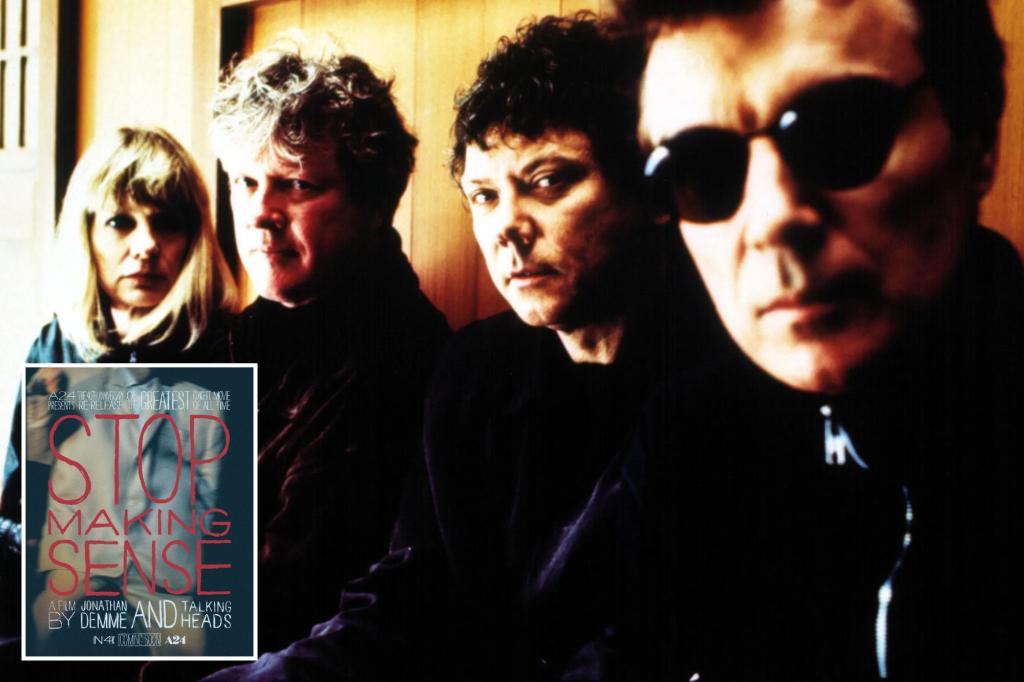


Fifty years ago this month, three art-school students known as Talking Heads played an audition at the Bowery club CBGB. Unlike the other emerging punk bands shaping the New York City music scene, frontman David Byrne, bassist Tina Weymouth, and drummer Chris Frantz had a unique look and sound.
Their lead singer, with a skittish and hollow-eyed demeanor, paired his unusual, keening vocals and enigmatic lyrics with hyper-rhythmic guitar playing, while the petite blonde bassist (a rare female bassist in the mid-’70s) and energetic mop-top drummer maintained a driving beat.
Their catchy track “Psycho Killer” — featuring a sing-along chorus — quickly drew the attention of club owner Hilly Kristal, leading to a series of bookings, including opening for the Ramones.
Later adding keyboardist/guitarist (and Harvard grad) Jerry Harrison, the band would become “the most original, musically ambitious, and rigorously creative rock group of their time,” writes Jonathan Gould in his riveting new biography, “Burning Down the House: Talking Heads and the New York Scene That Transformed Rock” (out June 16).
The book deftly interrelates New York City’s cultural, social, and economic history (from its bankruptcy and the downtown art scene to Son of Sam and the ’80s boom) as the band evolves into an expanded group of both African-American and white musicians, ambitiously exploring ever-more innovative sounds.
A former professional drummer and the author of well-received biographies of the Beatles and Otis Redding, Gould says that “having grown up in New York, a big part of my attraction to the subject involved the chance to write about the change in the city’s social life and geography over the past fifty years.”
He focused on Talking Heads, he relates, because “having written books about the archetype of a rock group and the archetype of a soul singer that together comprised an extended exploration of the centrality of race in Anglo-American popular music, I wanted to tell the story of a second-generation rock group’s engagement with Black music — as dramatized by David Byrne.”
Gould calls the Scottish-born, suburban Maryland-raised Byrne “one of the ‘whitest’ men ever to front a rock group, but who transformed himself over the course of his career into a singer, musician, and performer embodying many of the most kinetic qualities of Black music while still maintaining an unequivocally ‘white’ identity.”
From reinterpreting Al Green’s “Take Me to the River” to diving into the music of Africa and Latin America, Talking Heads released eight studio albums between 1977 and 1988.
The group reunited once in 2002 to perform at their induction into the Rock & Roll Hall of Fame. More recently, the band reconvened for a public discussion at the Toronto Film Fest and with Stephen Colbert to celebrate the re-release of “Stop Making Sense,” their seminal 1984 concert doc.
In “Burning Down the House,” Gould explores how Byrne’s Asperger’s syndrome affected his relationships, as well as how it “exerted a strong influence on his creative sensibility, beginning with his tendency to approach most aspects of music-making without the sort of preconceptions that most of us accept as a way of trying to show other people that we know what we’re doing.”
Gould adds, “David’s Asperger’s also contributed to his remarkable powers of concentration and observation, in part because people on the spectrum learn to pay very close attention to things as a way of navigating an unfamiliar and sometimes incomprehensible world. At the same time, I think it’s important to put this in context. David’s Asperger’s was one of many influences on an artist who sought out and absorbed influences like a sponge. It was not the be-all-and-end-all of his personality or of his creative sensibility.”
In a gripping narrative, Gould traces Talking Heads’ journey from their hometowns to their art schools, Chrystie Street loft, and eventual global stardom. He sharply analyzes their work and includes rich portraits of individuals, art movements, and music scenes in their orbit. While Gould interviewed the band’s longtime friends and colleagues, all four declined to speak with him.
“Though I was initially disappointed that they chose not to cooperate with my research,” he says, “I’ve come to regard it as a blessing in disguise. I have the feeling that not speaking with them insulated me enough from their conflicting personal narratives to enable me to gain perspective on the formation and musical evolution of the band.”
Gould finished the project even more of a fan of their music than when he began his book some five years ago.
“Initially, I was drawn most strongly to the trio of albums — Fear of Music, Remain in Light, and Speaking in Tongues — that had the greatest ambition and intensity,” he relates. “As a drummer, I have a great appreciation of Chris’s playing, beginning with his steadiness and solidity. And I consider David to be a genius — a word I don’t use lightly — on account of the utterly distinctive nature of his singing, guitar playing, and songwriting. Simply put, I can’t think of anyone else in popular music who sounds like him or writes like him.”