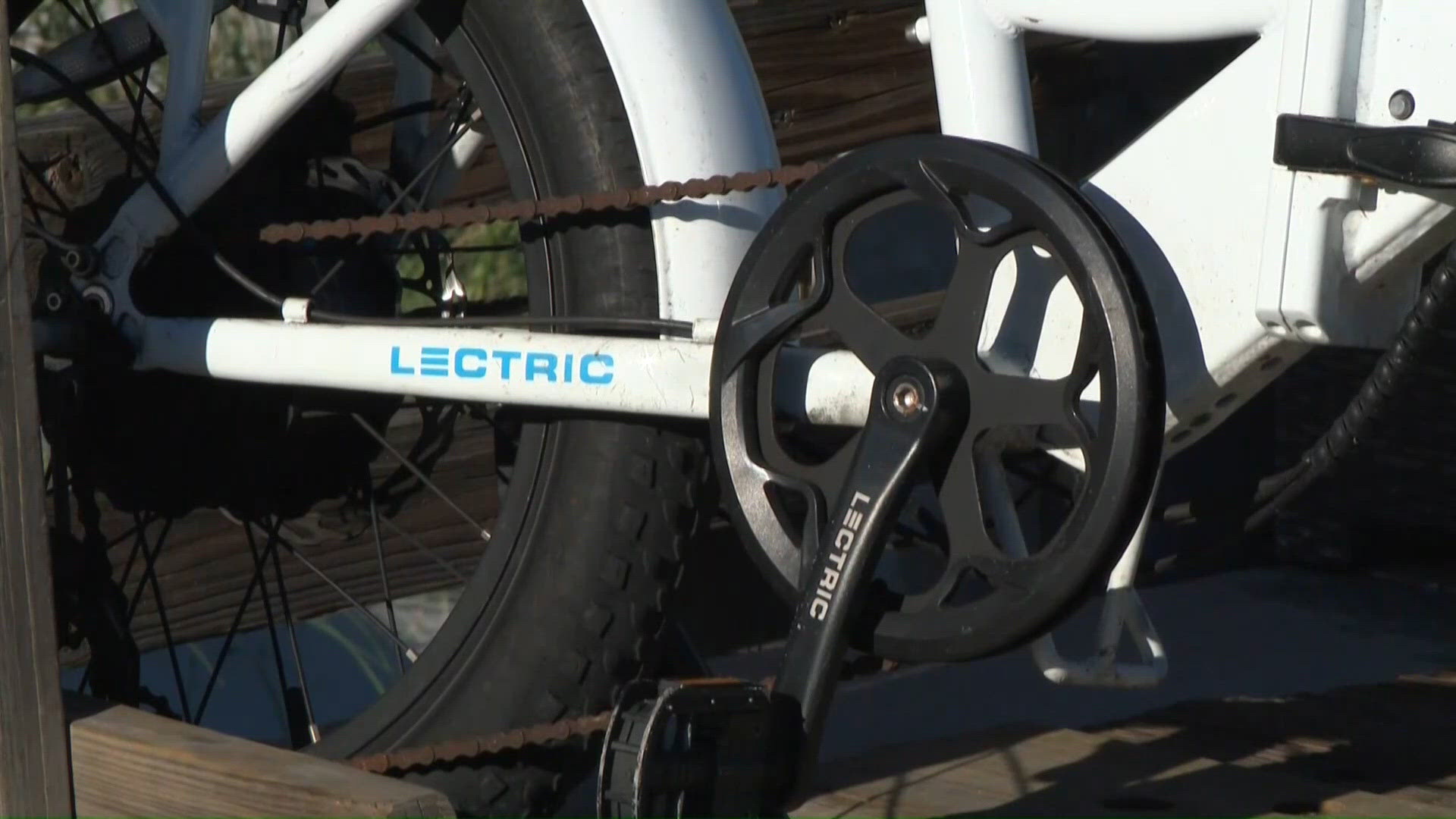
Beach leaders gathered to review a regional e-bike safety study and discuss whether Atlantic Beach, Neptune Beach and Jacksonville Beach should adopt uniform speed limits and regulations.
JACKSONVILLE BEACH, Fla. — E-bike riders traveling between Atlantic Beach, Neptune Beach and Jacksonville Beach can face different rules from one community to the next. As the popular vehicles become more common, leaders in all three cities are weighing whether a coordinated set of regulations would improve safety and reduce confusion.
During a joint meeting Wednesday at Jacksonville Beach City Hall, the North Florida Transportation Planning Organization presented findings from a regional e-bike study. The agency recommended that the Beaches communities adopt consistent safety regulations, including a 10 mph speed limit on sidewalks and shared-use paths.

No new regulations were approved at the meeting. City managers and police chiefs are expected to continue developing possible recommendations before the issue returns for discussion at upcoming city council meetings.
Different rules, same beaches
Atlantic Beach currently caps e-bike speeds at 10 mph on sidewalks and multi-use paths. Jacksonville Beach and Neptune Beach permit speeds of up to 15 mph in those areas.
Atlantic Beach Mayor Curtis Ford said the differing regulations can leave riders and residents confused when they travel between the neighboring communities.
“My goal tonight is to at least start the dialog on how we write similar or same legislation so that our citizens, when they go from Atlantic Beach to Neptune to Jacksonville or vice versa, are not dealing with multiple rules and laws that confuse,” Ford said.
Ford said Atlantic Beach enacted its first e-bike legislation about a year and a half ago. He recalled asking a police officer to ride an e-bike along a multi-use path outside City Hall to show how quickly the vehicles can approach pedestrians.
“We started with 20 miles an hour. Oh my goodness, that was fast,” Ford said. “15 miles an hour, still very fast. Even 10 miles an hour is a shocker for most people who are just walking on a sidewalk to be passed by a very quiet machine that comes up from behind.”
What the study found
The TPO examined crash data from January 2020 through March 2026 and identified 46 reported e-bike crashes in the Beaches communities. Twenty-five of those incidents occurred in crosswalks, while 78% resulted in injuries.
Researchers also found that reported e-bike crashes rose by roughly 800% from 2020. Thalia Fusté of the TPO said the increase reflects both the growth in e-bike use and shortcomings in crash reporting, since state reports do not always provide a specific category for e-bike incidents.
“The e-bikes are not going away this time, and these crashes are going to continue to rise,” Fusté said.
ALSO READ: DOJ Unveils Nationwide Tax Fraud Case Against 76, Citing $500M Losses
The study calls for all three cities to establish a shared 10 mph speed limit on sidewalks and shared-use paths, clarify where e-bikes are permitted, expand safety education for riders and parents, and consider measures such as improved signs and physically separated paths.
Parents push for tougher rules
Crystal Workman, a local resident, said both of her teenagers have been injured in e-bike crashes. Her daughter required emergency room treatment after falling from an e-bike.
“I think they’re very dangerous,” Workman said.
Florida law requires e-bike riders under 16 to wear helmets. Workman said she believes the requirement should apply to riders of all ages and that local speed limits should be reduced.
“I think that the mileage level should be lower, and I think that they should mandatory be having to wear helmets,” she said. “Otherwise, they will should get cited.”
E-bikes vs. e-motos
Florida law recognizes three e-bike classes. Class 1 and Class 2 e-bikes are limited to 20 mph, while Class 3 models can reach speeds of 28 mph. All e-bikes must have operable pedals.
E-motos, which can travel faster than 28 mph, fall under different state regulations. Riders must be at least 16 years old, and the vehicles must be registered and operated with the appropriate license.
Jacksonville Beach Mayor Chris Hoffman said education will be central to any new e-bike safety strategy, especially efforts aimed at young riders and their parents.
“Making sure that the users of the e-bikes and their parents, especially if they’re minors, know what the laws are, so we need to be really clear, and it will help us if we’re consistent too across the three beaches,” Hoffman said.
Hoffman said he hopes the cities can form a joint committee to develop recommendations that can be applied consistently across the Beaches.
“Hopefully we’ll be able to kind of put together a little bit of a joint committee to come up with some recommendations that we can apply consistently across the three beaches,” he said.
What’s next
City managers and police chiefs from the three communities are expected to work together on possible regulations. Leaders said e-bikes will likely remain a recurring topic at upcoming council meetings as they work toward rules all three Beaches communities can support.