
Share this @internewscast.com

WASHINGTON — Discussions between Iran and the United States ended on Thursday without an agreement regarding Iran’s nuclear program, as President Trump ramped up the U.S. military presence in the Middle East, seemingly preparing for potential conflict.
The talks held in Geneva did not result in a resolution, and with Trump’s self-imposed deadline to secure an accord looming this weekend, the clock is ticking for a diplomatic solution.
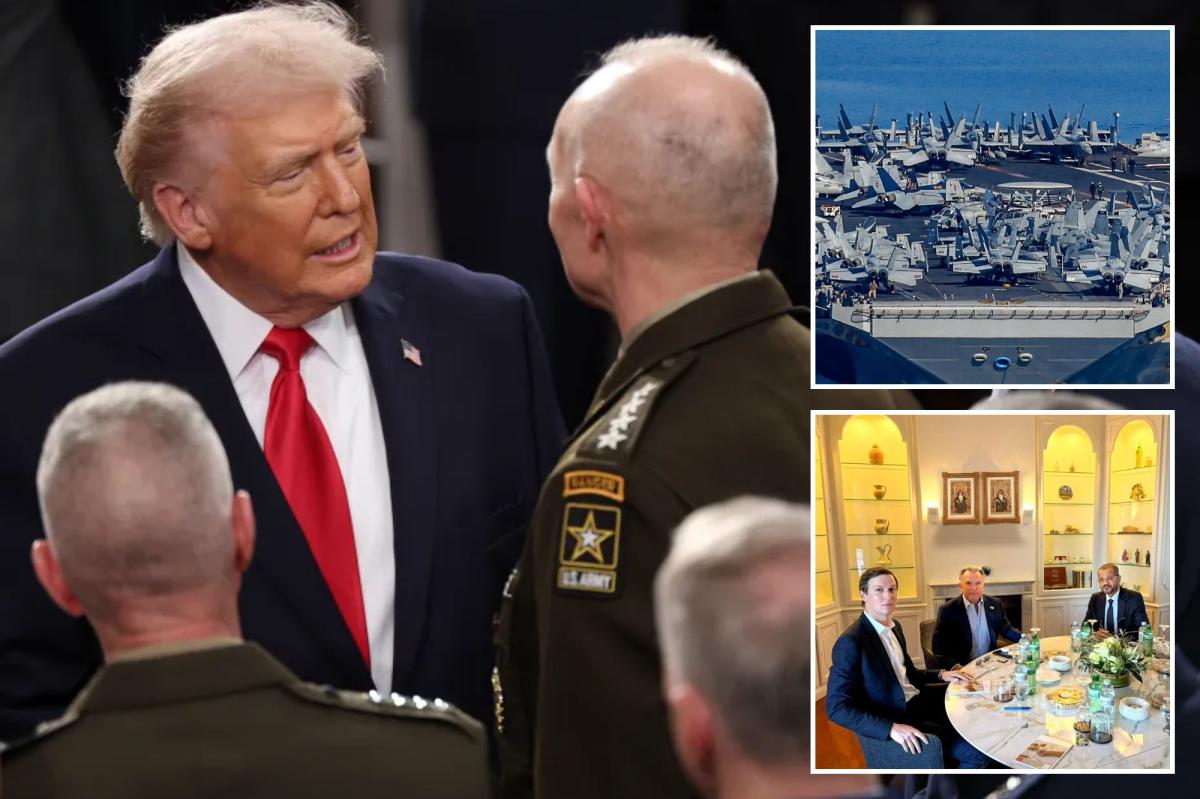
In the meantime, Trump has been bolstering military strength in the region. On Thursday, U.S. military assets, including ships and hundreds of aircraft, were strategically positioned within reach of Iran, indicating that military action could be imminent.
Experts suggest this might be one of the most significant military buildups in history without a subsequent strike. The U.S. has mobilized more air power in the area than at any time since the 2003 Iraq invasion, leading analysts to speculate that a U.S. strike could be forthcoming.
Although Trump has expressed a preference for a diplomatic agreement, he has also made it clear that military options remain on the table.
The meeting on Thursday occurred exactly a week after Trump informed his Board of Peace in Washington that he would decide on taking military action against Iran’s regime within the next ten days.
Under deadline pressure, all sides described progress after more than six hours of discussions in Geneva — with Iranian foreign minister Abbas Araghchi and mediator Badr Albusaidi, Oman’s foreign minister, saying follow-up “technical” talks would happen in Vienna, Austria, on Monday.
The Austrian capital is home to the United Nations nuclear watchdog, the International Atomic Energy Agency.
But Iranian state media said the country had rejected the central US demand that it relinquish its nuclear program — saying representatives “firmly” reiterated Iran’s “nuclear rights” while demanding the end of US sanctions.
Iranian Foreign Ministry Spokesman Esmail Baqaei bashed the American side halfway through the day’s discussions.
“There are contradictory statements from some US officials, which raise doubts about their seriousness,” he said after a break in talks.
A starkly different tune came from the foreign minister after negotiations concluded for the day, who said that “overall, it was one of the best rounds of negotiations and one of the most serious and longest.”
Who currently holds power in Iran’s political leadership is unclear amid reports that Supreme Leader Ali Khamenei has effectively sidelined President Masoud Pezeshkian, who took office in 2024 as a reformer.
“On some issues, understanding has now been established,” the foreign minister said. “And on some issues, it is natural that we have differences of opinion, and perhaps more than in the past, the seriousness on both sides was evident to reach a negotiated solution.”
There was no immediate response from the White House, but War Secretary Pete Hegseth and Gen. Dan Caine, the chairman of the Joint Chiefs of Staff, were spotted departing the executive mansion around the time the Geneva talks wrapped up.
The US team was led by special envoy Steve Witkoff and Trump’s son-in-law Jared Kushner, who left a morning session “disappointed,” but later felt the day’s work was “positive,” Axios reported.
The Wall Street Journal reported that Witkoff and Kushner have demanded that Iran dismantle three key nuclear sites — at Fordow, Isfahan, and Natanz — that were hit by the US this past June and turn over all of its enriched uranium to Washington.
The American side also reportedly has demanded that any agreement be permanent, with none of the so-called “sunset clauses” found in the 2015 Joint Comprehensive Plan of Action.
The outlet later reported that the Iranian side had rejected those demands, and it was unclear how flexible Witkoff and Kushner were willing to be.
During Tuesday night’s State of the Union address to Congress, the president claimed that Iran was “working to build missiles that will soon reach the United States of America,” among other “sinister designs.”
“We are in negotiations with them,” Trump said. “They want to make a deal but we haven’t heard those sacred words: ‘We will never have a nuclear weapon.’”
US officials have pushed to broaden the talks to include discussions of Iran’s ballistic missile program as well as the regime’s killing of thousands of protesters last month — but Tehran has refused to be drawn on those topics.
Trump, who did not appear in public Thursday, has pointedly refused to answer reporter questions about whether he would assassinate Khamenei, who has ruled the theocracy since 1989, though he has said he favors regime change.
Trump is widely believed to be leaning toward a strike — potentially starting with a limited hit — after Iran flouted his red-line threat of retribution last month if the country killed anti-regime protesters, which it proceeded to do on a historic scale.
Trump said Tuesday that 32,000 protesters were killed.
US officials have provided differing descriptions of Iran’s nuclear program and what Tehran must do to avoid strikes.
Witkoff said Saturday on Fox News that Iran was “probably a week away from having industrial-grade bomb-making material” — although others, including Secretary of State Marco Rubio, say Trump’s airstrikes last June make that unlikely.
“They’re not enriching right now, but they’re trying to get to the point where they ultimately can,” Rubio told reporters Wednesday.
Rubio also said ahead of the talks that it was “a big problem” that Iran “refuses to talk” about its advanced missile technology — a major concern of Israel and a key recommended target of US strikes by Prime Minister Benjamin Netanyahu.
Trump armada and jets arrive in unprecedented buildup
The world’s largest aircraft carrier, the USS Gerald R. Ford, and a supporting strike group left the coast of Crete Thursday morning for the Israeli coast — where the ships may be used for offensive strikes and to shield Israel from retaliatory rockets.
The Ford’s voyage is expected to take about 24 hours, putting it in range for strikes by the time markets close Friday for the weekend, which historically has been when Trump has launched military strikes.
Another American aircraft carrier, the USS Abraham Lincoln, and supporting ships are positioned in the Arabian Sea just south of Iran.
Meanwhile, 14 additional F-35s left Utah en route to the region Thursday morning — bringing the total US aircraft in the region to more than 200.
The Pentagon’s first kamikaze drone unit, known as Task Force Scorpion, has been moved into position and may be involved in an attack, Bloomberg reported.
The buildup comes despite polling indicating public unease with an attack — after Trump himself ran for president three times, blasting his predecessors for destabilizing the Middle East through military interventions.
Polls show growing support for an attack, but those in favor remain in the minority.
An Economist/YouGov poll conducted Feb 20-23 found 49% of Americans oppose attacking Iran, 24% are unsure and 27% in favor.
That’s a shift from last month when a Quinnipiac University poll released Jan. 14 found 70% were opposed, 12% weren’t sure and 18% were in favor.