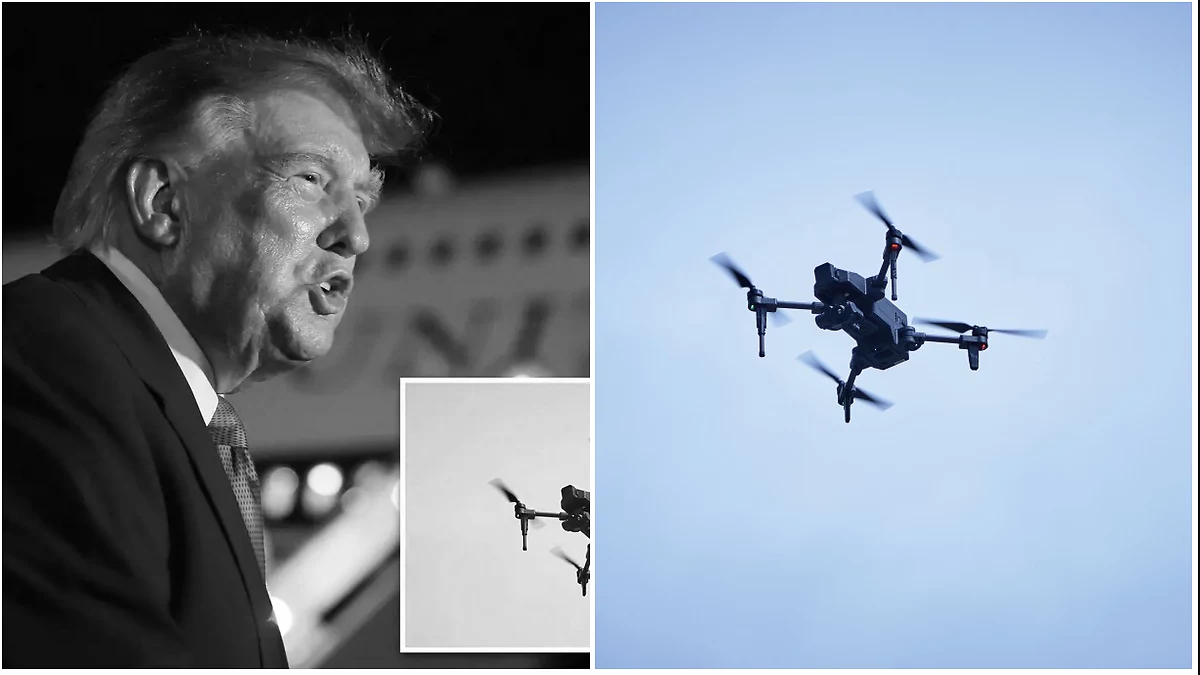

President Trump on Thursday signed a proclamation placing steep new tariffs on select imported drones, with duties reaching as high as 100%, as the administration moves to strengthen U.S. manufacturing and respond to national security concerns.
According to the White House, the 100% tariff applies to drones “of a certain size or with certain capabilities that are particularly sensitive for national security purposes,” including models with a maximum takeoff weight above 55 pounds and those equipped with thermal imaging technology.
The same 100% duty will also cover docking stations and key components used in those drones.
Smaller drones brought into the United States will face a 25% tariff under the proclamation.
Drones and related components imported from the European Union, Japan, Liechtenstein, South Korea, Switzerland and Taiwan will be subject to a 15% tariff, while imports from the United Kingdom will carry a 10% fee.
MORE STORY: Varun Batchigari Arrested in Germany After Arizona Girlfriend’s Killing
Trump said in the proclamation that Commerce Secretary Howard Lutnick had been directed to examine how imports of drones and drone parts affect national security, and that the new duties were adopted after the president reviewed Lutnick’s findings.
“The Secretary found that import penetration from foreign producers of [unmanned aerial systems] is substantial and that the United States is too reliant on foreign sources of UAS and UAS components,” Trump wrote.
Trump added that dependence on foreign-made drones “poses significant risks to US national security through our dependence on unreliable supply chains for an essential technology and the potential of significant cybersecurity vulnerabilities,” citing Lutnick’s conclusion that drones and components from certain foreign entities present security and safety risks.

Trump further indicated that it was determined that not enough drone and drone components are produced within the US “to safely meet national security needs and that the need and demand for domestically produced UAS and UAS components will only increase.”
The president noted his administration had “concerns” about whether the US has the ability to produce drones “at the required speed and scale to adequately support national security operations and activities, including during a surge for wartime or armed conflict, or in a manner to sustain long-term economic competitiveness,” which the new tariffs aim to address.
Trump further argued that “unfair trade practices” disincentives US producers from investing in expanding drone manufacturing capacity.
The new tariffs on drones sensitive to national security will take effect in 21 days, while the levies on drones and components that are not particularly sensitive will take effect in 180 days.