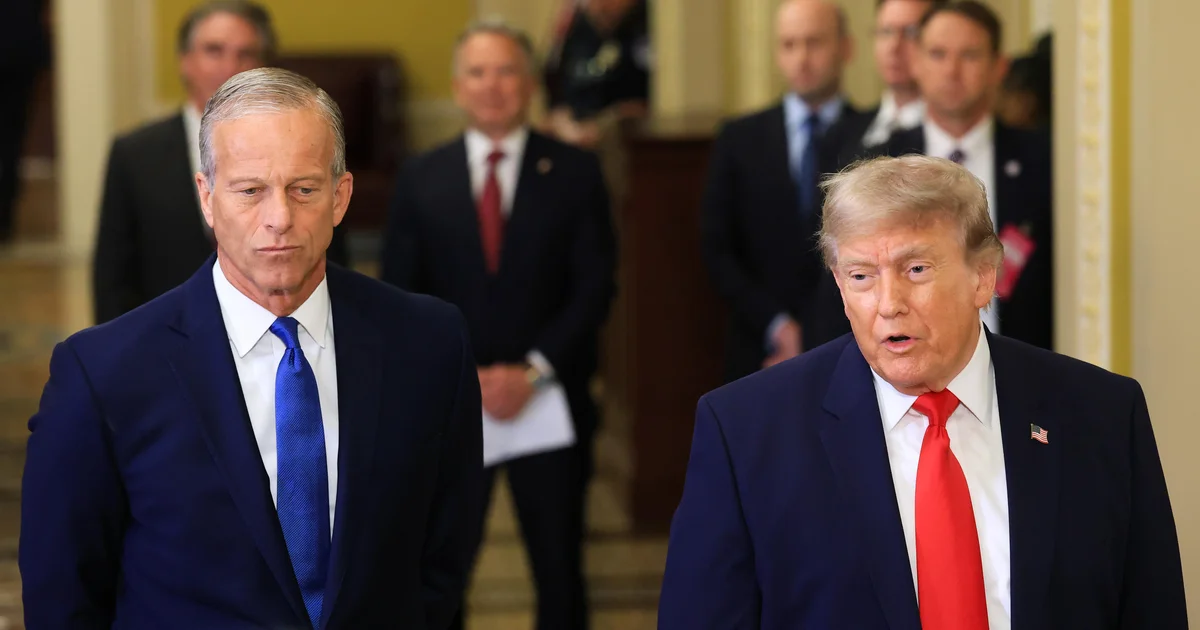

Washington — President Trump’s sudden decision Wednesday to cancel the signing of a bipartisan housing measure overshadowed his visit with Republican senators on Capitol Hill, where members of his party have become increasingly uneasy about a string of moves disrupting their legislative agenda.
Mr. Trump met privately with Senate Republicans for more than an hour over lunch. Afterward, Sen. Bill Cassidy of Louisiana said he challenged the president over the conflict with Iran and described the exchange to reporters as tense.
Cassidy, who was defeated in May by a Trump-endorsed primary challenger, said he told the president that “our original objectives have not been achieved, and I want to know what’s going on.” The senator added that he planned to vote in favor of limiting the president’s authority to launch strikes against Iran “until I get a briefing.”
“At which point, as I recall, he did not particularly care for my comments. Raised his voice,” Cassidy said. “I lost my temper. That’s not appropriate. It’s the Irish in me. But I, again, matched his tone and his volume.”
Before the meeting, Mr. Trump was expected to press senators on an elections measure known as the SAVE America Act, despite repeated warnings from GOP leaders that the bill does not have the votes to pass.
The president had also been scheduled to sign legislation at the Capitol aimed at reducing housing costs. But just hours before the planned ceremony, he said he was canceling the signing “until such time as we pass the desperately needed SAVE AMERICA ACT.”
Earlier in the day, Mr. Trump said the housing legislation — a rare bipartisan agreement on a major issue ahead of the midterm elections — “pales in comparison” to enacting the SAVE America Act.
Anna Moneymaker / Getty Images
The SAVE America Act would create stricter requirements for voter registration and ballot access, among other changes. Trump’s insistence on advancing the measure has posed a persistent challenge for Senate Republican leaders. Democrats strongly oppose the bill, saying it would block millions of eligible voters from participating in elections. Several Republicans have also signaled they would not support it, leaving the measure short of the 60 votes generally required to move legislation forward in the Senate.
The math hasn’t stopped Mr. Trump and his allies from pushing for the Senate to take it up anyway. The president, Sen. Mike Lee of Utah and some conservatives in the House have pressured Senate Majority Leader John Thune and other Republicans to eliminate the filibuster to get the bill through. But the GOP leader has made clear that the votes aren’t there to change the Senate’s rules or execute a “talking filibuster,” which would grind the chamber’s work to a halt.
GOP Sen. Rick Scott of Florida told reporters he invited Mr. Trump to attend the lunch because he was “talking to the president and thought he would be a good invite.” He pointed to a handful of issues, including the elections bill, that he expected the group to focus on.
“The voters still want the SAVE America Act,” Scott said. “What’s our plan?”
The president has withheld his support for legislation to increase pressure on lawmakers before. Earlier this year, Mr. Trump threatened not to sign most other bills until Congress passes the SAVE America Act. Last week, Mr. Trump said he wouldn’t reauthorize a warrantless surveillance authority unless the elections bill was included.
GOP Sen. Thom Tillis of North Carolina called the push to pass the elections bill “a waste of time.”
“It’s a distraction and it’s not going to happen in this Congress,” Tillis told reporters Tuesday.
The upheaval over the housing measure added a new dimension to what was already expected to be a contentious meeting between the president and Senate Republicans. Before the president’s latest move, Tillis said he expected senators would be “pretty candid” about the legislation. GOP Sen. Mike Rounds of South Dakota predicted that it would be a “good visit,” though he noted that he expects senators will “get a talking to.”
“But at the same time, we’ll be able to convey back to him, and he’s always been very good in a conversational way when he’s coming to our meetings,” Rounds said, speaking before the president canceled the housing bill signing. “It’ll feed back and forth, different members will feel more comfortable stating their positions, but tomorrow should be an interesting day.”
Rounds made clear that “we don’t have the votes in the United States Senate to pass it currently.”
“The president is lobbying, he’s making it very clear how important he thinks it is. I’m a cosponsor on the bill, I think it’s important, but the numbers are not there,” Rounds said.
But that hasn’t stopped the president from pushing Thune to win over the conference on the issue.
“That’s what being a leader’s about,” Mr. Trump told reporters Tuesday. “John is a leader and hopefully he can get the votes.”
Rounds said “Thune is correct when he says arithmetic still matters in the Senate,” adding that “it doesn’t mean that the president isn’t going to continue to try to lobby hard to get every opportunity to have the different votes, but the outcome will remain the same.”
The administration has appeared out of step with the GOP majority in recent weeks, with a number of poorly timed announcements that have forced Senate Republicans to adjust. Last month, the Justice Department’s announcement of an “anti-weaponization” fund upended long-sought funding for immigration enforcement agencies. And just last week, the president threw a wrench in the upper chamber’s plans to confirm his newest pick for director of national intelligence, which would have resolved an impasse over a lapsed warrantless surveillance program.
Thune said at a news conference Tuesday that he and the president “at times have differences of opinion,” but he added that “the issues that really matter to the future of this country and to the American people, we have been united on.”
Thune said the question before Senate Republicans is how they can “optimize the chance to get as much done as we can in the amount of time that we have left between now and the midterm elections.”
“I’m hoping that as we sit down and meet as a family, as a team, that we can look at some of the things that we all want to work together on to try to get done before this election,” Thune said. “And there are things that I believe will create a record of accomplishment that our candidates can run on.”
Ibrahim Aksoy
contributed to this report.