
Share this @internewscast.com

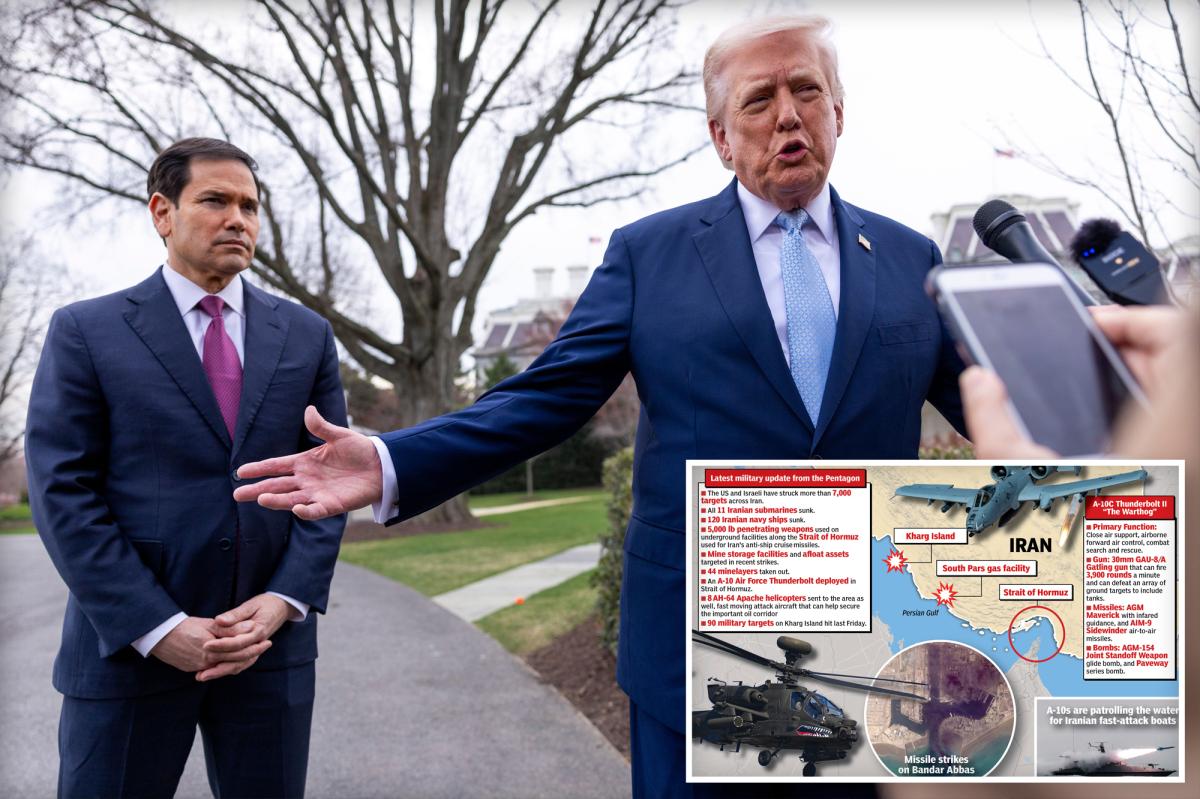
WASHINGTON — On Friday, President Trump dismissed the idea of a potential cease-fire with Iran, suggesting that the Strait of Hormuz might resolve the situation on its own.
Addressing reporters as he departed the White House, Trump remarked, “I’m not interested in a cease-fire. You don’t call for a cease-fire when you’re effectively overpowering the opposition.” His comments came in response to Pope Leo XIV’s appeal for a halt in hostilities.
Trump further explained, “Militarily, Iran is merely obstructing the Strait. But from a strategic standpoint, they’re already defeated.”
The closure of the Strait of Hormuz by Iran has led to a spike in oil prices over the past three weeks, with Tehran using this critical waterway as leverage against the United States and Israel.
Trump assured reporters that reopening the strait would be a “simple military maneuver,” but hinted that it might not be necessary to take any action.
“It’s fairly secure, but it requires substantial resources, such as ships and manpower,” he added, indicating the logistical needs for maintaining control of the passage.
“NATO could help us, but they, so far haven’t had the courage to do so. And others could help us,” Trump fumed.
“We don’t use it. You know, at a certain point, it’ll open itself.”
‘10 years to rebuild’
Trump contended that the damage in Iran is so severe that it will take a decade to rebuild the nation of 93 million people.
“I think I could leave right now and it would take them 10 years to rebuild … If we stay longer, they’ll never rebuild,” Trump told Stephanie Ruhle, an anchor at the outlet formerly called MSNBC.
Elsewhere in the Friday interview, the president reiterated that regime change was not the major goal of the US operation, insisting instead that “the major thing is that they cannot have a nuclear weapon.”
Trump didn’t say what would take so long to rebuild, but he likely meant Iran’s military capacity after sinking most — if not all — of the country’s navy while targeting facilities that produce ballistic missiles and suicide drones.
The fate of Iran’s roughly 972 pounds of 60% enriched uranium is unclear. The material can be enriched further relatively quickly for nuclear bombs.
Trump has said that he has avoided targeting Iran’s electrical grid and pipelines on Kharg Island, which loads about 90% of the country’s oil exports, because of how long it would take to rebuild — while leaving open the possibility.
More Marines deploy
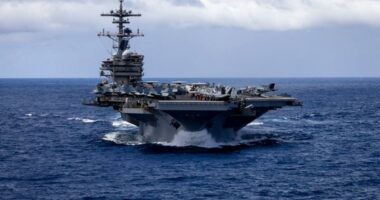
The Pentagon, meanwhile, is deploying another three-ship expeditionary unit — with about 2,500 Marines — to the Middle East.
The move is the second such dispatch in a matter of days.
The San Diego-based USS Boxer amphibious assault ship and two other ships comprising the 11th Marine Expeditionary Unit have set sail to the region – a voyage that will take weeks — the Wall Street Journal and Associated Press reported.
A different expeditionary unit of similar size is already en route, consisting of the Japan-based USS Tripoli, also an amphibious assault ship, and two supporting vessels.
The Tripoli was reported crossing the Strait of Malacca north of Singapore Wednesday and is expected to reach the waters near Iran by the end of March.
Trump has not ruled out ordering troops to storm Iran’s coast to secure the Strait of Hormuz or take Kharg Island.
The president’s prior naval deployments foreshadowed large-scale action, including his positioning of two aircraft carrier strike groups near Iran just before launching the joint US-Israeli war on Feb. 28.
Trump previously assembled an armada near Venezuela before ordering the Jan. 3 raid that captured the country’s president, Nicolas Maduro, to face US drug and weapons charges.
The Pentagon declined to comment on the latest deployment.