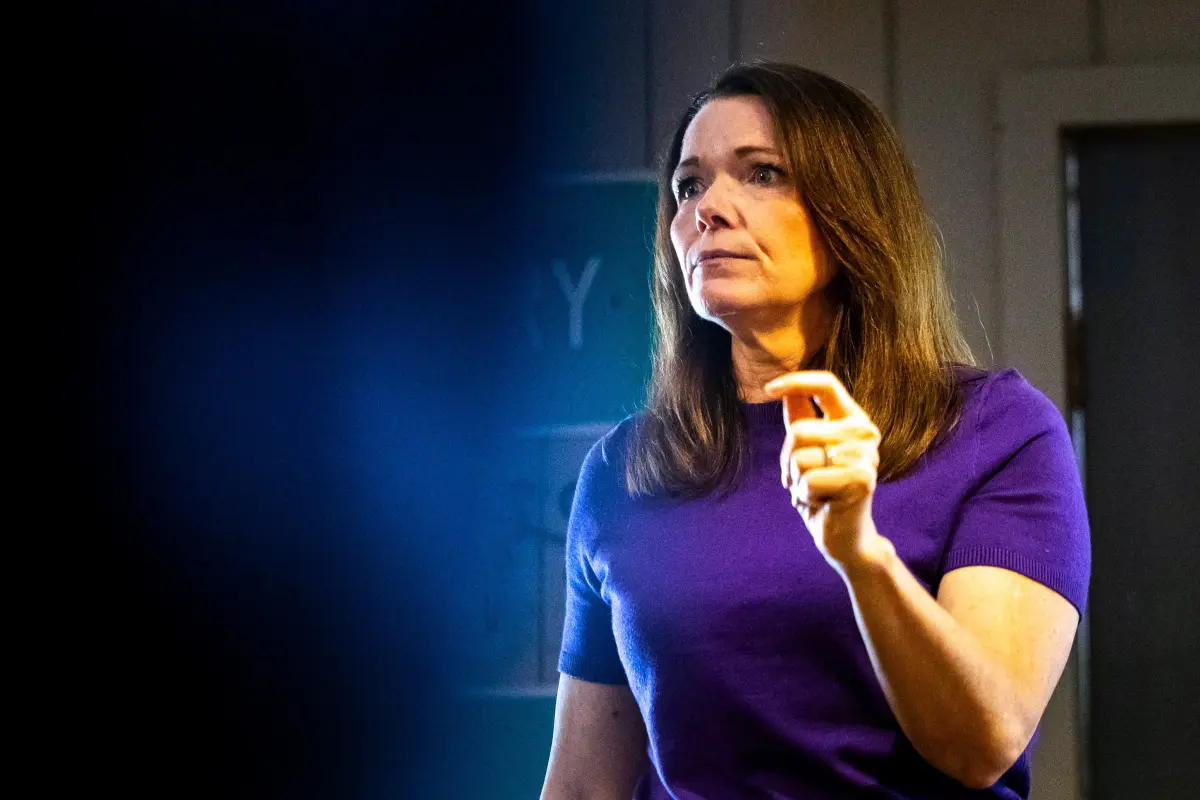
Christina Bohannan, an Iowa lawmaker and Democratic nominee in one of the nation’s most closely watched congressional districts, previously criticized an Iowa “Back the Blue” law enacted after the 2020 protests over George Floyd’s death, describing the measure as an “overreaction.”
“I think that we’re seeing a backlash and, frankly, an exaggerated backlash, an overreaction to all of that,” Bohannan said during a 2021 virtual legislative forum focused on social justice.
“That’s what’s happening. A lot of this is happening because they just don’t have a lot of minorities in their districts. They don’t interact with people on any kind of regular basis, and, so, they don’t see these issues.”
Critics say the resurfaced remarks reinforce their portrayal of Bohannan as soft on crime—a label they argue does not fit Iowa voters—as she mounts her third campaign against Rep. Mariannette Miller-Meeks, R-Iowa.
“Christina Bohannan achieved the ultra-rare final boss level of woke where police are bad, criminals are good and anyone who disagrees is racist,” Zach Kraft, a Republican National Committee spokesperson, said in a statement to Fox News Digital.
“There is a reason why this DEI queen has been rejected twice by voters. She is straight up nuts, and her soft-on-crime agenda would endanger all Iowans.”
Bohannan began her professional career in education, teaching at the University of Iowa College of Law. She stayed there until 2020, when she won a seat in the Iowa House of Representatives by defeating a Democratic incumbent who had served for 20 years.
Her congressional campaigns have come before.
Bohannan first challenged Miller-Meeks in 2022, losing 53.4% to 46.6%. She returned for a rematch in 2024 and narrowed the gap considerably, falling by less than a percentage point—50.0% to 49.8%—or 799 votes.
Across each of those contests, Republicans have highlighted Bohannan’s academic comments and her record in the state legislature while arguing that she would take an overly lenient approach to crime.
The video that recently resurfaced involved Senate File 342, which Gov. Kim Reynolds signed in 2021. The law increased penalties for rioting, elevating the offense to a class D felony punishable by up to five years in prison, and imposed tougher penalties for unlawful assembly.
The legislation followed a national surge in anti-police sentiment after George Floyd, a Black Minneapolis man, died when Officer Derek Chauvin pressed his knee against Floyd’s neck area during an arrest. Floyd’s death fueled a nationwide debate over police safety, accountability and racial profiling.
While states including Minnesota and Washington adopted restrictions affecting police and other law enforcement officers, Iowa lawmakers moved in the opposite direction, backing additional protections for officers and public safety.
Iowa Rep. Jarad Klein, the Republican sponsor of the bill, presented it as a direct show of support for law enforcement during a speech on the House floor.
“Let me be clear: If you support law enforcement, truly support law enforcement, you will be voting ‘yes’ tonight. If you stand up and say you support law enforcement, your words will become meaningless with a ‘no’ vote. Actions speak louder than words,” Klein said.
Reynolds made a similar argument when she signed the measure into law.
“I made it clear in my Condition of the State Address that Iowa’s law enforcement will always have my respect, and I will always have their back. Today’s bill embodies that commitment in a historic way. The public peace is too important, and the safety of our officers too precious to tolerate destructive behavior,” Reynolds said in a press release.
Bohannan, however, said she opposed the legislation because she believed its provisions went too far.
“The bill that’s coming over to the House from the Senate about the protestors actually would make it OK for a person to drive negligently or grossly negligently and hit a protester, and there would be immunity for that. It’s sick. These are kids, mostly,” she said.
The enacted law does include a provision shielding drivers from civil liability, but only when they are “exercising due care” and injure someone engaged in disorderly conduct by blocking traffic on a public street or highway.
Bohannan’s campaign did not respond to a request for comment from Fox News Digital on her statements from 2021 or whether she stood by her views of the Back the Blue bill.