
UK spy powers draw US scrutiny over alleged Apple encryption backdoor demand

U.K. surveillance laws have come under the spotlight following concerns raised by House Judiciary Committee Chairman Jim Jordan. On June 5, Jordan, a Republican from Ohio, voiced apprehensions over the potential exposure of communications belonging to U.S. officials and citizens, as reported by various sources.

The issue revolves around the U.K.’s application of secretive Technical Capability Notices under the Investigatory Powers Act. Critics argue these notices could compel U.S. companies to weaken their encryption protocols or insert “backdoors” into their systems. Such actions would be required without the companies being able to disclose these requests unless authorized by the U.K. government.

Opponents of the law warn that it could erode privacy, introduce security vulnerabilities, and restrict congressional oversight. A former intelligence official has even cautioned that this could serve as a “standing invitation to Beijing,” raising significant national security concerns.

Andrew Badger, a former Department of Defense official, expressed his concerns to a news agency, stating, “We have already seen how this ends.”

Representative Jim Jordan emphasized the Republican stance as being driven by “common sense,” contrasting it with what he described as the “crazy positions” of the Democrats. He highlighted the importance of addressing these privacy issues while also considering the national security implications.

“There are legitimate privacy concerns here, and those have been well aired. The less examined issue is national security,” Badger said.

“A backdoor compelled by one ally becomes a standing invitation to Beijing, Moscow and Tehran so once one government can quietly compel access, others will demand the same, and a one-off concession hardens into a permanent vulnerability,” he warned.

According to the Telegraph, a June 5 letter sent by Jordan to U.K. Home Secretary Shabana Mahmood, showed the Trump ally had called for a review.

The report said Mahmood’s decision had been to deny a U.S. company permission to speak with Congress about an alleged encryption backdoor notice.

Jordan was also said to have warned that a lack of bilateral coordination raised concerns about the “trust and effective partnership between our two countries.”

“Five Eyes works because every partner trusts the others not to weaken the systems they all depend on,” Badger, co-author of “The Great Heist: China’s Epic Campaign to Steal America’s Secrets,” said.

“If Washington also concludes that U.K. surveillance powers could inadvertently expose Americans and American officials to espionage, it puts real strain on the relationship and makes future cooperation on intelligence and cyber harder to sustain.”

The Thames House headquarters of MI5 in London on Nov. 18, 2025. Britain’s domestic security service has warned of growing state-backed threats, including more than 20 Iran-backed plots uncovered in the UK, as lawmakers consider new legislation targeting foreign state-linked groups. (Betty Laura Zapata/Bloomberg via Getty Images)

On the encryption issue, Badger noted that mainstream encrypted platforms now function as “de facto infrastructure for sensitive communication well beyond the consumer market.”

“Any access point built into them becomes a permanent target. It is not a private key the requesting government gets to keep to itself,” he said.

U.S. and British cyber officials have also repeatedly warned that an axis of hostile states — including Russia, China and Iran — poses threats to Western security and infrastructure.

As previously reported by News Agency, cyberespionage by groups such as Salt Typhoon, linked to China, has carried out operations targeting sensitive communications.

“China is actively running one of the largest state-backed cyberespionage operations ever uncovered. The Salt Typhoon campaign has targeted hundreds of organizations across roughly 80 countries and, through those intrusions, gained access to sensitive communications and networks used by senior Western officials,” Badger warned.

“Chinese state hackers didn’t defeat encryption. They walked straight through the lawful-intercept systems telecom providers had built, reaching the communications of senior officials and even information about surveillance targets.”

China- Surveiilance

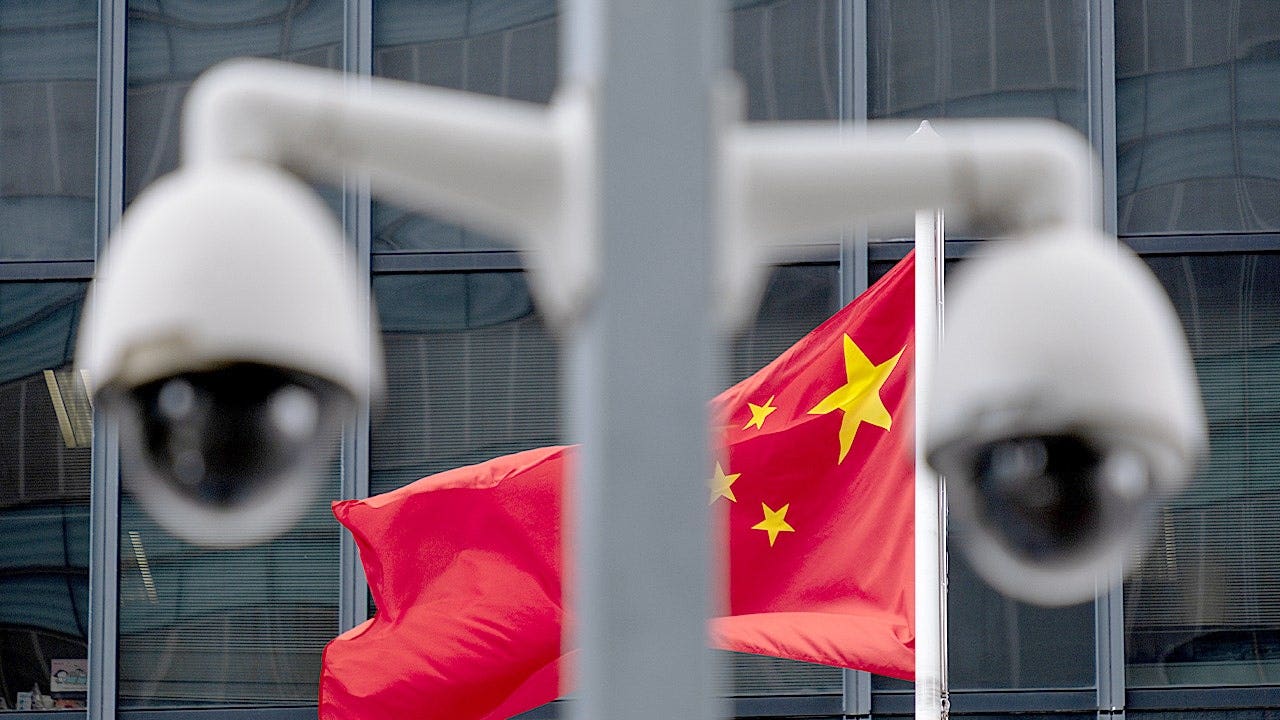
The flag of China is flown behind a pair of surveillance cameras outside the Central Government Offices. (Roy Liu/Bloomberg via Getty Images)

Reports also surfaced that U.K. Foreign Secretary Yvette Cooper used a burner phone during a recent trip to Beijing and raising further concerns about state-sponsored espionage.

Badger noted that the episode reflects a broader pattern of Chinese targeting of British democratic institutions, including the “hacking of senior Downing Street officials’ phones and an Electoral Commission breach that exposed the data of roughly 40 million voters,” he said.

“The telling thing is that no one issues burner phones for a trip to Sweden or Germany,” he said.

“The precaution is itself an admission of the threat environment. The working assumption — correctly — is that anything digital taken into China should be treated as potentially compromised.”

The systemic vulnerability also highlights a fundamental contradiction in Western diplomatic strategy, according to Badger.

“This case perfectly underscores the contradiction at the heart of the U.K. Labour government’s China policy: chasing positive economic relations and expanded trade with Beijing on one hand, while being forced to take elaborate precautions against a state whose core interests remain fundamentally at odds with its own on the other,” Badger said.

“You can’t simultaneously treat China as a trusted economic partner and a hostile intelligence threat. It’s a fundamental contradiction. The need to use burner phones symbolically underscore this.”

–>

Leave a Reply

Your email address will not be published. Required fields are marked *