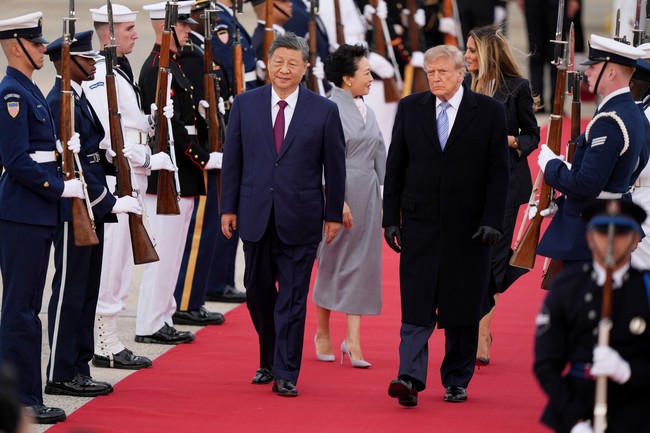
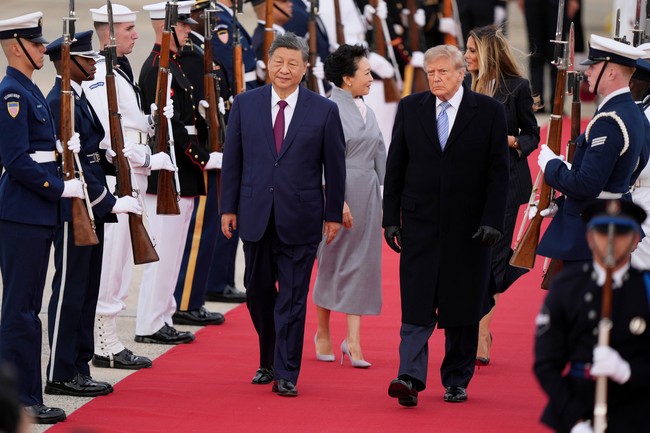
President Donald Trump has concluded another summit with Chinese leader Xi Jinping in Washington, leaving governments and commentators across the United States, Europe and Taiwan to assess what the meeting means.
The talks were bound to draw attention. They brought together the leaders of the world’s two most powerful nations for a high-stakes discussion of trade, security and geopolitics. Even so, much of the legacy media has sought to minimize the summit—and Trump’s broader China strategy.
The New York Times faulted the meeting for yielding “few tangible policy announcements on some of the most pressing issues of modern times.” The newspaper added that, “At least in public President Trump seemed more focused on playing host than challenging his geopolitical rival.”
The criticism marks a striking reversal. Not long ago, left-wing critics accused Trump of taking an excessively confrontational approach toward China. Now, they appear dissatisfied that he was not forceful enough.
The visit was undeniably ceremonial, but the limited number of concrete announcements reflects how deeply the U.S.-China relationship has shifted. That change is rooted in Beijing’s long record of misconduct—and in Trump’s decision to make China answer for it.
Xi’s visit produced few immediate policy breakthroughs. That outcome, however, is hardly surprising when the other party is a communist strategic rival with fundamentally different goals.
The record of Chinese actions against the United States is extensive. For years, Beijing has been accused of stealing intellectual property and conducting corporate espionage to accelerate its economic rise. It has also heavily subsidized Chinese multinational companies and used trade-dumping practices that violate World Trade Organization rules.
China has hacked hundreds of American businesses and government agencies, including in a recent cyberattack aimed at the U.S. power grid. The FBI has warned that Chinese hackers could potentially pose a threat to America’s nuclear weapons infrastructure. More recently, Beijing has supplied Iran with drone and missile components, helping extend Tehran’s conflict with the United States.
Taken together, those actions show a sustained effort to weaken American economic growth and national security—often in violation of international law and, at times, with direct consequences for Americans. That history, rather than Trump’s cordial public manner, explains why meaningful progress was so difficult during the summit.
Xi’s previous U.S. state dinner came in 2015, during Barack Obama’s presidency. At that event, Obama proposed a toast “to the people of China and the people of the United States,” expressing hope that the two countries would work together “like fingers on the same hand, in friendship and in peace.”
Yet around the same period, six of those same Chinese people were caught stealing trade secrets from American companies. The Obama administration did little to halt China’s expanding campaign to exploit its supposed “friend,” and the United States ultimately bore the cost.
READ MORE: Trump Draws Large Crowds at Nebraska Rally Amid Strong Support
Trump’s approach during Xi’s visit was therefore consistent with the strategy he has pursued elsewhere. If Washington wants Beijing to alter its behavior, cultivating a direct relationship with Chinese leadership can be useful—provided it is paired with firm opposition to policies that harm American interests.
That combination recalls Ronald Reagan’s dealings with the Soviet Union, when he negotiated with and hosted Mikhail Gorbachev while maintaining pressure on Moscow. Trump has taken a similar path with North Korea, engaging Kim Jong-un in an effort to temper the regime’s threats of catastrophic conflict.
The same logic applies to Xi. By hosting the Chinese leader—and even describing the United States and China as a G2—Trump is seeking a durable channel for diplomacy that could give Washington greater leverage through both soft and hard power.
Yet much of the media continues to portray that strategy as evidence of incompetence rather than calculation.
The summit also offered another revealing detail: the absence of Chinese CEOs. When Xi visited the Obama White House in 2015, he arrived with a delegation of business leaders eager to expand access to American markets. In 2026, those executives either stayed away or played only a minor role.
That development was not accidental. The Trump administration has long concluded that Chinese companies can serve as instruments of Communist Party policy, often in ways that undermine American economic and national-security interests.
Trump has responded with export restrictions on a range of American technologies and components bound for China, along with outright bans on certain Chinese companies. His administration has also invested in domestic industry as part of a broader effort to counter Beijing’s economic influence.
The administration has approved mergers involving American technology companies with the stated aim of helping them compete against globally prominent Chinese firms such as Huawei. Meanwhile, the Justice Department has put Huawei executives on trial in New York City.
If Chinese companies were largely missing from Washington last week, it may be because they understood that U.S. authorities are no longer overlooking their tactics. By that measure, their absence represents a consequence of Trump’s China policy—and potentially a sign that it is working.
It’s time to admit that America’s relationship with China has changed. The official summits may be less productive, but America is more competitive and secure as a result.


