
The bond market is sending a stark warning. The yield on the 30-year Treasury note climbed to 5.44% Wednesday, the highest level since 2004, before easing slightly Thursday morning. The 10-year Treasury yield, a key influence on mortgage rates, briefly approached 5.15% Thursday—a level not seen since 2001.
Yields had already risen as investors weighed persistent inflation and the expanding U.S. debt load. They moved even higher Wednesday after stronger-than-expected economic figures prompted traders to anticipate more interest-rate increases from the Federal Reserve. Several members of the central bank’s Federal Open Market Committee, which determines monetary policy, also indicated this week that they support additional hikes.
“Four burners, all on high”
Wall Street analysts said markets are also growing more uneasy about a potentially prolonged conflict in the Middle East. The U.S. and Iran traded fresh threats during this week’s United Nations General Assembly in New York. Economists warn that extended tensions could keep oil prices elevated, fuel inflation and intensify pressure on the Fed to raise its benchmark interest rate.
Adding to the bond market’s strain, demand was weak at Wednesday’s auction of five-year Treasury notes. To attract buyers, the U.S. government had to offer higher yields. Bond prices and yields move in opposite directions, and rising yields indicate that investors want greater compensation as they view the market as increasingly risky.
“When the world’s largest borrower has to raise its price to find buyers, you MUST pay attention,” Mark Malek, chief investment officer at Siebert Financial, said in an email. “Yields don’t only rise because the Fed says so. They rise when lenders demand more to lend—and every mortgage, corporate bond and small-business loan in America is ultimately priced off that same benchmark.”
“Growth, oil, a hawkish Fed and reluctant buyers. Four burners, all on high, all at once,” Malek added.
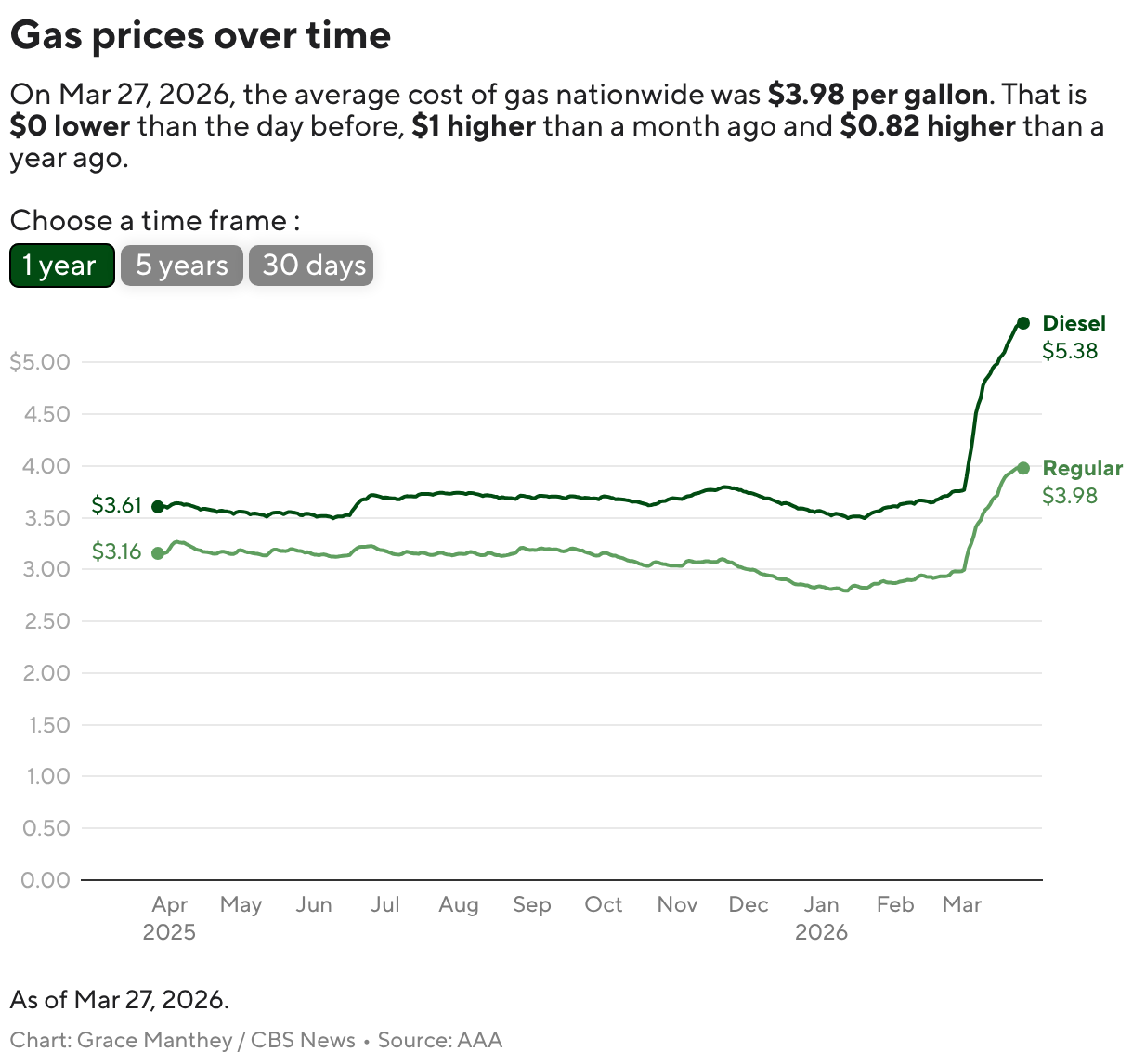
Investors are also preparing for inflation to accelerate after U.S. diesel prices reached a record $6.53 per gallon Tuesday. Diesel powers much of the agriculture, trucking and construction industries, and economists say a sustained surge could spread through the broader economy, raising the cost of food and other retail goods that must be transported to stores.
Earlier this month, the Federal Reserve raised interest rates for the first time since 2023. Chairman Kevin Warsh emphasized the central bank’s aim of bringing inflation closer to its 2% annual target. Inflation had been nearing 2% at the beginning of the year but reignited after the Iran war pushed global oil prices higher. The Consumer Price Index was up 3.4% on an annual basis in August.
Getting consumer-price growth back to the Fed’s preferred 2% pace could take years. Earlier this month, FOMC members projected that inflation might not return to that level until 2029. Their median forecasts also show inflation potentially rising to 3.7% in the fourth quarter.
“The jump in bond yields this week is driven by inflation and the belief that it’s going to take a lot more Fed rate hikes to curb it,” Heather Long, chief economist at Navy Federal Credit Union, said in an email.
Interest-rate futures traders see a 70% probability of a quarter-point increase at the Fed’s October meeting, according to CME FedWatch. They assign a 56% chance to another hike in December. The FOMC does not hold a rate-setting meeting in November.
If both increases occur, the Fed’s benchmark rate would rise to between 4.25% and 4.5%—roughly 0.75 percentage points above its level at the start of September. Some analysts also anticipate another rate increase in 2027.
Economy heating up
The bond market came under fresh pressure Wednesday when purchasing managers’ data showed that U.S. business activity was expanding at its fastest pace in years. The report also indicated that costs facing companies were climbing rapidly.
A government report released Thursday showed that fewer Americans filed for unemployment benefits last week, providing another sign of economic strength. A hotter economy can intensify inflation, while a resilient labor market gives the Fed more room to increase borrowing costs.
The Fed generally raises interest rates to slow inflation and cool economic activity. Higher borrowing costs can reduce household spending and business investment, which in turn moderates growth.
When unemployment rises sharply, the Fed may instead cut rates to encourage spending and make it less expensive for companies to borrow and hire. But recent signs of stronger growth and steady job creation could give policymakers reason to keep raising rates, experts said.
“The biggest market risk right now may not be weak growth but excessive heat,” Malek said. “Strong economic activity is welcome, but it makes the Fed’s inflation problem considerably harder.”
What does it mean for your money?
Rising interest rates make homes, cars, credit-card balances and other forms of debt more expensive. The average 30-year mortgage rate surpassed 7% this week, reaching its highest point in nearly two years.
“On Main Street, this is yet another part of the affordability crunch,” Long said.
Savers could see a modest benefit if the Fed raises rates again. Banks generally increase the interest paid on savings accounts and certificates of deposit when the central bank lifts its benchmark, although the size of those increases varies. Some savings accounts now offer annual percentage yields above 4%.
Higher yields also make newly issued bonds and short-term Treasuries more attractive to investors, while putting pressure on stocks, experts noted. But that can put pressure on the equity market if investors shift money away from stocks.
“Cash and short-term Treasuries have become legitimate portfolio competitors again,” Malek said. “When investors can earn close to 5% without taking equity risk, every risky asset must clear a much higher hurdle.”
Alain Sherter
contributed to this report.