

KLAMATH RIVER, Calif. (AP) — As a child, Barry McCovey Jr. often slipped through fences and evaded security guards just to fish for steelhead trout in Blue Creek, surrounded by the redwoods of northwestern California.
For countless generations, his ancestors from the Yurok Tribe had depended on this natural watershed for fishing, hunting, and gathering, bordered by coastal forests. However, over the past century, timber companies took control of these lands, cutting off the tribe from their ancestral territory.
When McCovey started working as a fisheries technician, the company would let him go there to do his job.
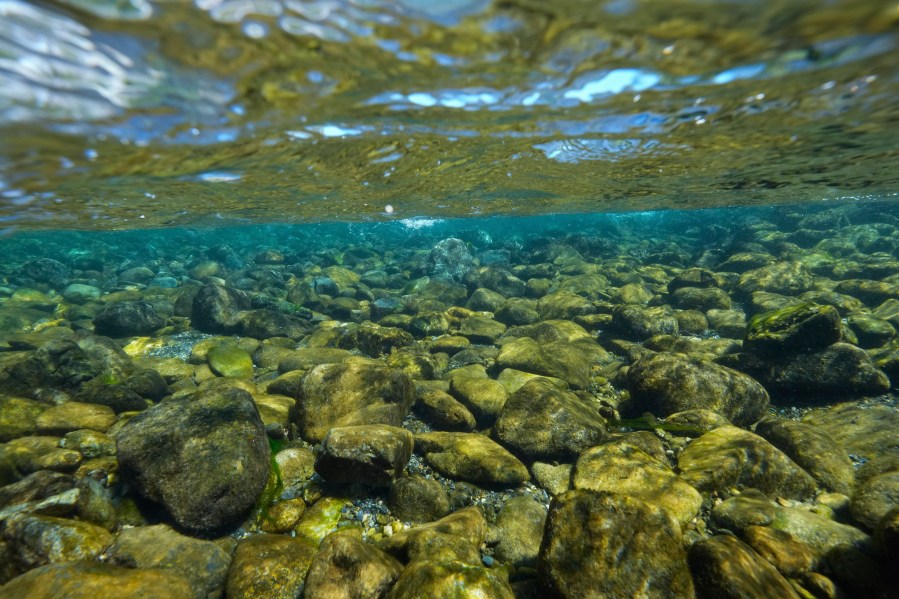
“While exploring Blue Creek with a snorkel, I realized how crucial this place was for me and our people, and I understood then that we needed to do whatever it took to reclaim it,” McCovey said.
After a 23-year effort and $56 million, that became reality.
Roughly 73 square miles (189 square kilometers) of homelands have been returned to the Yurok, more than doubling the tribe’s land holdings, according to a deal announced Thursday. Completion of the land-back conservation deal along the lower Klamath River — a partnership with Western Rivers Conservancy and other environmental groups — is being called the largest in California history.
The Yurok Tribe had 90% of its territory taken during the California Gold Rush in the mid-1800s, suffering massacres and disease from settlers.
“To go from when I was a kid and 20 years ago even, from being afraid to go out there to having it be back in tribal hands … is incredible,” said McCovey, director of the Yurok Tribal Fisheries Department.
___
EDITOR’S NOTE: This is part of a series of on how tribes and Indigenous communities are coping with and combating climate change.
___
Land Back is a global movement seeking the return of homelands to Indigenous people through ownership or co-stewardship.
In the last decade, nearly 4,700 square miles (12,173 square kilometers) were returned to tribes in 15 states through a federal program. Organizations are aiding similar efforts.
There’s mounting recognition that Indigenous people’s traditional knowledge is critical to addressing climate change. Studies found the healthiest, most biodiverse and resilient forests are on protected native lands where Indigenous people remained stewards.
Beth Rose Middleton Manning, a University of California, Davis professor of Native American Studies, said Indigenous people’s perspective — living in relation with the lands, waterways and wildlife — is becoming widely recognized, and is a stark contrast to Western views.
“Management of a forest to grow conifers for sale is very different from thinking about the ecosystem and the different plants and animals and people as part of it and how we all play a role,” she said.
The Yurok people will now manage these lands and waterways. The tribe’s plans include reintroducing fire as a forest management tool, clearing lands for prairie restoration, removing invasive species and planting trees while providing work for some of the tribe’s more than 5,000 members and helping restore salmon and wildlife.
Protecting a salmon sanctuary
One fall morning in heavy fog, a motorboat roared down the turbid Klamath toward Blue Creek — the crown jewel of these lands — past towering redwoods, and cottonwoods, willows, alders. Suddenly, gray gave way to blue sky, where an osprey and bald eagle soared. Along a bank, a black bear scrambled over rocks.
The place is home to imperiled marbled murrelets, northern spotted owls and Humboldt martens, as well as elk, deer and mountain lions.
The Klamath River basin supports fish — steelhead, coho and Chinook salmon — that live in both fresh and saltwater. The Klamath was once the West Coast’s third largest salmon-producing river and the life force of Indigenous people. But the state’s salmon stock has plummeted so dramatically — in part from dams and diversions — that fishing was banned for the third consecutive year.
“We can’t have commercial fishing because populations are so low,” said Tiana Williams-Claussen, director of the Yurok Tribe Wildlife Department. “Our people would use the revenue to feed their families; now there’s less than one salmon per Yurok Tribe member.”
Experts say restoring Blue Creek complements the successful, decades-long fight by tribes to remove the Klamath dams — the largest dam removal in U.S. history.
This watershed is a cold-water lifeline in the lower Klamath for spawning salmon and steelhead that stop to cool down before swimming upstream. That’s key amid climate-infused droughts and warming waters.
“For the major river to have its most critical and cold-water tributary … just doing its job is critical to the entire ecosystem,” said Sue Doroff, co-founder and former president of Western Rivers Conservancy.
Altered lands, waterways
For more than 100 years, these lands were owned and managed for industrial timber.
Patchworks of 15 to 20 acres (6.07 to 8.09 hectares) at a time of redwoods and Douglas firs have been clear cut to produce and sell logs domestically, according to Galen Schuler, a vice president at Green Diamond Resource Company, the previous land owner.
Schuler said the forests have been sustainably managed, with no more than 2% cut annually, and that old growth is spared. He said they are “maybe on the third round” of clear cutting since the 1850s.
But clear cutting creates sediment that winds up in streams, making them shallower, more prone to warming and worsening water quality, according to Josh Kling, conservation director for the conservancy. Sediment, including from roads, can also smother salmon eggs and kill small fish.
Culverts, common on Western logging roads, have also been an issue here. Most “were undersized relative to what a fish needs for passage,” Kling said.
Land management decisions for commercial timber have also created some dense forests of small trees, making them wildfire prone and water thirsty, according to Williams-Claussen.
“I know a lot of people would look at the forested hillsides around here and be like, ‘It’s beautiful, it’s forested.’ But see that old growth on the hill, like way up there?” asked Sarah Beesley, fisheries biologist for the Yurok Tribe, sitting on a rock in Blue Creek. “There’s like one or two of those.”
Fire bans, invasive plants and encroachment of unmanaged native species have contributed to loss of prairies, historically home to abundant elk and deer herds and where the Yurok gathered plants for cultural and medicinal uses.
Western Rivers Conservancy bought and conveyed land to the tribe in phases. The $56 million for the conservation deal came from private capital, low interest loans, tax credits, public grants and carbon credit sales that will continue to support restoration.
Restoration plans
The tribe aims to restore historic prairies by removing invasive species and encroaching native vegetation. The prairies are important food sources for elk and the mardon skipper butterfly, said Kling from the conservancy.
Trees removed from prairies will be used as logjams for creeks to create habitat for frogs, fish and turtles.
The tribe will reintroduce fire to aid in prairie restoration and reestablish forest diversity and mature forests to help imperiled species bounce back.
Members know its going to take decades of work for these lands and waterways to heal.
“And maybe all that’s not going to be done in my lifetime,” said McCovey, the fisheries director. “But that’s fine, because I’m not doing doing this for myself.”
___
The Associated Press receives support from the Walton Family Foundation for coverage of water and environmental policy. The AP is solely responsible for all content. For all of AP’s environmental coverage, visit