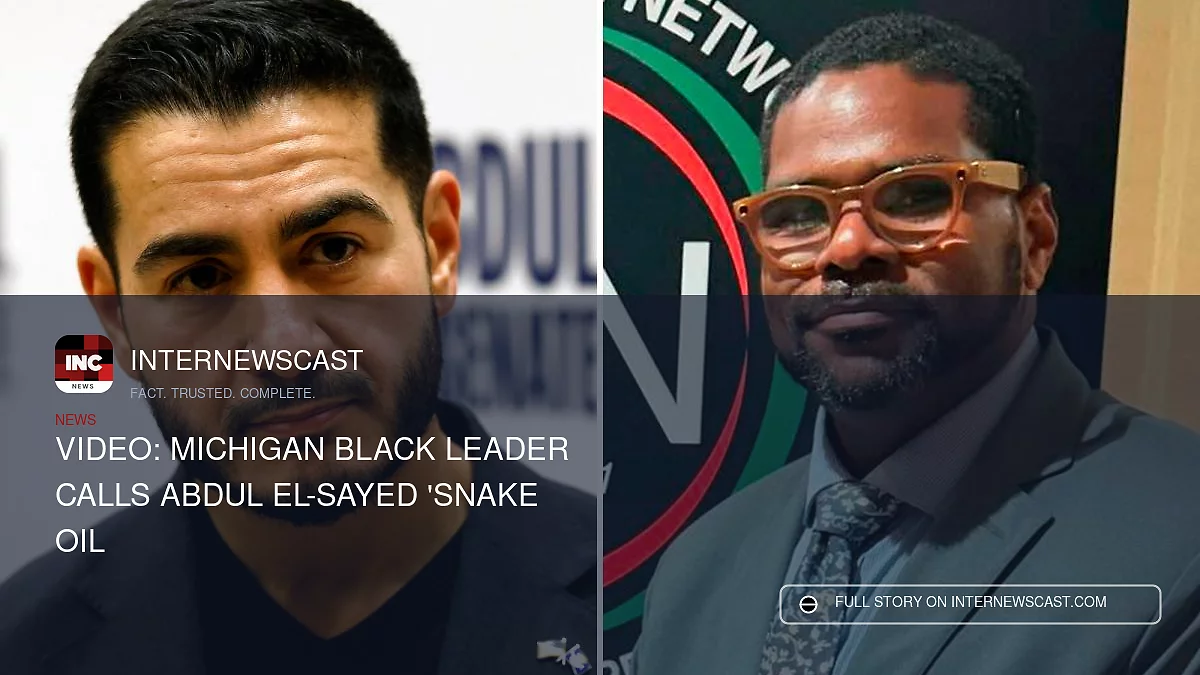

A Black Michigan leader known as Al Sharpton’s “little brother in the movement” is refusing to back Democratic Senate candidate Abdul El-Sayed, calling him an unreliable “snake oil” salesman and saying some members of the community hold him in “flat-out disdain.”
Charles E. Williams II, president of Sharpton’s Michigan chapter of the National Action Network, questioned El-Sayed’s cultural credibility in undercover footage obtained by The Midwesterner. His comments highlight the challenge facing some Black leaders who are wary of El-Sayed but feel pressure to support Democratic candidates.
“You can’t tug at people’s heartstrings by promising them pie in the sky. That’s not realistic,” Williams said in footage recorded outside a meeting at his historic King Solomon Missionary Baptist Church last Saturday.
Williams criticized El-Sayed’s promises of Medicare for All and campaign-finance reform, arguing that the candidate would lack the political power to make those proposals law.
“You don’t have a majority. You don’t control the executive branch. You can write legislation and send it to Donald Trump, but is he going to sign it? No,” Williams said.
He later accused “Democratic Socialists and super progressives” of making promises they could not deliver, describing their message as “snake oil” and “wolf tickets.”
Williams acknowledged that he hoped El-Sayed would lose the Democratic primary.
“I’ve tried to remain cordial with the party and not appear completely disconnected from it, but I’m not happy,” Williams said. “I supported the white lady over him,” a reference to El-Sayed’s primary opponent, Haley Stevens.
Williams also cited a personal dispute with El-Sayed, saying the candidate had told him one thing and then acted differently. He described that experience as part of a broader cultural concern he said he had encountered before.
During the meeting at his West Side Detroit church, Williams said Black voters were, at best, hesitant about El-Sayed but could face criticism if they chose a Republican candidate.
“There is hesitation, skepticism and outright disdain for the Democratic Party’s Senate candidate,” Williams said.
He also claimed that concerns about the Arab community’s treatment of Detroit residents were not limited to Black voters, making broader allegations during his discussion with get-out-the-vote volunteers.
“It’s unfortunate that Abdul gets caught up in all of this, but it’s a difficult situation,” Williams said.
IN CASE YOU MISSED IT: 82-Year-Old Runner Prepares for Milestone 50th New York City Marathon
Williams said he was encouraging people to vote but would not tell them to support Republicans. Several people in the room responded with “amens.”
“If they do, that’s their choice,” he said, repeating that voters should make their own decision.
Williams said the community could not afford to jeopardize the rest of the Democratic ticket because of disagreements over one race, urging voters to cast their ballots according to their own convictions.
That tension was visible Thursday when El-Sayed spoke at Historic Second Baptist Church in Benton Harbor.
The audience at the event was overwhelmingly white, despite the surrounding neighborhood being 82% Black, according to the latest census data.
“The crowd looks a little different,” journalist David Weigel wrote on X.
Sharpton traveled to Detroit Tuesday to meet with Williams and support get-out-the-vote efforts, but he stopped short of endorsing El-Sayed.
“This isn’t about whether we’re Democrats or Republicans. It’s about supporting whoever is best for us,” Sharpton told Black voters during the Detroit rally.
Contacted by phone, Sharpton declined to discuss El-Sayed and said only that he was in Michigan to encourage Black residents to exercise their right to vote.
“They should go out and vote and should not hesitate,” Sharpton told The Post, declining to address concerns about El-Sayed among Black voters while emphasizing that his organization’s efforts were nonpartisan.
El-Sayed has faced persistent difficulty winning over Black voters during the campaign, along with criticism that he has not sufficiently engaged with the community or addressed its priorities. His attempts to connect with the key Democratic voting bloc, including an awkward visit to a Grand Rapids barbershop, have also drawn unfavorable attention.
A Washington Post–Schar School poll conducted in September found a 16-point difference between overall Democratic support and El-Sayed’s support among Black voters in Michigan.
Williams and El-Sayed’s campaign did not respond to The Post’s requests for comment.


