
A volcanic eruption in Indonesia has thrown air travel into chaos, leaving huge crowds of passengers stuck after mass flight cancellations across the country.
Flight operations were halted at eight Indonesian airports on Sunday as thick volcanic ash from Mount Anak Krakatau drifted into the skies, disrupting routes and raising safety concerns.
At Jakarta’s main gateway, Soekarno-Hatta International Airport, officials grounded all aircraft until at least 11.59pm local time (16.59 GMT), according to a notice shared by the airport on Instagram. The shutdown left hundreds of travellers waiting inside the terminal as departure boards filled with cancellations.
The grounding order was extended multiple times during the day and affected 964 flights at Soekarno-Hatta alone, Indonesia’s transportation ministry said.
Across all eight affected airports, the disruption climbed to more than 1,500 flights, with around 170,000 passengers impacted, the ministry added.
Several major carriers, including Singapore Airlines, Malaysia Airlines, AirAsia and Lion Air Group, confirmed they had cancelled flights to and from Jakarta for the remainder of the day.

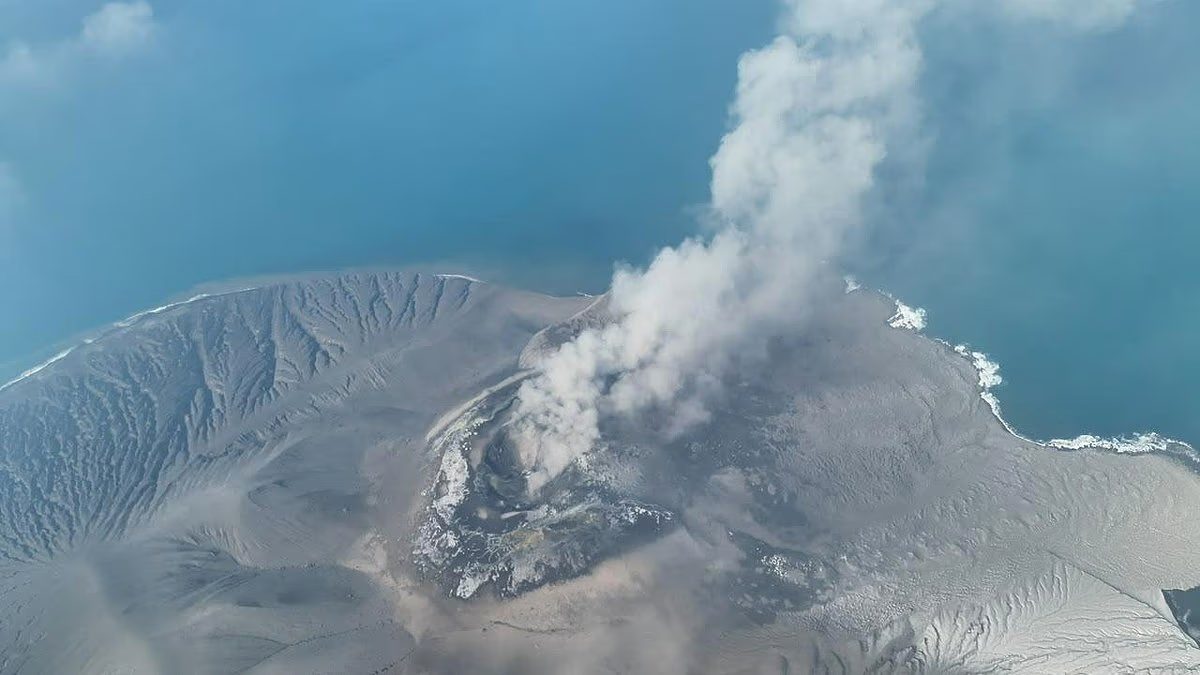
Indonesia’s Mount Anak Krakatau sends a towering plume of volcanic smoke into the sky in a drone image released by the country’s Ministry of Energy and Mineral Resources

Travellers wait in the check-in area at Soekarno-Hatta International Airport in Indonesia after flights were cancelled following the eruption of Mount Anak Krakatau
Anak Krakatau is a volcanic islnd that first emerged from the caldera formed by the 1883 explosion that destroyed the island of Krakatau.
Situated roughly halfway between Java and Sumatra in Indonesia’s vast island chain, it has been erupting since late on Friday, with volcanic ash detected at the airport early on Sunday, the transport ministry said.
Ash reached as high as 20,000 feet on the Java side of the volcano and 50,000 feet on the Sumatra side and some parts of Banten province in Java, meteorological agency BMKG posted on its website.
Ersy Laksita Rini, 55, was upset when she arrived at Soekarno-Hatta International and learned that her 8 am flight to Surabaya had been cancelled. She said the airline had not informed her ahead of time.
‘If the eruption happened last night and there were predictions of flight cancellations, we should have been notified from the start,’ she said.
‘That way, passengers wouldn’t have needed to come here so early and could have looked for alternatives instead.’
French national Eloan Tasset, 21, got a text from Batik Air that his flight to his holiday destination of Manado in North Sulawesi had been delayed, but he said it was unclear how long the delay would be.
‘If they tell me my flight is cancelled, I think I’m going to try to find a hotel in Jakarta,’ he said.
The airport operator said it was providing food and light refreshments for affected passengers and buses to hotels, in coordination with the airlines.
The disaster mitigation agency BNPB said it would conduct a weather modification operation, which could include cloud-seeding, on Sunday to promote rain.
‘If it rains heavily enough, the volcanic ash that has been disrupting our daily lives since yesterday and continuing today will be washed away quickly,’ BNPB chief Suharyanto told a press conference.
The transport ministry named three other airports across Java – Kertajati, Ahmad Yani and Juanda – as alternatives, ‘should airlines or operators be able to divert their flights’, minister Dudy Purwagandhi said.

Airplanes are parked on the tarmac as flights are cancelled at the Soekarno-Hatta International Airport on the outskirts of Jakarta, Indonesia following the volcanic eruption
BNPB spokesperson Berton Panjaitan said the agency ‘urges the public to remain calm while increasing vigilance. In the event of ashfall, people are advised to wear masks and eye protection, reduce outdoor activities, cover water sources and exercise caution when driving, as volcanic ash can reduce visibility.’
Ferries in the Sunda Strait were operating normally, the transport ministry said, urging vessels to stay at least 3 km (2 miles) away from Anak Krakatau’s crater and remain vigilant for volcanic hazards, including volcanic ash and other ejected materials.
Several schools cancelled activities on Saturday after students and residents suffered eye irritations from the ash, while fishermen cancelled fishing trips, local media outlet Kompas reported.
Police distributed masks to motorists in Cianjur, West Java, some 200 km (130 miles) from Anak Krakatau, the state news agency Antara reported, while the disaster management agency reported volcanic ash in the city, urging residents to stay indoors.
Governors of Lampung and Jakarta have ordered remote learning starting Monday to prevent health risks for students caused by volcanic ash, state news agency Antara said.
Some 850 km (530 miles) away from Anak Krakatau, Mount Semeru in East Java also erupted on Sunday, sending an ash column 1 km (3,300 feet) above the summit, said volcano monitoring agency PVMBG.
It advised residents to stay at least 5 km (3 miles) away from the crater and warned of the risk of hot ash clouds and lava flows up to 17 km (10 miles) from the summit.
Indonesia sits on the Pacific ‘Ring of Fire’, where earthquakes and volcanic eruptions are frequent. Anak Krakatau has been on alert level 3, the second-highest, since July 2.
Semeru was also on level 3, as were three other volcanoes: Merapi, Lewotobi Laki-laki and Sinabung.
The disaster mitigation agency said there was no imminent risk of tsunami from the volcano. A tsunami in 2018 caused by Anak Krakatau eruptions killed more than 400 on Java and Sumatra.
Anak Krakatau, which means child of Krakatau, began emerging a century ago from the area previously occupied by Krakatau, then known as Krakatoa. The older volcano destroyed itself in mass eruptions in 1883, which killed more than 36,000 people in a series of tsunamis.