While researching my 2014 biography Napoleon The Great, I worked through a vast collection of contemporary accounts and historical records.
However, I had not yet been able to consult the complete 15-volume archive of more than 40,000 letters written by the emperor. The collection, assembled by France’s Fondation Napoleon, was finally completed in 2018.
I have now read it in full, and the letters reveal a dimension of Napoleon’s character that I had previously underestimated. He could inspire ordinary soldiers with remarkable power, yet he treated the 26 senior commanders around him—the marshals of the empire—with extraordinary interference and suspicion. In modern terms, Napoleon was an extreme micromanager: a truly unbearable boss.
His attention extended to the smallest and most ridiculous details. He issued instructions about when particular troops should receive new eagle buttons for their uniforms, questioned whether an aide was entitled to wear the Legion d’Honneur ribbon and even ordered that windows be opened in a specific military hospital in Germany.
Ultimately, I believe this relentless interference contributed to Napoleon’s defeat at Waterloo in 1815. By then, many of his marshals—highly capable commanders in their own right—had become increasingly unwilling to serve under him.
The Duke of Wellington summed up Napoleon’s intrusive nature with a memorable observation: “Nothing was too great or too small for his proboscis.”
So, if you believe your own employer is difficult, spare a thought for the men forced to work beneath the authority of this power-obsessed Corsican.
Several of Napoleon’s marshals, who are the focus of my new book, were already famous figures in France when they received their appointments.

After his defeat at Waterloo, Napoleon was exiled to the remote South Atlantic island of St Helena

Historian Andrew Roberts argues that Napoleon’s obsessive micromanagement played a role in his defeat at Waterloo in 1815
Among them was Michel Ney, who would later take charge of the French rearguard during the disastrous retreat from Moscow.
Of the 600,000 French soldiers who entered Russia, barely 100,000 made it home. Those survivors crossed the frozen landscape westward, weakened by hunger and disease, battered by blizzards and attacked by Cossacks. Ney led from the front, fighting his way through Russian forces with sword and pistol.
Nicolas Oudinot displayed similar fearlessness. During his military career, he was wounded 32 times by musket fire, lances, grapeshot, bayonets and sabres.
Louis-Alexandre Berthier, meanwhile, may have been the finest chief of staff in military history. He could organise immense armies for battle at astonishing speed—and tolerate almost limitless humiliation from Napoleon.
From March 1796 to December 1797, Napoleon sent Berthier 457 letters. That was more correspondence than he exchanged with his wife, Josephine, prompting the troops to nickname Berthier “the Emperor’s Wife”.
Even the most insignificant matters fell within Napoleon’s remit. In one especially fussy order, he instructed Berthier to have “the staircase of one of the barracks on the main square of [the Corsican capital of] Ajaccio be adapted”.
When Berthier permitted his younger brother to take leave and return to France for the birth of his child, Napoleon reacted furiously. “I do not want to see him and I will not receive him,” he declared of his marshal. “I regard a general who leaves his troops as dishonoured… My wife could have died in Munich or Strasbourg, that would not have disturbed for a quarter of an hour the execution of my plans.”
Join the discussion
Can a leader ever justify destroying morale and trust in the pursuit of complete control?

In his new book Napoleon And His Marshals: Victory, Rivalry, Betrayal, Roberts explores how Napoleon’s rivals helped propel him to power before contributing to his eventual downfall
Another of the emperor’s management techniques was the doctrine of divide and rule. ‘You see,’ Napoleon told Tsar Alexander I of Russia in 1807, ‘I am careful to keep my generals at variance among themselves, in order that each may reveal to me the faults of the other.
YOU MAY ALSO READ: Proposed LNG Plant Could Cost Taxpayers €85 Million Even If Never Built
‘I keep around me a continual jealousy… One day, one thinks himself the favourite, the next day another – so that no one is ever certain of my favour.’
This approach might have been intended to create a team of rivals but instead it created a nest of vipers.
The result was that whenever the emperor was not personally present during a campaign, the marshals fell out with each other, often spectacularly.
There were at least four occasions when marshals drew swords during arguments or challenged each other to duels.
Their lust for glory encouraged them to start battles earlier than agreed, and during the Peninsular War in Portugal and Spain between 1807 and 1814, they point-blank refused to co-operate. Given the agonies their boss put them through, you have to ask why they put up with it all.
The answer is simple: wealth, fame and status. The marshals were immensely glamorous figures in French society, their exploits recorded in bulletins and proclamations that spread their fame nationwide.
They wore impossibly grand uniforms, with gold braid, red silk sashes, huge brocaded collars that came up to their ears and heavily plumed bicorn hats. Several had love lives that rivalled the Rolling Stones on tour in the 1960s.

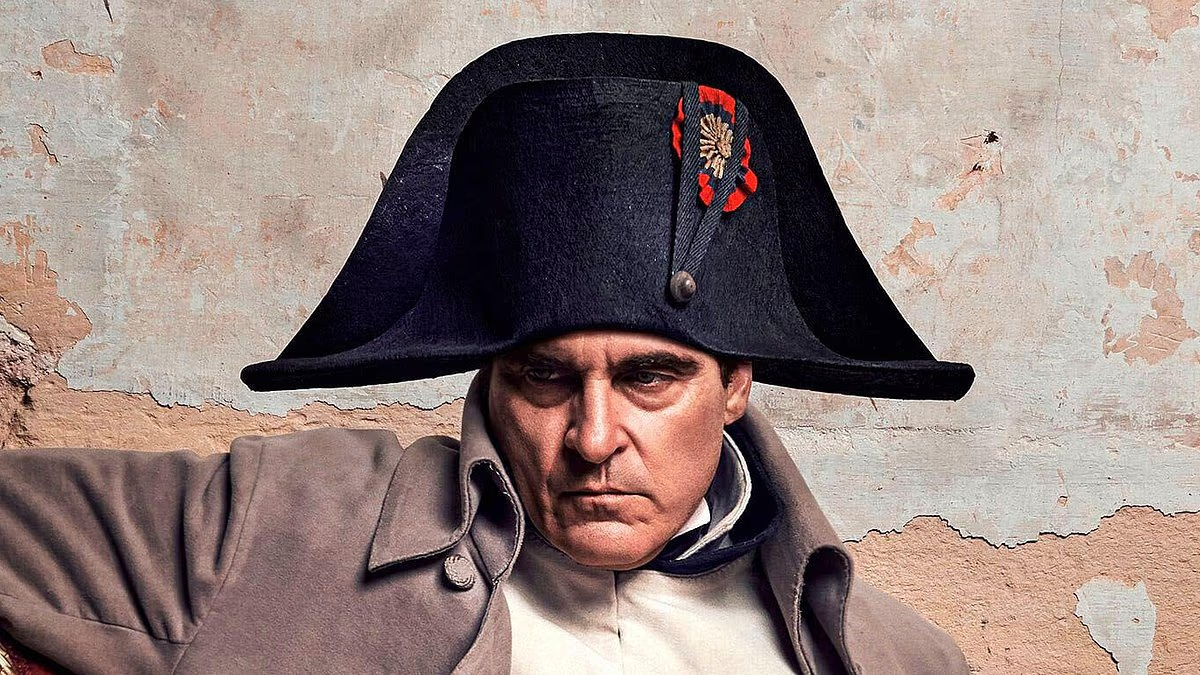
Joaquin Phoenix played the French emperor in the 2023 film Napoleon
Yet despite Napoleon loading his marshals with grand titles – six became dukes – and vast country estates and beautiful Parisian townhouses, as well as millions of francs in hard cash, only two of the 26 rode with him onto the battlefield of Waterloo on June 18, 1815.
Four had died by then – from cannonballs, drowning and a fall from a high window – but what of the other 20?
Yes, many would have been put off by the fact that Napoleon had by then spent ten months in exile on the small Mediterranean island of Elba after being defeated by a coalition of European forces.
But within weeks of returning to mainland France, he had once again raised a vast army. So why were so few marshals ready to rally to his flag?
I came to the conclusion that they had simply had enough of a man who was undoubtedly a genius but was also an exhausting individual for whom to work.
The phrases ‘express my dissatisfaction’, ‘convey my disappointment’ and ‘please convey my extreme displeasure’ pepper Napoleon’s correspondence with Berthier, for example, who received more than 5,000 letters in all.
There was something almost pathological about the way that Napoleon expected these men to accept criticism without resentment.
He said of one marshal: ‘When he does something well, I will not say anything; when he does something that displeases me, I will tell him. That is my way of doing things.’
This might have been true – but it was a terrible leadership technique. And there is a lesson there for anyone managing people, from employing a builder to running a business.
In the end, of course, Napoleon paid the ultimate price for his terrible management style: defeat at Waterloo and exile by the British to St Helena, the grim South Atlantic island.
If only he had mastered the art of managing people better – who knows, he might have conquered the entire continent of Europe and our history might have been very different.
Napoleon And His Marshals: Victory, Rivalry, Betrayal by Andrew Roberts, published by Allen Lane, is out on October 8


