
A shark expert has voiced surprise after a woman was bitten while swimming between the flags at one of Sydney’s most popular beaches.
The swimmer, believed to be in her 30s, suffered serious injuries to her arm and leg at Coogee Beach in the city’s eastern suburbs shortly before 11.15am on Saturday.
Bystanders helped pull the woman from the water before police began administering first aid. Paramedics arrived a short time later to continue treatment.
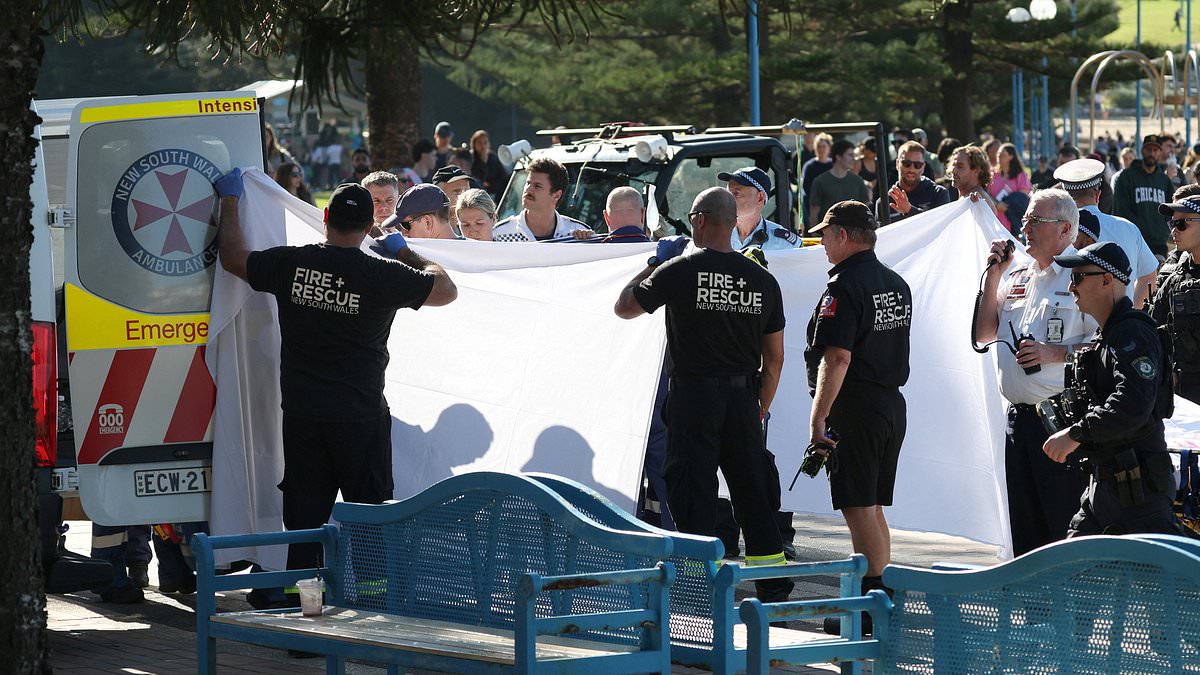
Images from the scene show emergency crews holding up a white sheet as the woman was treated inside an ambulance near the shoreline.
Dr Daryl McPhee, a shark expert and associate professor of environmental science at Bond University, said the animal involved may have been a great white shark.
“We’re unsure at this stage, but given the time of year and the location, it is most likely a white shark,” he told Daily Mail.
‘As the water cools around the Sydney region, you expect to see less bull sharks and more white sharks.’
Dr McPhee said shark bites do occur at this time of year but was alarmed by reports that the incident had occurred in the more shallow water between swimming flags.
‘There’s one thing that’s out of character, which was that it occurred between the flags,’ he said.
‘That’s an area where there’s normally a lot more people, there’s a lot more eyes on the water, there’s surf lifesavers.’
A young woman is in a critical condition after she was bitten by a shark at Coogee Beach
Members of the public pulled the woman from the water with police performing first aid
Photos from the scene show a white sheet held up by emergency responders as the woman was treated in an ambulance near the water’s edge
The nearby Coogee Oval was cleared to allow a CareFlight helicopter to land.
Randwick City Council has closed all nearby beaches, including Coogee, Clovelly and Bronte.
A witness said the swimmer had been doing laps not far from the shore when screams were heard and ‘a lot of blood’ was seen in the water.
‘A lifeguard on a surfboard rushed over to attend when screams were heard. I saw the shark’s fins,’ she told news.com.au.
‘A swimmer was doing laps not far from shore. The lifeguard made an X symbol with his arms and the shark alarm sounded’.
Locals are seen crowding at the water’s edge after a shark attack at Coogee Beach
Shark expert Dr Daryl McPhee (pictured) suggested the shark may have been a Great White
Shark nets, which are about 150metres long, 60cm wide and run six metres deep were removed from beaches in the electorate on April 30.
They will be reinstalled by the council in September 1.
But Dr McPhee warned that one shark bite incident does not directly correlate to moving the nets.
‘Shark nets are highly contentious, with questions on whether they work or not, and their impacts on other wildlife,’ he said.
‘There’s a clear push among some Sydneysiders to increase the number of nets and increase the amount of lethal activity directed at white sharks.
‘However, on the flip side, a lot of people oppose shark nets in general because of those impacts on the fauna.
‘The government has attempted to take a central path, where nets are in place for the busiest times of the year and removed during the migration period.’
Coogee, Bronte and Clovelly have been closed following the shark attack

People are seen at Coogee beach after a woman was bitten by a shark while swimming laps
SMART drumlines remain in place at the beach, which use baited hooks attached to floating buoys to trigger an alert to authorities.
The attack comes after a diver died after being mauled by a shark in front of loved ones off the Western Australia coast last Saturday.
Daniel Turpin, a 35-year-old panel beater, was spearfishing with family when he was bitten by a suspected 4.5metre shark just before 11.30am at Michaelmas Island off Albany, 400km southeast of Perth.
In January, NSW was rocked by a series of shark attacks over a 48-hour period.
Nico Antic, 12, was bitten by a bull shark while he was jumping off rocks with friends near Nielsen Park in Sydney’s east.
He was rushed to hospital with severe injuries to both of his legs and died almost a week later on January 24.
The attacks sparked a mass closure of Sydney beaches, with experts linking the surge to murky water conditions, heavy rain and increased bait fish activity.
Dr McPhee noted that experts are seeing a long-term trend in increased shark bites, including fatal bites.
‘In terms of fatal bites in Australian waters, between 2000 and 2019, on average, there were 1.65 fatal bites per year. But between 2020 and 2025, there was on average four, and in 2026 there has already been four,’ he said.
‘In NSW, the increase in bites from 2000 was principally as a result of bites from northern NSW and the mid-north coast.
‘What has been unusual this year is that two bites that resulted in serious injuries and one fatal bite were in the Sydney area.’
In his data specific to NSW, Dr McPhee noted that, between 2000 and 2019, there were on average 4.6 fatal and non-fatal shark bites per year.
Between 2020 and 2025, there were on average 4.16 shark bites per year.
But, in 2026 there have been six so far.