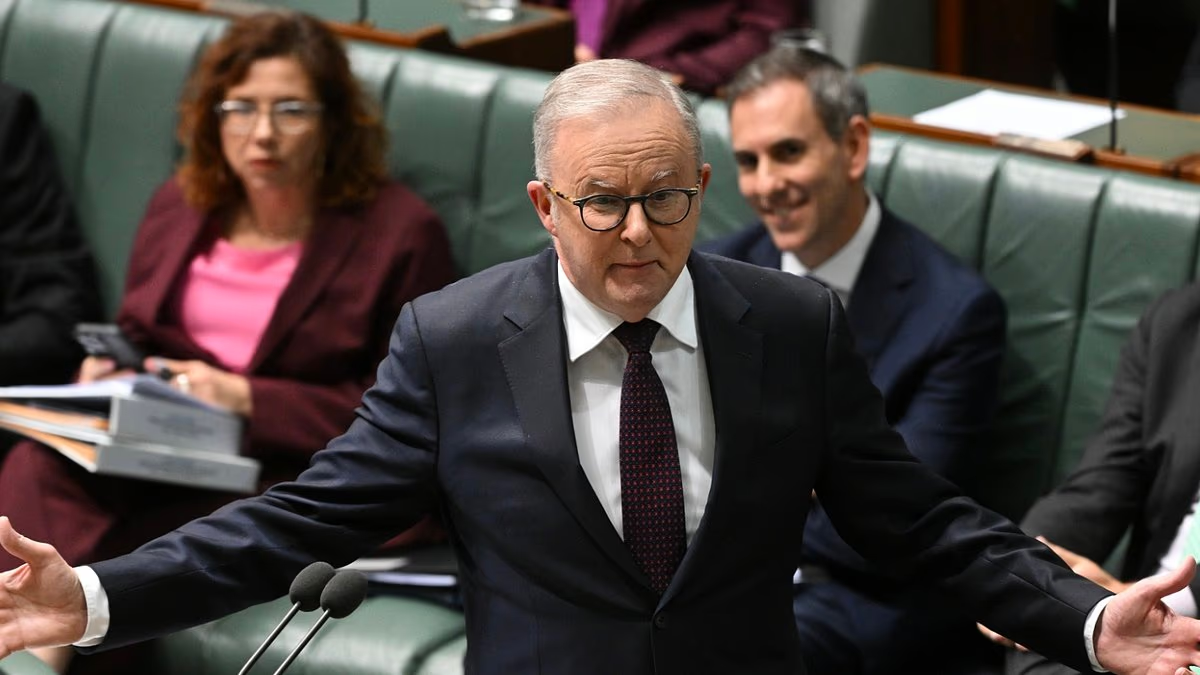
Labor figures I have spoken with suspect Anthony Albanese is eyeing a place in the record books: becoming the first Labor prime minister to remain in office into his 70s, a feat achieved only by Liberal giant Robert Menzies, before pushing past John Howard to become Australia’s second longest-serving leader.
For those hoping the Albanese era ends sooner rather than later, the numbers make for sobering reading. To move ahead of Howard, Albanese would have to stay Prime Minister until February 2034 — a little more than a fortnight before he turns 71.
That would require Labor to win not only the 2022 and 2025 elections already chalked up, but also the contests due in 2028 and 2031.
To loyalists inside the Prime Minister’s Office, such a run may look like an ambitious legacy-building mission. To a growing number of restless Labor MPs who believe Albanese is already wearing thin with voters, it lands rather differently: less as a dream, more as a warning.
That is not to suggest a leadership coup is around the corner. Labor’s caucus remains orderly, Albanese’s grip on the party room is still firm, and MPs have not forgotten the damage inflicted when the Rudd and Gillard governments turned leadership upheaval into a recurring spectacle.
Even so, the discontent behind closed doors is genuine — I have heard it directly. Much of it centres on a belief that veterans of the turbulent Rudd-Gillard-Rudd period still dominate the upper ranks of the Albanese government, leaving too little room for the generational change many Labor insiders argue is needed to sharpen its policy direction.

Some Labor MPs believe Anthony Albanese is determined to keep leading the party into his 70s
The list tells its own story.
Albanese first arrived in federal Parliament in 1996. Tanya Plibersek came in 1998, Catherine King in 2001, Penny Wong in 2002, while Tony Burke and Chris Bowen entered in 2004.
Each of them has now spent more than two decades in Canberra. They are deeply embedded political operators who, like long-term inmates suddenly released into ordinary life, might find the outside world difficult to navigate. All six also served as ministers during the Rudd-Gillard-Rudd years.
Behind them sits another tier of long-serving Labor names some believe should be making way. Richard Marles, Mark Butler, Jason Clare and Julie Collins were all elected in 2007, as was Senator Don Farrell. Each of the five had also reached ministerial office before Labor lost government in 2013.
In total, that means 11 members of the current Cabinet previously served as ministers in the last Labor government. And that count does not include Amanda Rishworth, who was a parliamentary secretary in 2013.
Some of these names are capable operators. Experience isn’t a disqualification from office, in fact it’s often a plus. But experience is only valuable if people learn the correct lessons from failure, which most of this lot haven’t done.

Jim Chalmers has ambitions to succeed Anthony Albanese but may have to remain behind him for many years to come.
The self-serving lesson Labor’s old guard drew from the Rudd-Gillard-Rudd catastrophe was that leadership instability caused everything to go wrong. End the coups, maintain discipline behind one leader and the problem is apparently solved. Except it isn’t, not if the policies and the ideological world view is no better.
Albo regards his stable leadership as proof that Labor has repaired itself. The absence of revolving doors at the entrance to the prime ministerial suite is held up as a governing achievement in its own right.
It’s an improvement, but it misdiagnoses why the last Labor government failed the nation.
The leadership wars were a symptom of dysfunction, not its sole cause. Rudd and Gillard also failed because policymaking became chaotic, announcements were confused with outcomes and political fixes repeatedly displaced durable economic reform.
The mining tax was mangled. Climate and energy policies became a rolling political disaster. Promises were made, abandoned, redesigned and reversed. Spending programs were hurried into existence without sufficient discipline as debt ballooned.
Labor increasingly mistook government activity for economic achievements. The same instincts are visible today.
The tax system continues to decay under the strain of a federation that needs updating, while bracket creep quietly does the government’s revenue work at the expense of people’s take home pay packets.
Productivity remains utterly substandard. Government spending and taxpayer-funded subsidies are unworthy substitutes for genuine structural reform. Industrial relations policies have gone backwards not forwards.
Ambitions to make housing more affordable are undermined by population settings that work against them. The energy transition is held together by subsidies, mandates, targets and ministerial assurances while businesses and households pay the price.
And all of this is happening in the context of rolling broken promises, dismissed by Albo with the sort of contempt that rarely flies.
None of which is within the Hawke-Keating tradition of genuine reform to entrench long-term prosperity.
Bob Hawke and Paul Keating opened the economy, reduced tariffs, deregulated finance, modernised the labour market, introduced compulsory superannuation and pursued competition. They worked with business and unions, but they didn’t allow either to veto the national interest.
Their reforms were difficult because they changed the way the economy operated. Modern Labor prefers policies that merely change the way government money is distributed.
The old guard invokes Hawke and Keating as Labor saints while governing more like the protectionists Hawke and Keating defeated in their struggle to modernise Labor in the 1980s.
This is precisely why generational renewal must be intellectual as well as chronological. While the Rudd-Gillard generation still in parliament has ideologically failed Hawke and Keating, fortunately the next generation are showing signs of life.
Daniel Mulino, now Assistant Treasurer and Minister for Financial Services, has a PhD in economics from Yale. Andrew Charlton, the Cabinet Secretary and Assistant Minister for Science, Technology and the Digital Economy, has a doctorate in economics from Oxford.
Neither qualification automatically provides political courage or guarantees good judgment. But it’s absurd that so much of Labor’s economic depth remains in the outer ministry and the antechamber of cabinet while veterans of the Rudd-Gillard years continue to dominate Cabinet.
There are others on the backbench who deserve consideration as part of a broader renewal (for example, Varun Ghosh and Gordon Reid). But promotions require vacancies, and vacancies don’t arise when an entire generation treats ministerial office as a form of permanent tenure.
The central figure in any renewal must be Jim Chalmers. It falls on him to get out of his comfort zone and start agitating for fresh talent to join him on the frontbench. But this comes with a very important caveat: Chalmers needs to change his ways. He can’t keep being used by Albo as the frontman for an economic agenda befitting a lesser nation.

Peter van Onselen has spoken to Labor MPs who fear Albo won’t know when it’s time to go
Chalmers is already Treasurer. He’s a Queenslander with leadership ambitions and belongs to a younger parliamentary generation than the Rudd-Gillard veterans. He’s articulate, recognisable and better-placed than anyone to turn Labor towards a modern version of the Hawke Keating tradition.
But that would require a radical change of heart.
So far, Chalmers has appeared more interested in matching the political style and policy instincts of his mentor Wayne Swan, whose record included the mining tax debacle, a surplus that was repeatedly promised but never delivered and an increasing reliance on redistribution and class rhetoric in place of serious economic reform.
Swan at least eventually had the good sense to leave Parliament, unlike the other lot of leftovers from that era still floating around.
Chalmers must decide whether he wants to remain the loyal custodian of that tradition or become the reforming Treasurer that Australia really needs. That would mean tax reform, not simply higher taxes. Also spending restraint, improved productivity and competition.
An honest alignment of housing, infrastructure and migration policy should also be on his agenda if Chalmers wants to lead the next generation successfully.
It also means being willing to tell Labor constituencies things they do not want to hear. That was the essence of Hawke and Keating. Reform without internal conflict is usually not reform at all. Chalmers should know that, having done his political science PhD on Keating’s leadership style.
Albo should use his second term to renew his ministry and prepare Labor for the next decade. But with the factions selecting his ministers, that’s easier said than done, even if the PM had the inclination to do so.
Instead, Albo’s colleagues increasingly fear he views the record-breaking 2025 victory as the beginning of a personal lease on the prime ministership stretching well into the next decade.
John Howard’s longevity was extraordinary, but his ending should serve as a warning. He remained so long that succession was deferred, renewal was frustrated and the government’s identity became inseparable from its ageing leader. Howard did not merely lose office in 2007, he lost his own seat. And he wasn’t much older than Albo is now.


