
Share this @internewscast.com

NEW YORK – In the early hours of Sunday, oil prices surged following the U.S. announcement of a blockade on Iranian ports set to commence on Monday.
U.S. crude oil experienced an 8% increase, reaching $104.24 per barrel, while Brent crude, the global benchmark, climbed 7%, hitting $102.29.
The Brent crude market has seen considerable volatility since the onset of the conflict with Iran, fluctuating from around $70 per barrel before hostilities began in late February to peaks exceeding $119. On Friday, just before the peace negotiations, Brent crude for June delivery dipped 0.8% to $95.20 per barrel.
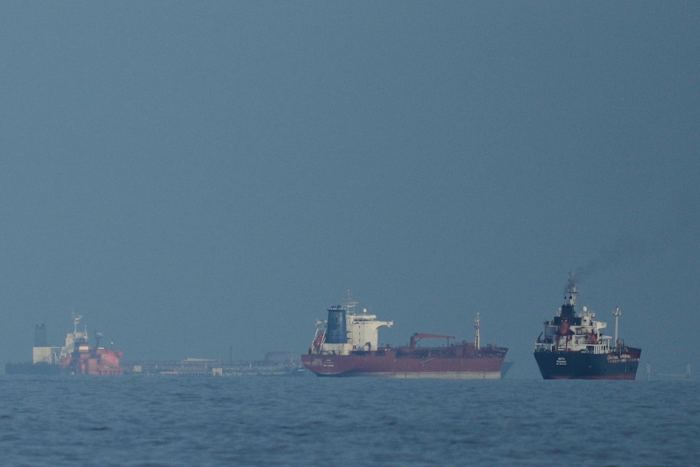
Iran has maintained significant influence over the Strait of Hormuz, a crucial channel for international oil transport.
The U.S. Central Command announced that the blockade would be “enforced impartially on vessels from all nations” accessing or leaving Iranian ports and coastal zones, including every Iranian port along the Persian Gulf and Gulf of Oman.
They clarified, however, that ships moving between non-Iranian ports would still be permitted to pass through the Strait of Hormuz.
Around a fifth of the world’s traded oil typically flows through the Strait of Hormuz every day. Saudi Arabia, Iraq, the United Arab Emirates, Kuwait, and Iran are all major exporters.
Traffic in the Strait has been limited even in the days since the ceasefire. Marine trackers say over 40 commercial ships have crossed since the start of the ceasefire.
Claudio Galimberti, chief economist of Rystad Energy, said the blockade will raise prices but might move the needle on talks.
“It means the oil markets will be even tighter than before,” he said. “However, I think this is a negotiation tactic, which eventually resolves into a full opening of Hormuz. So, more pain now, but more gain later.”
However, Jim Krane, Energy Research Fellow at Rice University, said the blockade might be effective as a long-term strategy to impose pain on the Iranian economy, but it isn’t a good short-term negotiating tactic when the oil market is already under strain.
“If the deficit to the oil market takes another jump it is going to impose pain on every person on Earth that’s subject to market oil prices,” he said.
Copyright 2026 The Associated Press. All rights reserved. This material may not be published, broadcast, rewritten or redistributed without permission.