
Share this @internewscast.com
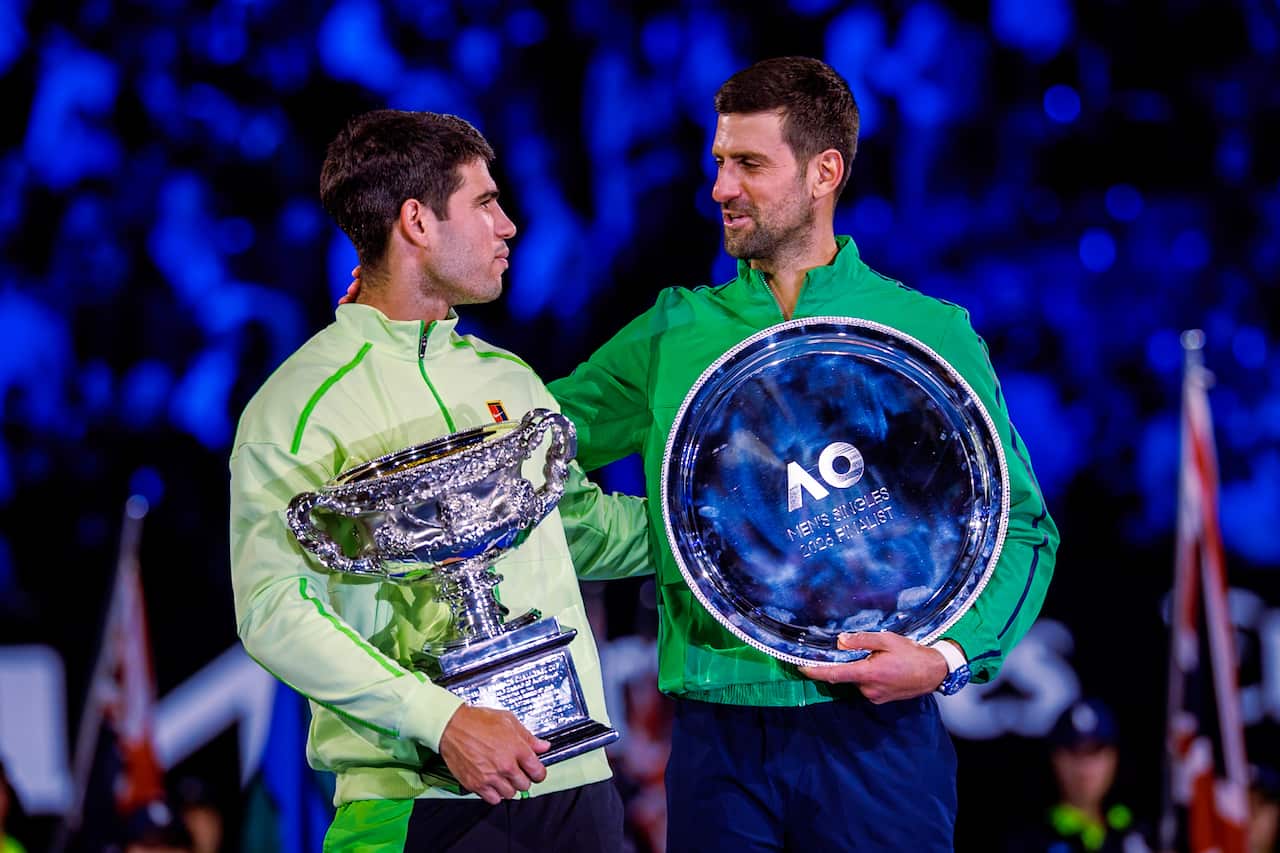
Tennis has ushered in a new champion as Carlos Alcaraz triumphed over the iconic Novak Djokovic in a thrilling Australian Open final, claiming the title of the youngest male to achieve a career Grand Slam.
The top-ranked player in the world staged an impressive comeback after losing the first set, ultimately thwarting Djokovic’s quest for a historic 25th major singles title with a 2-6, 6-2, 6-3, 7-5 victory on Sunday night at Rod Laver Arena.
By handing Djokovic his first defeat in 11 Melbourne Park finals, Alcaraz secured his first Australian Open crown, complementing his previous victories at the French Open, Wimbledon, and the US Open.
The Spanish prodigy joins an elite group of tennis legends—Don Budge, Fred Perry, Roy Emerson, Rod Laver, Andre Agassi, Roger Federer, Rafael Nadal, and Djokovic himself—as the ninth man to win all four prestigious Grand Slam tournaments.
Remarkably, Alcaraz achieved this milestone at the age of 22 years and 272 days, making him the youngest to accomplish such a rare achievement.
American tennis great Don Budge was 91 days older when he completed his Grand Slam collection at the 1938 French Open.
Alcaraz has now won seven slams — surpassing stars including Stefan Edberg and Boris Becker and drawing level with fellow all-time greats John McEnroe, John Newcombe and Mats Wilander — in just 20 major appearances.
‘It feels crazy’
Fittingly, Nadal enjoyed a front-row view as Mark Edmondson, on the 50th anniversary of his 1976 Open triumph, presented the Norman Brookes Challenge Cup to his countryman.
“It’s a little bit weird seeing Rafael in the stands. It’s the first time, I think, if I’m not wrong,” Alcaraz said.
“You were watching me when I was like 15, 14 years old, so it’s been a long time but, yeah, it’s such an honour playing in front of you.
“It feels a dream come true. I dreamt about getting the Australian Open to complete the career Grand Slam, so I’m lost now. I don’t even know what what to say.
“But it feels crazy, to be honest.”
Alcaraz also paid tribute to his vanquished opponent, hailing Djokovic as an “inspiration”.
“He deserves an ovation, for sure,” the champion said. “For doing the amazing things he’s doing.”
Djokovic, though, accepted the night belonged to Alcaraz.
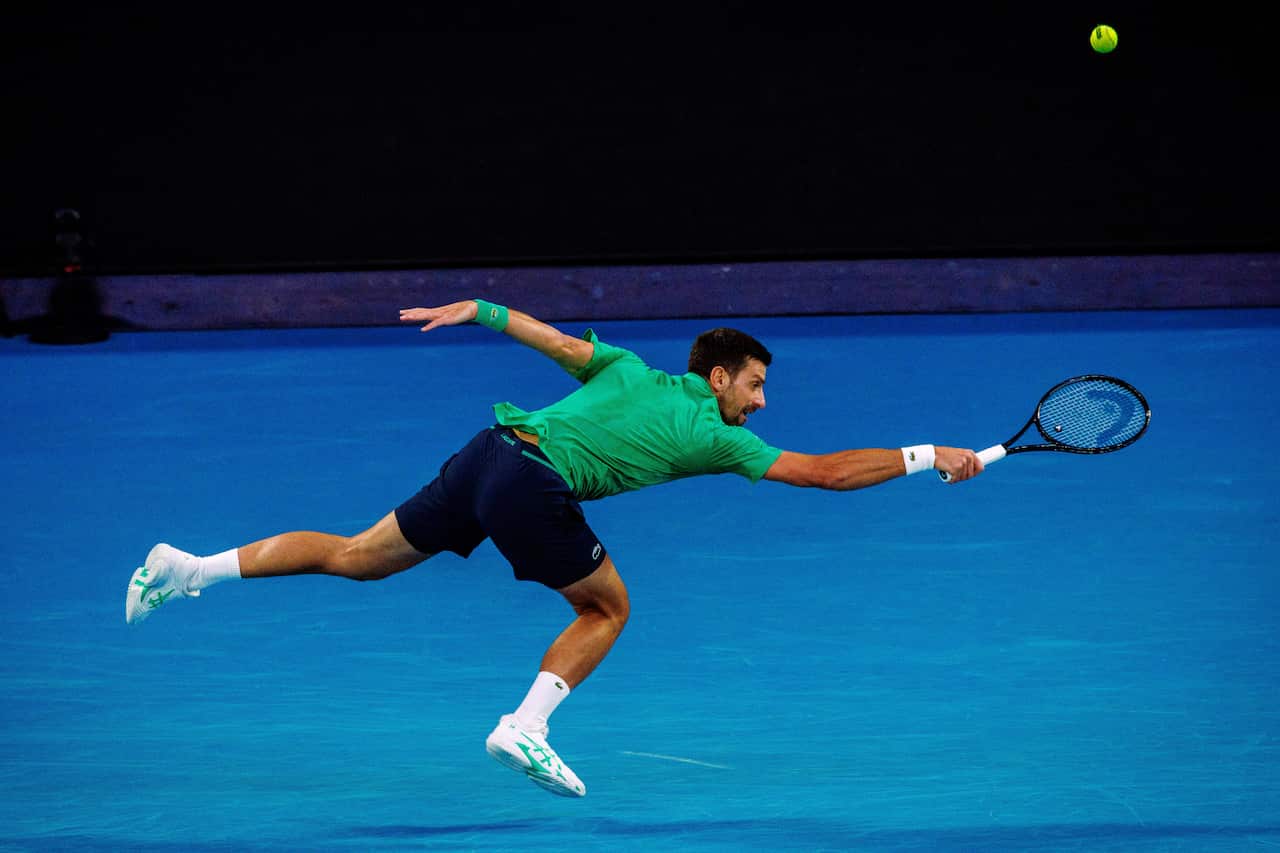
“What you’ve been doing, I think the best word to describe it is historic, legendary,” he said.
With both coming off epic, marathon semi-final victories on Friday night, intrigue surrounded how the two gladiators would shape up physically for the blockbuster final.
At 38 years and 255 days, Djokovic had been bidding to become the oldest player in the open era stretching back to 1968 to win a grand slam men’s singles title.
Instead the former world No.1 suffered his first final loss on his RLA battleground.
Having also won last year’s French and US Open titles, Alcaraz now holds three of the four grand slam trophies.
And, continuing their domination, Alcaraz and Jannik Sinner join Djokovic and Nadal as only the second pair ever to share nine consecutive grand slam titles.
Only Nadal and Federer, with 11 straight slams between 2005 and 2007, have enjoyed a longer stranglehold on the men’s majors.
For the latest from SBS News, download our app and subscribe to our newsletter.