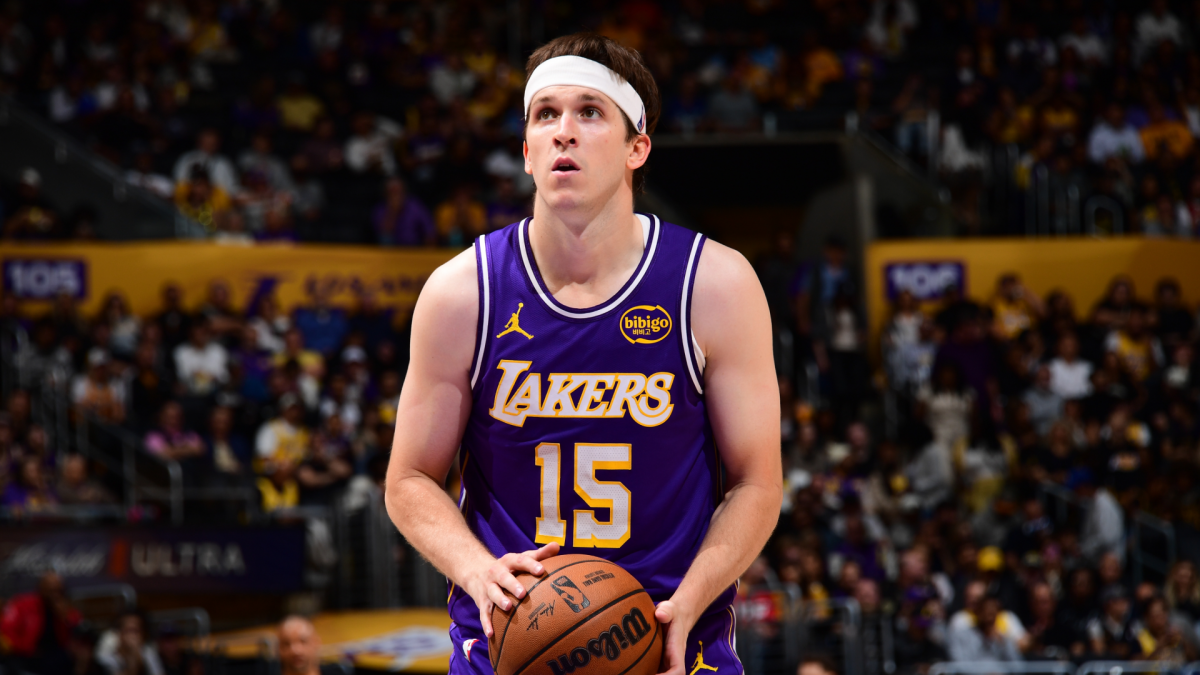

Austin Reaves is returning to the Lakers on a four-year, $185 million deal that includes a player option for the final season, according to ESPN. On an annual basis, the agreement represents a full maximum contract for a player with six or fewer years of NBA service, which applies to Reaves. Los Angeles had the ability to offer him up to five years, but the sides settled on a slightly shorter commitment. The deal also marks the richest contract ever secured by an undrafted free agent in league history.
Reaves’ previous agreement had become one of the NBA’s biggest bargains, largely because of the way the collective bargaining agreement shaped his market. After the 2022-23 season, he entered restricted free agency, giving the Lakers the right to match any outside offer while also providing them with built-in leverage to keep him.
Because Reaves had only two years of experience at the time, he fell under the Gilbert Arenas provision. That rule blocked rival teams from offering him more in the first two seasons of a contract than the Lakers were permitted to match, a figure of roughly $12 million. Other teams could have structured an offer with a major salary jump on the back end, all the way up to his max at the time, but the expectation that Los Angeles would match discouraged serious bids. As a result, the Lakers retained Reaves on a four-year contract worth under $54 million, the maximum they could offer using his Early Bird Rights. In return for accepting a team-friendly number, Reaves received a 2026-27 player option that helped set the stage for this new payday.
So how does this agreement shape the Lakers’ offseason from here? Here are the key ripple effects to consider:
Why this doesn’t affect the Lakers’ cap space
Los Angeles is still projected to enter the offseason with the most cap room in the NBA. The exact figure will depend on how several player-option decisions unfold, but the common estimate sits near $48 million. While giving Reaves max money will matter for the franchise’s long-term finances, it does not meaningfully reduce the team’s immediate ability to open cap space this summer. For now, the Lakers remain positioned with more spending flexibility than any other club.
The reason comes down to cap holds. When a player becomes a free agent, his prior team carries a preset charge on its books that allows it to retain the right to exceed the salary cap in order to re-sign him. Those holds are tied in part to the player’s previous salary, and Reaves’ last contract was far below his actual market value. That leaves him with a cap hold of just under $21 million, a number already included in Lakers cap-space projections. If Los Angeles had lost Reaves or renounced his rights, it could have pushed its available space close to $70 million.
To benefit from that discounted cap hold, the Lakers simply need to wait to officially sign Reaves until after they address their other cap-space priorities — assuming they decide to actually use cap room, a point that remains worth monitoring. Until his new contract is formally completed, Reaves counts for $20.9 million against the Lakers’ cap; once he signs, his new salary replaces that figure. That means Los Angeles can still operate with nearly $50 million in potential space for now, with the possibility of even more depending on what Marcus Smart and Deandre Ayton decide with their options.
What does this mean for the rest of the free-agent market?
Reaves was widely viewed as the best player on the entire free-agent market. He reportedly drew max-level interest from at least one team — Detroit — and there was almost certainly additional intrigue in sign-and-trade scenarios, as well as from the other cap-space teams, Brooklyn and Chicago.
That forced the Lakers to go all the way up to the max in order to keep Reaves. There was no hometown discount here. A somewhat similar story seemingly played out for Trae Young with the Washington Wizards. For months, he was expected to remain in Washington on a three-year, $120 million deal. However, external interest forced Washington to go up to four years and $212 million, which was the equivalent of what another team could have offered him on the open market. Ayo Dosunmu didn’t get a max, but he too exceeded expectations on his five-year, $112 million deal. The guard market, it seems, is hotter than anyone figured.
All of those interested parties now have to turn elsewhere for offense, and the rest of the free-agent market is set to benefit. Unless someone wants to try to steal James Harden away from Cleveland, we are likely done with the star portion of that market. There are, however, a number of players left for teams to fight over. Most notably: Quentin Grimes, Coby White, Norman Powell, Anfernee Simons, Collin Sexton, and restricted free agent Bennedict Mathurin.
Most of those financially flexible teams we mentioned as Reaves suitors — Detroit, Brooklyn and Chicago — figure to pursue those players. Their incumbent teams will probably try to keep them as well. Detroit, by virtue of its ability to create cap space and its status as a contender, probably controls the market at this point, but the most interesting team pursuing guards right now is probably the Heat.
After trading for Giannis Antetokounmpo, Miami has only about $18 million in room beneath its first apron hard cap. That probably isn’t going to be enough room to keep Powell unless they find a way to save money elsewhere. One way or another, the Heat have to come out of this summer with another shot-creating guard, and the Miami market, the chance to win and lack of state income taxes in Florida make them a very desirable destination. They’ll do everything in their power to end up with one of those guards.
What’s next for LeBron James? Re-setting the odds for his next team, plus why retirement seems less likely now
Sam Quinn
Where do the Lakers go from here?
While the Lakers have the capacity to create $48 million or so in cap space, it is not a foregone conclusion that they will actually do so. Creating that cap space means renouncing their rights to their other free agents. While they could, in theory, keep some of them with cap space, the cleanest path to retaining everyone would be operating above the salary cap.
If the plan here is to keep LeBron James, Rui Hachimura, Luke Kennard and Jaxson Hayes (and Ayton and/or Smart if they opt out of their deals), then this is what we should expect the Lakers to do. Operating above the cap would allow the Lakers to pay James and Hachimura anything up to their max with full Bird Rights. Hayes (Early Bird Rights) and Kennard (Non-Bird Rights) are limited in what they can make, but not to such an extent that it should affect the team’s ability to retain either. The Lakers are currently hard-capped at the second apron because they spent cash in a draft night trade for Cameron Carr, but at present, they have almost $85 million in space beneath that hard cap, so it is unlikely to be a problem even if they keep everyone.
So the question for the Lakers then becomes… is there some way to use that $48 million in cap space that makes them better than just running it back? That depends on what’s actually available to them.
All of the best free agents in this class, particularly the ones who would make sense for the Lakers, are restricted. Their teams have the right to match any offer. That means the Lakers cannot simply unilaterally recruit free agents like, say, Walker Kessler, Jalen Duren or Peyton Watson. They can give those players big offer sheets and hope their teams don’t match them, but doing so ties up their cap space during the 24-hour waiting period. Given how quickly free agency moves now, it’s possible that many of their own free agents leave for other deals before those offer sheets get matched, essentially costing the Lakers players for no benefit.
The Lakers could choose to use their cap flexibility in the trade market, making unbalanced deals for veteran players. However, given how much demand there is for the sort of defensive centers and athletic wings the Lakers need, they’d still almost certainly have to attach draft capital to do so. That might be their best chance at securing one of their restricted targets. Their cap space puts them in a position to throw huge offers at those players, which could force their current teams to decide between matching what might be a bad contract or losing a valuable player for nothing. A sign-and-trade could be a sensible middle ground for both sides, sending assets back to the target’s original team and allowing the Lakers to offer a more sensible deal.
The middle ground here might be a compromise. The Lakers could operate below the cap, use some of their space to add players externally, and then use the rest of it to retain a key player or two. Keep in mind that if the Lakers operate below the cap, they will still have access to the cap room mid-level exception worth around $9.4 million to spend on top of their space. If they operate above the cap, they’ll either have the full, non-taxpayer mid-level exception at their disposal to add a $15 million external player or, if keeping their own players proves expensive enough to take them above the first apron, the smaller taxpayer mid-level exception at $6.1 million instead.
What does this mean for the Lakers in 2027 and beyond?
The Lakers have had lofty ambitions for the 2026 offseason essentially since they acquired Luka Dončić. This was always the obvious pivot point, the moment in which most of their existing contracts expired and Reaves would have a low enough cap hold that they could meaningfully alter the team. Maybe that still happens. If it doesn’t, the Lakers are decidedly less flexible once Reaves officially signs his deal. At that point, the Lakers simply have two max contracts on their books.
Could the Lakers theoretically still create max cap space for the (at least for now) loaded free-agent class of 2027? Yes, though it would be tight. Right now, the projected cap for the 2027-28 season is just above $173 million. Reaves and Dončić will combine to make around $98 million for that season. For now, the Lakers have minimal commitments for that summer. They have team options on Dalton Knecht, Adou Thiero and Bronny James they could pass up if needed (though James and Thiero are cheap enough that there’s minimal benefit in declining those options). Rookie Cameron Carr will be entering the second year of his rookie deal at a reasonably low price. The only other hefty salary on the books would be the $13.3 million player option owed to Jarred Vanderbilt. The Lakers could waive and stretch him, or attach draft picks to move him.
But taking this path would mean making no commitments this offseason longer than one year. James might be open to a big one-year deal, but would any of the younger Lakers? Would any notable external free agents? Could the Lakers trade for expiring contracts knowing that they’re replacing them in a year?
Again, the answer is theoretically yes, but practically unlikely. Dončić has been on the team for a year and a half. Eventually, the Lakers have to actually build a roster for him instead of just selling him on flexibility. Unless there is very good intel suggesting that someone like Nikola Jokić intends to decline an extension in Denver and become a free agent next offseason, the Lakers probably have to assume they’re giving out some multi-year deals this offseason.
And if that’s the case, this offseason is probably their last big chance to spend cap space. Afterward, their balance sheet will start to look a bit more typical of a contender: two stars at the top with a hopefully affordable band of role players beneath them. The Lakers have been benefitting from the below-market deals Reaves has been forced to play on essentially since discovering him as an undrafted free agent in 2021. Now he’s getting what he deserves, and the Lakers will have to adjust their roster-building approach accordingly.