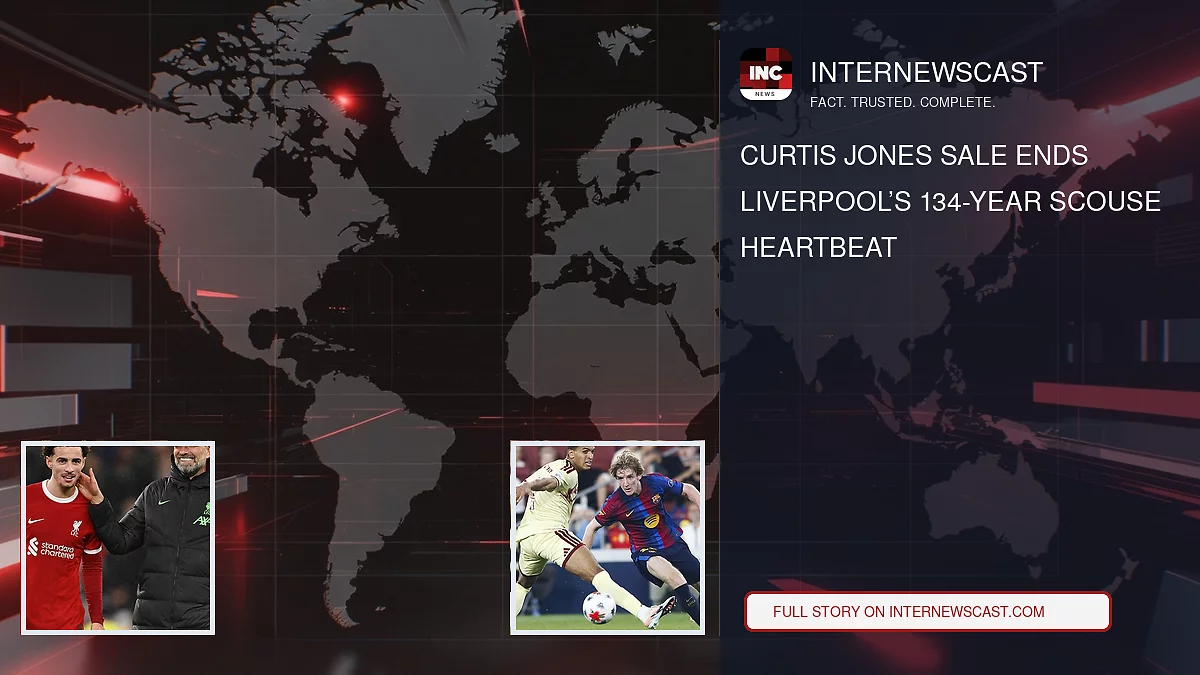

For the Liverpool academy graduate once tipped by Steven Gerrard to become the club’s next “Scouse heartbeat,” last season delivered a quietly brutal reminder of how fragile that dream had become.
Curtis Jones had just impressed in Liverpool’s FA Cup fourth-round meeting with Brighton, timing his run superbly and finishing with the kind of technical assurance that has long marked him out as a gifted midfielder. The emotion on his face told its own story. Yet when Arne Slot was asked afterwards about what might come next for Jones, the Liverpool head coach struck a cautious note, pointing out that the midfielder was competing with “many good players” in a crowded squad.
Even then, the path ahead for the Toxteth-born player appeared steep and uncertain.
Six years earlier, Jones had admitted it would be “unbelievable” if the Kop’s famous line about having “the Scouser in our team” — a chant associated with Trent Alexander-Arnold — were ever sung for him. That moment will not arrive now. He also spoke then about the importance of Liverpool retaining a “Scouse heartbeat” within the squad. With his departure, that local presence has disappeared.
It marks the end of a remarkable Merseyside thread running through generations of Liverpool teams, from Gerrard, Jamie Carragher, Robbie Fowler and Steve McManaman in the modern era to Phil Thompson and Sammy Lee during Bob Paisley’s great years at Anfield.

Curtis Jones is joining Inter Milan, bringing the curtain down on 134 consecutive years of the Reds always having at least one Liverpool-born player in the first team squad

Jones, 25, was born in Toxteth and has been with Liverpool since he was a kid
Under Bill Shankly, that local identity was just as prominent, with Ian Callaghan, Chris Lawler and Gerry Byrne among those who carried it forward. Ian St John, one of Shankly’s trusted leaders and captains, once summed up the manager’s blueprint as a blend built around “Scousers and Jocks.”
Don’t let it be said that either of those two great managers would have contemplated, for one moment, fielding a Scouser whom they deemed fractionally less likely to secure a win for them than someone else.
Paisley was brutal in the way he replaced Thompson with Graeme Souness as captain after a poor run of results around Christmas 1981. Shankly and Paisley made it a meritocracy because a deep and visceral hatred of losing was seared across their souls.
Those who later stepped into their shoes perhaps saw the symbolism and good optics of Liverpool-born players even more. Brendan Rodgers described hearing Shankly talking about their value on the tapes of the great man speaking which he played in his car. Jurgen Klopp said he would love a ‘team of Scousers’ and eulogised about ‘Scouse soul’.
But the club’s Kirkby academy simply hasn’t been able to maintain the supply of local players in a development system which, like every other, has an increasingly international dimension.
This is not a new development and to some degree it’s cyclical. Carragher discussed the lack of local players following himself and Gerrard through in an interview 21 years ago and there have been some poignant landmarks. Liverpool fielded a player born in the Liverpool region in every Merseyside derby since 1986 – 69 consecutive meetings – until the 2015 fixture.
With players now scouted from across the planet, it is easier to lose those locals who don’t present the promise at the age of 11 which is evident at the age of 18. Anthony Gordon, who was born in Liverpool and a boyhood Red, spent time on the club’s books before Everton snapped him up at the age of 11.

Jamie Carragher and his fellow Scouser Steven Gerrard lift the Champions League trophy for Liverpool in 2005 in Istanbul. But the club will have no homegrown players this season

Trent Alexander-Arnold is another local lad who has left the club in recent years
Everton have been better recruiters of local talent down the decades, arguably helped in more recent years by less pressure and less global scrutiny.
Gordon was back on Liverpool’s radar when Newcastle were ready to sell him, two years ago, as they attempted to comply with PSR. Jarell Quansah was part of a package discussed but Liverpool, who have since sold the centre-half to Bayer Leverkusen, did not want to lose him at that time. How they could have used his presence now.
Managers have craved having a Scouser in the team because they know the value of an individual who can articulate to team-mates, with real authenticity, the expectation, the derby, the history, the peculiarities of the support and the intensity with which the club is scrutinised. A Liverpool-born player requires no explanation.
As one fan posted on social media about Jones’ departure: ‘Best way to kill a club’s identity is to sell all homegrown players for pennies and overspend on unproven foreign players. So stupid.’
Carragher always insisted that Djibril Cisse exaggerated a story of Gerrard using the city as a source of inspiration at half-time during the 2005 Champions League final in Istanbul, but the captain would certainly have spoken from the heart more than anyone on that monumental night.
The timing of this break with history is also unfortunate. Jones leaves at precisely the time that Liverpool seem that much further removed from their roots, with the sale of a third of the club to an investor consortium headed by Jeff Bezos.

Former Liverpool boss Jurgen Klopp said he would love a ‘team of Scousers’ and eulogised about ‘Scouse soul’

Anthony Gordon, who was born in Liverpool and a boyhood Red, spent time on the club’s books before Everton snapped him up at the age of 11. He has now moved on to Barcelona
American ownership these past 16 years has seemed a little closer to home than it might, given that FSG is based in Boston, Massachusetts, a city with distinct Irish and Liverpool links. Many Liverpool-based supporters feel the consortium’s introduction takes the club that little bit further from them.
There is always an emotional dimension when it comes to city of Liverpool and its football. It’s precisely why Shankly said that the game transcended considerations of life and death. So this is unmistakably a sad day for the place.
Carragher, just like the great men who have managed his beloved club, craves titles and trophies above anything, but it was he who has captured the value of Scousers in the team better than anyone.
‘They will have more of an emotional attachment,’ he said in an interview some years back. ‘It’ll hurt them more when they lose. When they’re playing, they’ll want it more. It’s only small margins, but local players would be more loyal to the club.’


