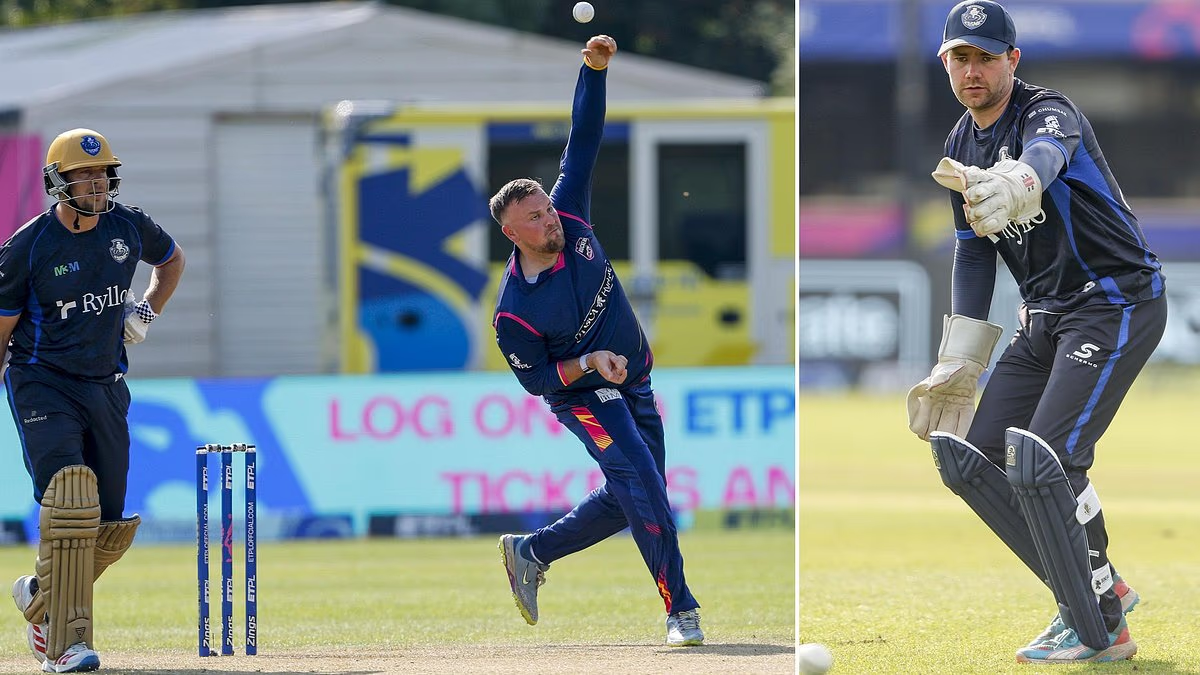

Scottish cricket staged its first inter-city derby in more than 100 years last week, though even many of the game’s most committed followers may have missed the moment.
The landmark fixture, understood to be the first of its kind since 1894, was not played in Glasgow or Edinburgh. Instead, it unfolded in Voorburg, a small town in the Netherlands, where a modest crowd turned out in the Thursday afternoon sunshine to witness a curious piece of Scottish sporting history.
Supporters watching from afar could tune in only with a TNT Sports subscription, and the match also had to compete for attention with the opening day of England’s Test against Pakistan at Lord’s on another channel.
European white-ball cricket has endured several false starts over the years, with previous tournament plans collapsing for various reasons. Even the latest version, the six-team European T20 Premier League, was pushed back by 12 months after failing to launch as scheduled last summer.
This year has brought further growing pains for the competition, a partnership between Cricket Ireland and the India-based company Rules X, as well as for the two Scottish franchises trying to establish themselves on the new stage.

Edinburgh Castle Rockers’ Mark Watt in action against Glasgow Cosmic at Voorburg Cricket Club

West Indies great Chris Gayle withdrew from his position as Glasgow co-owner and team ambassador
Edinburgh Castle Rockers had initially been set to operate under New Zealand-based ownership, but those backers pulled out after losing confidence, leaving the ETPL to intervene. Trevor Bayliss, the former England head coach, was then brought in to lead the side less than a week before the tournament began. When asked to identify his toughest early task, the Australian offered a blunt answer: “Learning the players’ names.”
The Glasgow Cosmic, at one point set to be named the Mugafians after their Indian owners, have had their own difficulties, including West Indies legend Chris Gayle’s decision to step away from a role as co-owner and team ambassador. In as head coach has come Matthew Hayden, the legendary Australian batter but someone who has spent more time in retirement in the commentary booth than in the coaches’ box.
With foreign or central ownership, Australian head coaches and no local ties beyond a vague connection to each city, it seems fair to question just how Scottish these franchises really are. The main driving force behind the push to establish a European tournament had been to increase the profile of Scottish, Dutch and Irish cricket while also giving opportunities to players from those countries to compete with, and against, some of the leading lights from Test-playing nations.
On both fronts, there is a bit to go yet. Tournament rules state that each line-up must contain a minimum of five players from the ‘host’ nations – the Netherlands, Ireland and Scotland – alongside up to four players from the bigger nations and two others, either locals or players from other Associate nations including the US, Portugal and Italy.
Thursday’s one-sided opener, won in a canter by Edinburgh by seven wickets, saw just seven Scottish players in total among the 22 who took to the field. Five of them, including Glasgow captain George Munsey, are already over 30 years old and most already well experienced on the T20 touring circuit. To frame this as a rare chance for young Scottish talent to learn from veterans like Liam Livingstone or Mitchell Santner would be pushing it somewhat.
From a Scottish perspective, it was disappointing to see priority given to overseas veterans like JJ Smuts, the former South African all-rounder who now represents Italy, and Andries Gous, the US batter also once of South Africa, over local talent. Unused Scottish squad players Safyaan Sharif, Ollie Jones, Finlay McCreath, Brad Currie, Chris McBride, Oliver Davidson and Liam Naylor all sat and watched the opener from the sidelines.
Both Edinburgh and Glasgow are also massively hindered by the fact there will be no matches in Scotland in the first season. After the first round in Voorburg, the travelling circus rolls onto Malahide in Dublin for the concluding pool fixtures and then the knockout phase.

Matthew Cross of Glasgow Cosmic takes wicket against Edinburgh Castle Rockers
Trying to develop wider interest in a team that has no home matches was never going to be easy but the sides haven’t helped themselves either on that front. Both spoke about bringing their squads to Scotland to engage with local communities ahead of the tournament but never followed through.
In an interview with Mail Sport a few months ago, Cosmic CEO Rashid Ali Khan even talked about paying to take cricket-mad Glaswegians over to the Netherlands to watch games in the flesh. He has yet to deliver on that promise.
It throws up the eternal question when it comes to these T20 franchise tournaments: who cares? The whole concept can often feel quite soulless, teams of well-paid mercenaries thrown together to fight for an arbitrary cause, playing against each other one week and then together the next. With foreign owners and no local support base, it seems to serve few beyond the batters and bowlers for hire and those watching, and betting, from the Indian sub-continent.
Still, even this flawed concept has to be better for the development of the Scottish game than nothing at all.
The hope must be that more players get the chance to feature as the tournament progresses and that the profile of the event continues to grow all the way to the final on September 20.
With a successful first season behind them, the ETPL will then hopefully fulfil its promise of bringing games to Scotland next year for the second edition, providing a spectacle for local cricket fans while also giving more opportunities to Scottish players and inspiring future generations. Building a rivalry between Glasgow and Edinburgh with an engaged fanbase behind each one would help, too. After a 132-year absence, it’s long overdue.


