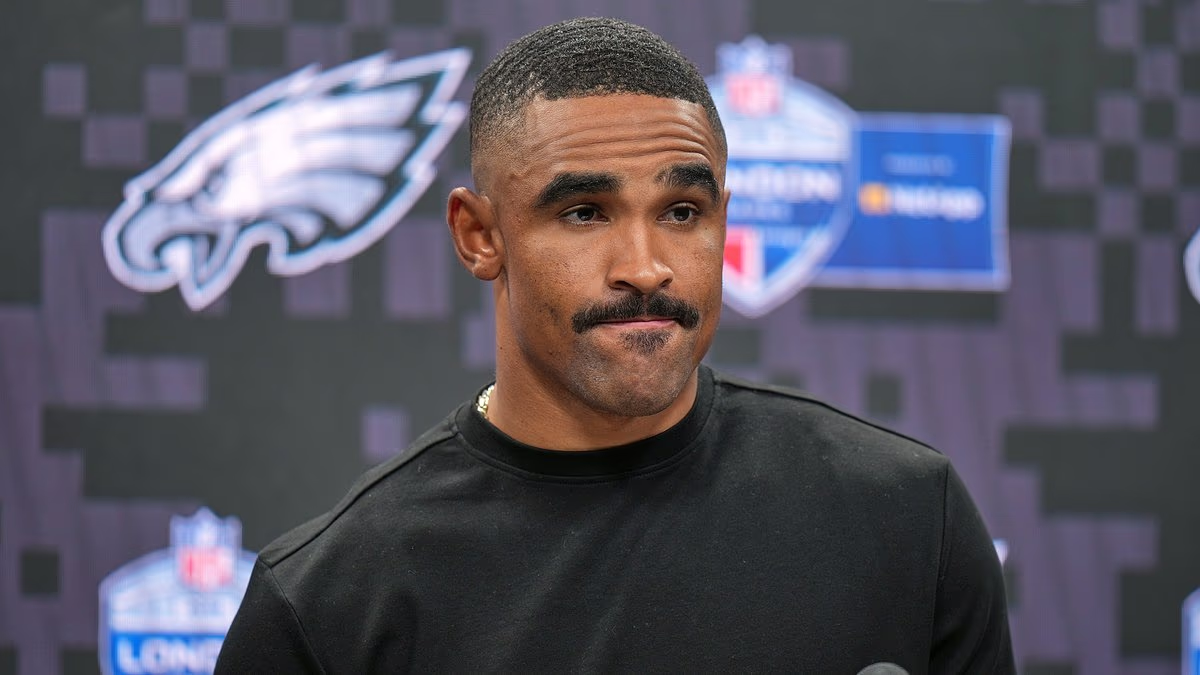

Philadelphia Eagles quarterback Jalen Hurts may have faced a life-threatening emergency in the days before doctors discovered multiple blood clots in his lungs, according to a sports medicine specialist. The revelation has intensified scrutiny of how the team handled the star player’s condition.
Hurts is expected to miss the remainder of the NFL season after the clots were identified on Wednesday. The diagnosis came three days after he played against the Jacksonville Jaguars in London and then traveled back to Philadelphia, roughly 10 days after a cleat struck his calf during a game against the Los Angeles Rams.
An ultrasound reportedly detected a clot after the Eagles arrived in London for the Jaguars matchup, and Hurts was listed on the injury report Friday with a calf issue. Reports said he was assessed at a London hospital and slept very little before kickoff. Despite that evaluation, he was cleared to play.
Dr. Jesse Morse, a sports medicine specialist who has not treated Hurts personally, told the Daily Mail that allowing the quarterback to take the field was “the craziest decision that I can fathom.” He also described the potentially serious risks Hurts may have faced during the game and afterward.
The Daily Mail has contacted Jalen Hurts’ representatives and the Philadelphia Eagles seeking comment.
Morse said Hurts’ reported lack of sleep created an additional concern. Fatigue can significantly slow reaction times, he explained, leaving an NFL player more vulnerable to a concussion or other injury during a fast-moving game.

Jalen Hurts is expected to miss the rest of the NFL season after multiple blood clots were found in his lungs

The Eagles are facing growing questions about the medical decisions made after Hurts’ diagnosis
ESPN initially reported that Hurts remained awake throughout the night before the Jaguars game because of concerns that the clot could travel. His agent, Nicole Lynn, later disputed that account, saying he did sleep after returning to the team. Lynn added that Philadelphia had arranged a private room for him at Tottenham Hotspur Stadium.
Following the Eagles’ narrow loss in London, Hurts described the circumstances surrounding his practice week as “very unique.” Philadelphia did not announce until Wednesday, October 14, that a follow-up ultrasound had shown the clot had moved. The team has not confirmed whether Hurts underwent any additional ultrasounds between the Jaguars game and that later discovery.
Hurts’ appearance in the London game suggests he had not begun taking blood-thinning medication before kickoff. Such treatment would generally have prevented him from playing because of the heightened danger associated with being hit while taking anticoagulants.
Morse questioned why Hurts was not immediately placed on medication designed to reduce the chance of the clot moving. Instead, he said, the quarterback was allowed to play despite the potential consequences.
He also criticized the decision to put Hurts through a physically demanding game and then send him on an international flight from London to Philadelphia. According to Morse, both the exertion of the game and the travel could have increased the danger of further clotting or caused the existing clot to shift.
Morse said Hurts may have remained at risk from the time the clot was first diagnosed, through the Jaguars game and transatlantic flight, and into the following days until blood-thinning treatment began. In the worst-case scenario, he said, a clot could have traveled to the lungs, brain or heart and proved fatal.
The specialist said the decision to play Hurts, together with the reported handling of his condition afterward, could potentially be considered a “fireable offense.” He described the situation as reckless on a catastrophic level and suggested that multiple people could ultimately be held accountable.
Morse said responsibility could involve the coaching staff, general manager, doctors or broader medical personnel. In his view, the situation was too significant to be treated like an ordinary decision involving a depth player who could simply be rested without major consequences.
“This is the quarterback of the team. This is the leader,” Morse said, arguing that the seriousness of Hurts’ condition meant key figures within the organization would likely have been aware of what was happening.
He added that the medical staff should have been prepared to overrule any desire Hurts had to compete, regardless of the quarterback’s willingness to play. Players, Morse noted, naturally want to be on the field, but medical clearance must be based on the risk involved.
Morse said the potential danger included the clot breaking loose, traveling from the blood vessel to the lungs and causing a saddle pulmonary embolism, a medical emergency that can be fatal.

Hurts passed for more than 200 yards in Philadelphia’s 19-17 loss to the Jaguars in London

Hurts later told reporters he had faced a ‘very unique’ situation before the Jaguars game
Eagles head coach Nick Sirianni insisted Monday he has ‘full trust and full faith’ in the team’s medical staff and added: ‘We always put our players health first and foremost in every situation.’
Attention is now turning to whether Hurts will be able to return at all, with concerns the situation could end his career. He will need to be cleared after months on blood thinners, which Morse says is far from guaranteed now he faces increased risk of blood clots after a ‘unique’ sequence of events.
‘It could be (career-ending),’ Morse said. ‘At the minimum, this is three months. And we’ve had several players suffer blood costs and come back. But to my knowledge, and I studied this stuff really well, I don’t think we’ve ever had an NFL player get confirmed multiple blood clots in his lungs. Which means this is not the first time, and this was not only one.
‘The only way you could potentially prevent a new blood clot from forming is to be on a blood thinner. You cannot be on a blood thinner and a play contact sport. You will bleed out and you can’t stop the hose when the faucet is turned on, which is what a blood thinner does. You can’t turn it off until like 34 days later. So it’s not worth the risk.
‘Unless they decide to make this a unique exception to the rule, this could be career ending. At the minimum it is season ending, but this is a very unique situation.
‘Just the fact that this was a trauma-induced clot. That was probably worsened by the international flight each way. Diagnosed, acknowledged that it existed, recommended not to sleep, because if he slept, the immobility could potentially cause the blood clot to move into his lungs, yet you allowed him to play in an NFL game? And then flew him back on a flight for 6 to 7 hours? I don’t know how they could medically clear him, safely.’
Morse also points to increased risk, albeit a rare one, of suffering blood clots after getting a COVID-19 vaccine. In 2021, it was found that around 4 in one million people who got the Johnson & Johnson COVID-19 vaccine later got a blood clot syndrome. The vaccine is no longer available in the United States and medical experts say the benefits of getting a COVID-19 vaccine generally outweigh the risks.

Hurts is set to remain with the team while he is ruled out of football due to his health condition

Hurts initially suffered the injury when he took a cleat to the calf against the Los Angeles Rams
‘They’re calling this provoked versus unprovoked, is usually the term we use. So this would be a provoked blood clot, meaning it was a trauma which led to it.
‘The trauma that caused it could potentially cause a new one. So if this was an unprovoked blood clot, meaning he just developed blood cloth out of the blue, he wasn’t doing anything, he didn’t get hit, then that is permanent career-ending. No questions.
‘That’s what happened to Chris Bosh for the for the Miami Heat. But at the same time, knowing the sport that he plays, how can you justify the risk?’


