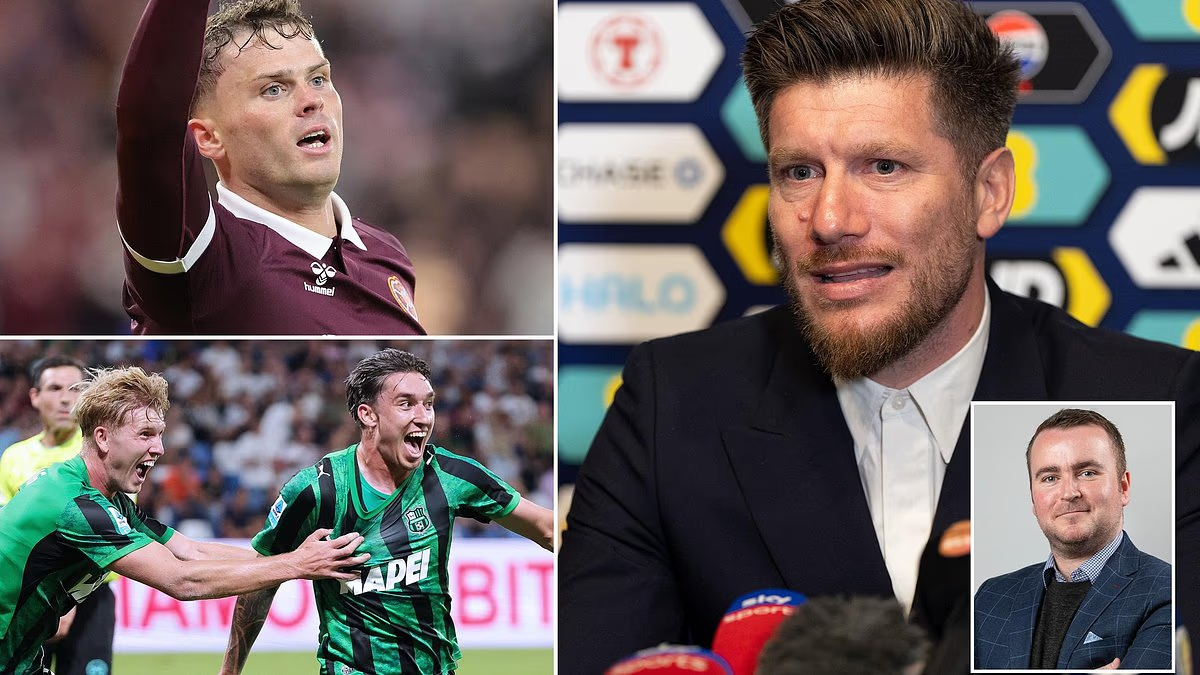
It is only a month since Sebastien Pocognoli was named Scotland’s new head coach. In football terms, he has barely had time to settle in.
He has not yet led a training session or taken charge of a match. So far, his Scotland experience consists of a couple of media conferences and the announcement of his first squad.
Even so, the change at Hampden is already unmistakable. Pocognoli’s arrival has brought a sense of energy and optimism that Scotland badly needed.
Simply by selecting his first squad for the upcoming Nations League fixtures, Pocognoli has demonstrated a more progressive and positive approach than Scotland saw from Steve Clarke, particularly during the final stages of his tenure.
Clarke’s squad announcements and press conferences had become predictable and routine. For the most part, supporters already knew which players would be selected before the list was released.
Pocognoli has blown that familiar script apart. His first selection is bold, ambitious and adventurous — precisely the kind of fresh start the Tartan Army had been hoping to see.
The 28-man squad includes seven uncapped players, while 14 members were not part of the squad that travelled to the World Cup in the summer. The average age has also dropped from 29 to 26.

Pocognoli has selected seven uncapped players in his first Scotland squad
Everything about the selection feels different. It rewards current form rather than past loyalty, which is exactly how international football should work.
Pocognoli has assessed the available talent and asked a question that often appeared to go unanswered under the previous regime: who is performing well now, and who has the potential to make Scotland better?
Oli McBurnie has been recalled after five years away, while Robbie Ure, Colby Donovan, Luis Binks, Luke Graham, Stephen Welsh and Josh McPake have all been included. This is not a continuation of the old order; it is a clear overhaul.
There is little point in endlessly revisiting Clarke’s record. He guided Scotland to three major tournaments, including a World Cup, and deserves credit for that achievement.
Clarke made Scotland relevant again and created memories that supporters will treasure. However, by the end, his time in charge had run its course.
The team had become predictable, built around the same players and the same tactical ideas. Once Scotland reached major tournaments, the same mistakes were repeated time and again.
For emerging players attempting to break into the team, the pathway appeared increasingly narrow. Clarke’s Scotland was shaped by his caution and rigid approach.
Pocognoli appears to have no intention of following that template. His squad makes his thinking clear: the door is open, and players are being invited to step through it.

Steve Clarke’s Scotland squads often appeared to favour loyalty over current form
McBurnie is playing regularly and performing well for Hull City in the Premier League. After scoring 19 goals last season to help Hull secure promotion, his absence from the World Cup now looks particularly difficult to understand.
He had effectively been frozen out under Clarke, with his last Scotland cap coming in 2021. Given his form, that decision became increasingly difficult to justify, leading to speculation that the former manager held a personal grievance against him.
Among the other new arrivals, Ure has recently joined Sevilla for a significant fee. Donovan, meanwhile, is starting for Celtic and, at just 20, still has considerable room to develop.
Graham and Welsh are performing in the English Championship for Stoke and Swansea. Indeed, Welsh was arguably the best Scottish centre-back in the SPFL last season for Motherwell, yet didn’t go to the World Cup.
McPake is catching the eye with some excellent performances at Hearts. These are not sentimental picks, nor are they a continuation of the old guard. They are form picks. That alone marks a major shift in attitude.
Under Clarke, the hierarchy felt fixed. You earned your place through years of service and then held it until injury or absolute crisis intervened. In the end, loyalty became inertia.
Under Pocognoli, everyone has a clean slate. There is no hierarchy beyond the blatantly obvious in the likes of Andy Robertson, John McGinn and a few others.
The Belgian has not reinvented the wheel with any of this. He has simply refused to keep spinning the same wheel as Clarke had done for years.
Lennon Miller, Kieron Bowie, James Wilson, Findlay Curtis, Ben Gannon-Doak. This is not a group built purely to frustrate and contain. It is a group that feels youthful, positive and exciting.

Winger Josh McPake has caught the eye playing for Hearts this season
Bowie was another odd case under Clarke. After leaving Hibs and moving to Verona in Italy back in January, Daily Mail Sport understands that neither Clarke nor his staff made any effort to contact Bowie over the second half of last season.
No attempt to check in and see how he was doing, no effort to maintain a relationship, no encouragement in his efforts to make the World Cup squad.
Now? He just scored for Sassuolo at the weekend in a 3-2 win over Juventus in Serie A – and his reward is a place in the Scotland squad.
Pocognoli’s squad moves the dial and changes the conversation around all of this. Suddenly, punters are talking about who might seize a chance rather than who is guaranteed their place.
Of course, none of this guarantees results. International football is a short-term, high-stakes business. Some of these new faces may well struggle. Established players may well fight their way back in.
Four matches against Slovenia (twice), Switzerland and North Macedonia offer Pocognoli the chance to really put his stamp on this team and change the style of play.
If he gets off to a flying start, the Tartan Army will worship his every move. Yet, even if results don’t go his way and it becomes a difficult start, it would be foolish to write him off too quickly.

Kieron Bowie earned a place in the squad after scoring for Sassuolo against Juventus
Given the change in personnel and the change in playing style, this could take time to bed-in properly. But the starting point in all of this is everything.
Pocognoli has arrived with a lot of goodwill from supporters. There’s a lot to like here. He wants to deliver a more exciting brand of football whilst bringing through younger, fresher players.
Clarke’s Scotland eventually felt like a closed system under lock and key.. Pocognoli has taken a sledgehammer to it and smashed it open on day one.
Ultimately, it’s a squad that looks radically different because the man picking it believes it needs to look different. After years of closed ranks, that directness is refreshing.
It may only be a squad announcement. But it is the first real sign that Scotland might finally be ready to look forward with a sense of genuine excitement.
That in itself is a breath of fresh air. In Scottish football, those are rare enough to savour.


