
Manchester City players and supporters are unlikely to find much reassurance in Zlatan Ibrahimovic’s autobiography. Yet I Am Zlatan does provide a vivid account of how a dressing room responds when a devastating scandal crashes into the heart of a football club.
The confusion, denial, fear and desperate attempts to escape are all captured in chapter 14, which recounts the turmoil at Juventus in July 2006. The club had just been told it would be relegated to Serie B and stripped of two Serie A titles.
Like the Manchester City players who could one day face a similar crisis, Juventus’ footballers were not found responsible for the Calciopoli scandal. They had not secretly lobbied to influence referee appointments, nor had they been caught in the extensive network of intercepted telephone calls. The wrongdoing centred on the club’s executives.
‘This world had been turned upside down,’ Ibrahimovic wrote. ‘It wasn’t possible to take it all in. We’d won two titles in a row – were we going to lose everything?’
He then described the daily destruction that followed as La Vecchia Signora — the Old Lady — was dismantled piece by piece. Manager Fabio Capello was the first to leave. He did not even wait for the verdict, departing 10 days before it was announced after recognising which way events were heading. Several senior executives followed him out of the door.

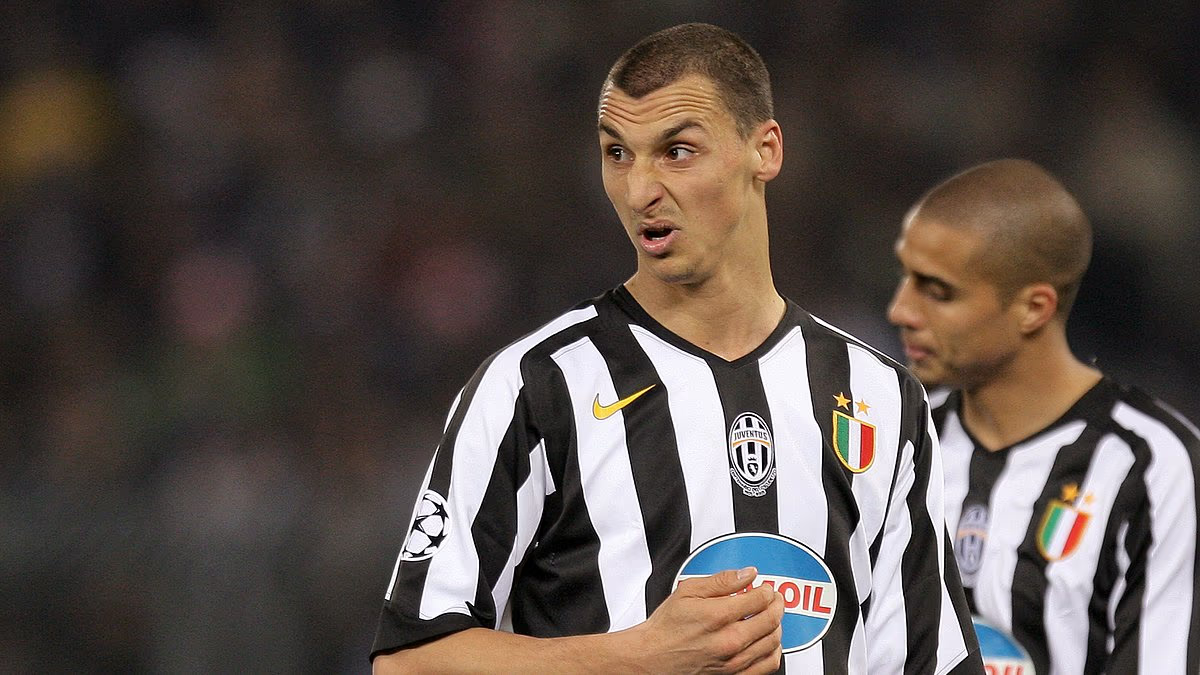
Zlatan Ibrahimovic was 25 when his ‘world had been turned upside down’ as Juventus were relegated to Serie B and stripped of two league titles in the Calciopoli scandal

Manager Fabio Capello (right) quickly departed, while star midfielder Pavel Nedved (left) remained with Juventus

Ibrahimovic left Juventus for Inter Milan that summer and went on to win the next three Serie A titles
A confused group of world-class players was suddenly being addressed by Alessio Secco, who had received an unexpected promotion to club director after previously organising the details of the team’s training schedule.
‘Crazy,’ was Ibrahimovic’s description of Secco’s rise. He then recalled conversations that could soon be taking place around the Etihad Stadium, if they have not already started.
Ibrahimovic wrote: ‘One after one the players got away, (Lilian) Thuram and (Gianluca) Zambrotta to Barcelona, (Fabio) Cannavaro and Emerson to Real Madrid, Patrick Vieira to Inter, and every one of us who were left called our agents: “Sell us, sell us.”
‘Uncertainty and desperation hung in the air. I was on my way up in my career. Was everything going to come crashing down? No way was I going to sacrifice a year in the second division. My best years were in danger of being wasted, I told Mino (Raiola, his agent), “Do whatever it takes just get me out of here”.’
Ibrahimovic was 25 at the time and ultimately got his wish. He joined Inter Milan a month after the verdict and won the next three Serie A titles. Before that, however, Juventus attempted to turn the situation into a test of loyalty.
Ibrahimovic recalled how the Juventus hierarchy contrasted his desire to leave with the loyalty of the few prepared to remain, including Pavel Nedved, Gianluigi Buffon, Alessandro Del Piero, Giorgio Chiellini and David Trezeguet. The atmosphere became increasingly bitter. The club’s battle with the authorities turned into an internal struggle, creating a spectacular and deeply sad collapse.
It raises the question of how much of that bleak Juventus experience could await Manchester City. If City are ultimately found guilty after their appeals, the prevailing expectation in Premier League circles is that any points deduction could be severe enough to make at least one relegation unavoidable.

Juventus goalkeeper and club great Gianluigi Buffon was among the handful of star players who stayed

Another Juventus icon, Alessandro Del Piero, raises the Serie B trophy in June 2007 after the club won promotion back to the top flight at the first attempt

If Manchester City were relegated through the divisions, which players would follow Del Piero and Buffon by remaining at the club?
My understanding is that Manchester City’s contracts do not contain relegation clauses, meaning agents representing the club’s biggest stars cannot simply offer cut-price deals to interested teams.
On the surface, that could work in City’s favour. But how could the club realistically afford to retain those players while operating on Championship revenue — assuming, in the first place, that any of them wanted to stay?
There is no parachute big enough to hold up the weight of Erling Haaland’s £500,000-a-week contract. Haaland, at 26, is one year older than Ibrahimovic was when Juve imploded, and we would expect him and the vast majority of his team-mates to bolt if City go down. Nothing original in that prediction; nothing offensive about those decisions if they come in due course.
But let’s talk about love, because Buffon, Nedved, Del Piero, Chiellini and Trezeguet loved that Old Lady.
They all could have had their pick of options and they all stayed. With the exception of Trezeguet, they travelled to Rimini in September 2006 and opened their Serie B campaign with 1-1 in front of 10,000 people. A year later they were back in Serie A and loved by fans in deeper ways than before.
As Buffon later put it: ‘In football, you can send a message to the outside with loyalty. To the fans, you can say, “In difficult moments, I’ll be there”.
‘We play for fame, money, trophies and a lot of things, but we also play to feel a sense of belonging. I decided to stay at Juve because I believe in gratitude.’
If there was anything to love about the Juventus scandal, it was that single aspect from its aftermath. That irrefutable evidence of decency within individual components of a broken machine.

Will Erling Haaland want to head back to the likes of Kenilworth Road, if City are relegated?


So Ruben Dias, do you fancy another trip back to Swindon Town (left) or Bristol City (right)?

Boyhood City fan Phil Foden (right) might be more amenable to staying at the club down the divisions, but what about those with weaker loyalties?
Maybe Manchester City will eventually have heroes they can cast in a similar light. And possibly that will serve as a test of where City truly belong in the conversation about big clubs, because it is one thing for a player to love the Old Lady of Italian football, and perhaps harder to imagine an equal affection for the new-money face of Abu Dhabi.
From today’s vantage point, it is easy to see both as responsible for egregious acts of cheating. But it’s tricky to foresee a world where so many first-teamers choose to stick it out with City.
Phil Foden? He’s a lifelong fan. Ditto Rico Lewis and Nico O’Reilly. They’ve all been pictured kissing the badge at some point or other. But the rest will likely see the dilemma in far simpler terms if the harsher judgments come to pass.
The rest might find City too hard to love if they are no longer useful. The rest might already be on to their agents, plotting the same route to the door as Ibrahimovic once did. It would be hard to blame any of them.


