
Share this @internewscast.com
When Marisa Peters was 33, she went to the doctor after noticing specks of blood on toilet paper when she used the bathroom.
Having recently given birth to her oldest son, doctors assumed the new mom had hemorrhoids.
But, over the next five years, the blood turned to ‘ribbons’ in her stool and eventually started filling the toilet bowl. She frequently found herself rushing to the bathroom.
Still, her fears fell on deaf ears as doctors thought she was too young and too healthy to have colon cancer. It wasn’t until she was 39 that Peters was finally diagnosed with stage 3 rectal cancer in 2021.
‘If I had been seen earlier, we could have avoided this whole thing,’ the California mom-of-three told the Daily Mail.
Now 43, Peters, wants to help prevent other people from facing the same fate by teaching young adults the key steps to take if they develop symptoms – as well as how to avoid the crucial mistake she made.
Peters urges those with symptoms like hers to be ‘specific and deliberate’ with their doctors about ‘demanding a colonoscopy’ – the gold standard test for diagnosing colon cancer.
Not only can it catch the disease early, it can also spot pre-cancerous growths before they become deadly.

Marisa Peters, pictured here, was diagnosed with stage 3 rectal cancer at age 39 after five years of her symptoms being brushed off. She is now teaching other young patients how to avoid a similar fate
Peters explained that ‘the fast track to a colonoscopy’ is being able to be detailed with your doctors about any symptoms you may be experiencing.
‘If you go in and you don’t have those kinds of details to articulate, or perhaps you are a bit too shy to speak up about it, it’s going to create more barriers for you along the way, and wishing won’t make this go away.
‘You have to be your own advocate.’
In her own case, when Peters finally told her gastroenterologist in detail about her symptoms, the doctor ‘was deeply concerned from the get-go’.
However, both Peters and her doctor then made a crucial mistake: The physician asked her if she ‘wanted’ a colonoscopy and Peters pushed back, instead choosing to do an at-home stool test, which came back with positive colon cancer markers.
She then had to have a colonoscopy anyway to confirm the diagnosis and wishes she just had one in the first place to save time.
‘I didn’t know anything about the rise of colorectal cancer [in] young people – I wasn’t educated on that topic at all,’ Peters said.
When treating patients with symptoms like blood in the stool and abdominal pain, doctors need to say, ‘you need to have [a colonoscopy] done rather than it being something you want,’ she told the Daily Mail.
Peters’ cancer is considered early-onset – a term that refers to cases in people younger than 50, which are on the rise in the US.
From 1999 to 2018, the rate of colon cancer in the under-50 population rose from 8.6 to 13 cases per 100,000 people.
And colon cancer diagnoses in 20 to 34-year-olds is set to increase by 90% between 2010 and 2030.
Rates for teenagers have surged 500% since the early 2000s.
Peters, who started the nonprofit Be Seen to raise awareness of early-onset colon cancer, has found the patients she meets are getting younger. She even met with a 10-year-old girl, which really stuck with her.
‘That terrifies me as a mom with these three young boys,’ she told the Daily Mail.
Factors such as diet, lack of exercise and sedentary lifestyle have all been blamed for the rise in colon cancer, though these causes fail to explain why physically fit people like Peters – who has spent most of her life on stage, dancing up to eight hours a day and singing on Broadway – have increasingly been diagnosed.
Peters wants doctors and patients to focus more on symptoms rather than lifestyle risk factors.

Peters, pictured here with her husband after her colonoscopy, said young people with symptoms should be ‘specific and deliberate’ with their doctors to get necessary screening. She said if she would have been screened earlier, ‘we could have avoided all of this’

Peters is pictured here with her husband and three sons. In her advocacy work, she has met younger colon cancer patients. One was just 10 years old. ‘That terrifies me as a mom with these three young boys,’ she said
‘These boxes that put people into a particular category, that raise alarm bells for their care team, they’re not the alarm bells that are linked to people typically at these earlier stages of life, and that dismissal or delay in their diagnosis is what’s causing these late-stage long forming cancers,’ Peters explained.
In terms of the increase of younger people suffering from this disease, she says, ‘we just really don’t know why, and I think for people that can be really overwhelming.’
The latest evidence, published in April, suggests childhood exposure to a toxin released by E. coli bacteria could increase the risk of colon cancer by triggering inflammation and altering the balance of the gut microbiome.
Marijuana was also linked to colon cancer this week, as it is thought to block tumor-suppressing cells.
However, experts are still working on identifying specific causes for Americans with no known risk factors.
Peters thinks the answer is likely far from simple.
‘I personally don’t believe there will be one single silver bullet that says, “This is it.” I think there are a combination of factors that are causing this,’ she said.

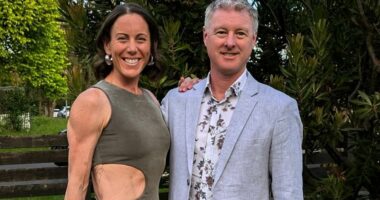
Peters, pictured here with her husband, is now cancer free and has started a foundation called Be Seen to increase access to screening for young colon cancer patients
Peters started the first of six rounds of chemotherapy about 10 days after receiving her diagnosis and then had 28 days of radiation while also taking an oral chemotherapy pill.
A month later, she had a full rectal reconstruction – a seven-hour surgery to restore her bowel function – and then another six rounds of chemotherapy.
Now, cancer free and back to performing, she is set to sing the National Anthem for the Los Angeles Dodgers in July.
Be Seen, which connects patients with resources, has already saved lives.
‘We have been credited with over 30 people having not just colonoscopies and polyps removed, but with having confirmed pre-cancerous polyps removed,’ Peters said.
‘We know that if those were left untreated, that would have resulted in my experience.’
As the organization grows, however, Peters’ advice stays the same.
‘Don’t stop being relentless until you’re heard, until your concerns are addressed and solved,’ she said. ‘It’s so important.’