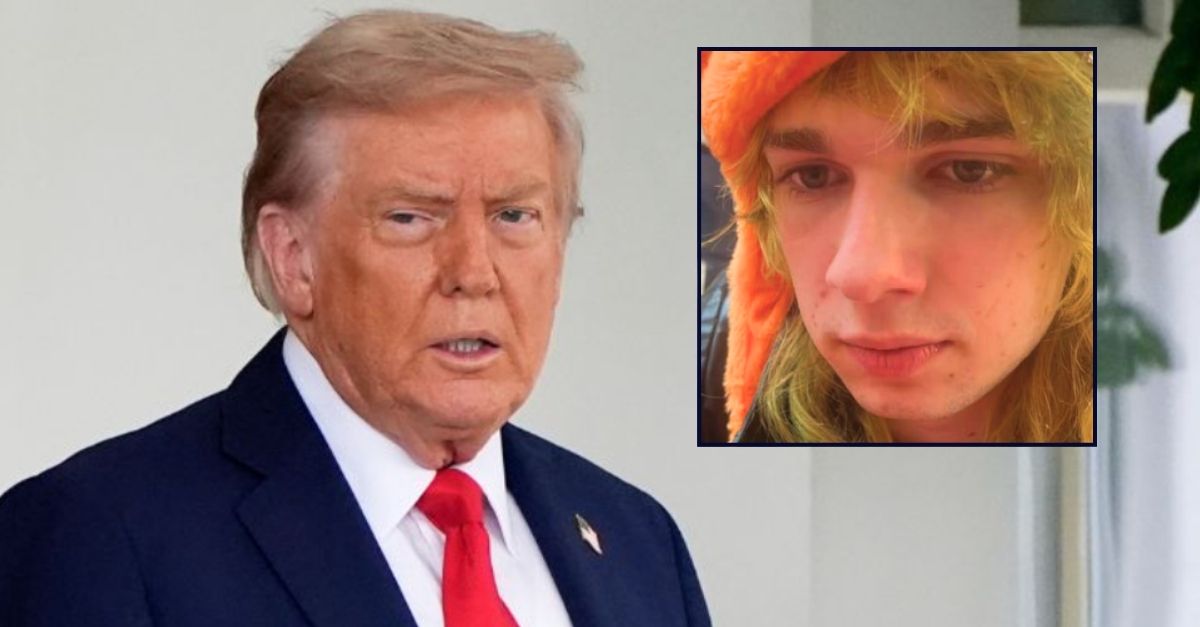

Inset: Phillip Wharton (U.S. Department of Justice). Background: President Donald Trump stands outside the White House, Monday, Aug. 18, 2025, in Washington. (AP Photo/Alex Brandon).
A man from Washington state, identified as Phillip Wharton, has been charged with making continuous threats to assassinate former President Donald Trump, claiming he intended to “wear his face as a mask,” according to the Department of Justice.
Despite repeated warnings from federal agents about the legal consequences of his actions, Wharton, 20, persisted in making threats against Trump. In a September 2025 Instagram post, he stated, “I am going to kill the president tomorrow,” following prior warnings that such threats could result in imprisonment, as outlined in a federal complaint.
Wharton’s post further emphasized the seriousness of his threat, claiming, “This is not a joke, but a confession admissible in a court of law.” He resides in Everett and was indicted in the Western District of Washington last week on two charges of threatening a federal official. Although arrested in November, he is currently released on bond.
The complaint details that Wharton began his series of threats in August 2025 through various social media platforms, including X and Instagram. Prosecutors noted that he also shared images of himself with weapons and sketches depicting individuals armed with weapons.
In one X post, Wharton allegedly described his intentions by stating, “What the guy in the White House sees after I kill the US PRESIDENT OF THE UNITED STATES OF AMERICA AND WEAR HIS FACE AS A MASK,” accompanied by a photo of himself.
“What the guy in the White House sees after I kill the US PRESIDENT OF THE UNITED STATES OF AMERICAN AND WEAR HIS FACE AS A MASK,” Wharton allegedly wrote in an X post, which featured a photo of himself.
“Real punks can agree with me on this one. Elon musk and trump are easy targets,” Wharton allegedly said in another post. “WHEN I TWEET THAT ILL ASSASSINATE THE US PRESIDENT THEY DELETE IT.”
Secret Service agents were alerted to the threats and tracked Wharton down through his social media accounts “by utilizing open-source techniques,” according to the complaint. At least one of Wharton”s alleged posts featured a self-reported location of Washington state and linked to a website featuring art that Wharton released online.
“On that website, the user had a listed name of Phillip Wharton on the account,” the complaint explains, noting how Wharton’s website had “drawings of individuals with weapons.”
Investigators identified an Instagram account with the same username that Wharton was allegedly using, @saydieonline, and identifying information that included his birthdate. The DOJ says photos of Wharton were posted across his various social media apps, which appeared to be the same person.
In September 2025, federal agents arranged a meeting with Wharton at a local bar after contacting his father and telling him what was allegedly going on. The agents confronted him about the alleged threats and Wharton confirmed he was behind the comments. He claimed he made the posts “because he felt angry about his belief that President Trump had been involved with sex trafficking two 14-year-olds and made reference to Trump’s involvement with Jeffrey Epstein,” according to the complaint.
Agents explained “the seriousness of making such threats toward the president and the potential consequences of making such threats,” per the complaint, and warned that if he continued to post threats against the president that he may be prosecuted.
“Wharton seemed compliant and understanding at the time,” according to the complaint. “Wharton agreed to stop making threats against the president.”
Two weeks later, the FBI reported that Wharton was allegedly back online and posting again.
“I am going to kill the president tomorrow,” he said, according to the complaint. “This is not a joke, but a confession admissible in a court of law.”
An October 2025 review of Wharton’s social media accounts revealed “additional posts of concern,” including images of Wharton holding an object resembling a firearm and a knife.
“Another post from September 3, 2025, contained an image of Lady Justice decapitating a pig with the word ‘ICE’ written on the pig’s head,” the complaint says. “A post from Wharton’s Instagram account … appeared to depict a person posing as Luigi Mangione pointing a banana as if it were a pistol to the back of a man holding a vacuum labeled ‘Health Insurance.’”
Wharton is scheduled to be arraigned on March 5.