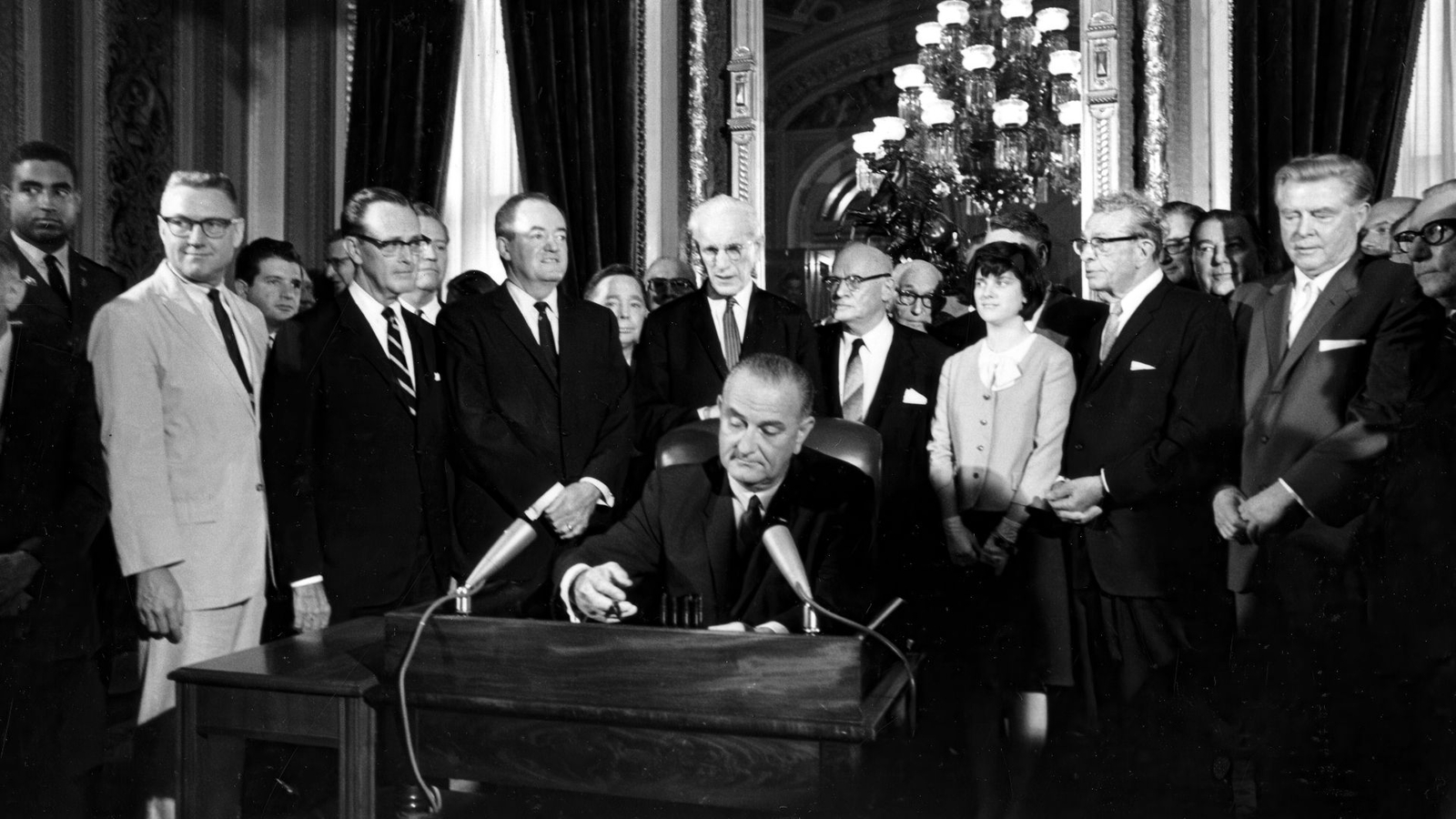

WASHINGTON — On Wednesday, we commemorate the 60th anniversary of a pivotal moment when President Lyndon Johnson walked into the U.S. Capitol, flanked by Martin Luther King Jr., to sign the Voting Rights Act into law.
This legislation safeguarded the right to vote, ensuring the government would counteract efforts to suppress it, particularly those targeting Black voters. For many, this marked the true beginning of democracy in the U.S.
That was then.
Over the past decade, the law has been gradually undermined, starting with the 2013 Supreme Court decision that nullified the need for certain states with discriminatory histories to obtain federal clearance before altering election regulations. Mere hours post-ruling, some states affected began proposing more restrictive voting laws.
These changes have persisted, notably following the 2020 presidential election and former President Donald Trump’s unfounded allegations of widespread electoral fraud. While the Supreme Court upheld a crucial element of the Voting Rights Act in 2023, there’s an upcoming case that could potentially reverse this decision and weaken the law significantly.
Experts on voting rights assert that these cases will largely decide if this historically significant law from a volatile period will continue to be celebrated in future anniversaries.
“We’re at a critical juncture right now,” stated Demetria McCain, policy director at the NAACP Legal Defense Fund. “It’s important to remember, our democracy is only approaching its 60th anniversary with the Voting Rights Act milestone. I emphasize this because there are numerous attacks on voting rights, especially impacting Black communities and communities of color.”
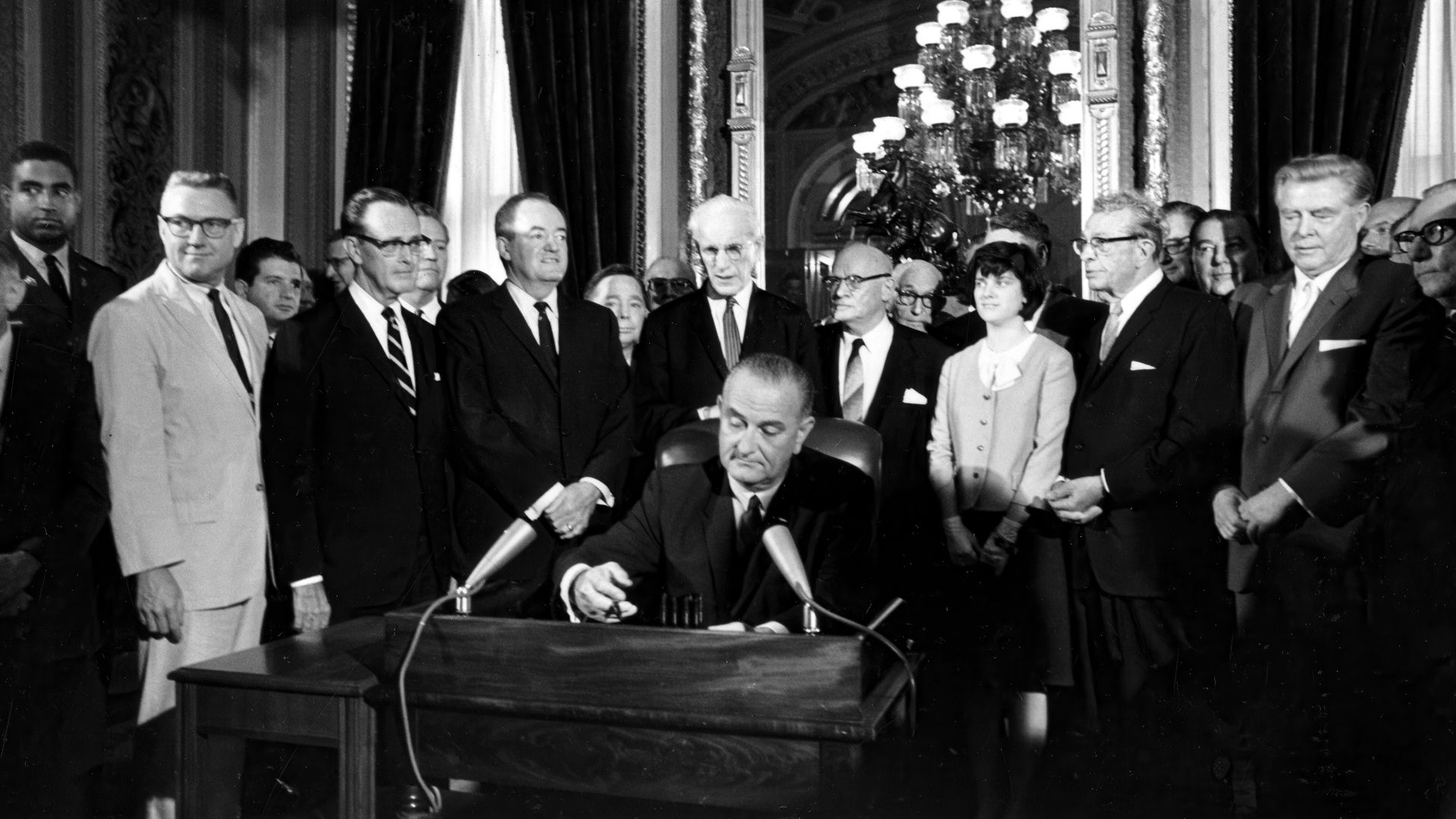
President Lyndon B. Johnson signs the Voting Rights Act of 1965 in a ceremony in the President’s Room near the Senate chambers in Washington, Aug. 6, 1965.
AP Photo, File
Native Americans celebrate a win that could be temporary
The reservation of the Turtle Mountain Band of Chippewa Indians is about 10 miles (16 kilometers) from the Canadian border, a region of forests, small lakes and vast prairie land. Its main highway is a mix of small houses, mobile homes and businesses. A gleaming casino and hotel stand out, not far from grazing bison.
In 2024, the tribe and another in North Dakota, the Spirit Lake Tribe, formed a joint political district for the first time. They had filed a lawsuit arguing that the way lines were drawn for state legislative seats denied them the right to elect candidates of their choice. U.S. District Court Chief Judge Peter Welte agreed and put a new map in place.
State Rep. Collette Brown ran for the legislature because she wanted to see more Native American representation, and she won under the new map.
“It felt surreal. I felt accomplished, I felt recognized,” said Brown, a plaintiff in the lawsuit and the Spirit Lake Tribe’s Gaming Commission executive director. “I felt, OK, it’s time for us to really start making change and really start educating from within so that we’re not silenced.”
Brown, a Democrat, co-sponsored several bills on Native American issues that became law, including aid for repatriation of remains and artifacts and alerts for missing Indigenous people.
This year’s anniversary of the Voting Rights Act “forces you to look at how far we’ve come,” from Native Americans to women, said Jamie Azure, chairman of the Turtle Mountain tribe.
Now the future of their district is in the hands of the Supreme Court.
Will individuals be allowed to file voting rights challenges?
The 8th U.S. Circuit Court of Appeals, which covers North Dakota and six other states, overturned Welte’s decision 2-1, saying the tribes and entities such as the NAACP Legal Defense Fund and the ACLU do not have a right to sue over potential violations of voters’ constitutional rights.
That ruling expanded on an earlier 8th Circuit opinion out of Arkansas that rejected a different challenge on the same grounds. Late last month, a 3rd Circuit court panel ruled in a separate case out of Arkansas that only the U.S. attorney general can file such cases – not private individuals or groups.
Those decisions upended decades of precedent. The Supreme Court has stayed the ruling for the tribes while it decides whether it will take the North Dakota case.
The University of Michigan Law School Voting Rights Initiative found that since 1982 nearly 87% of claims under that part of the Voting Rights Act, known as Section 2, were from private individuals and organizations.
Leaving individuals without the ability to file challenges is especially troublesome now because the Justice Department under Trump, a Republican, seems focused on other priorities, said Sophia Lin Lakin, who heads the ACLU’s Voting Rights Project.
The government’s voting rights unit has been dismantled and given new priorities that, she said, have turned enforcement “against the very people it was created to protect.”
The Justice Department declined to answer questions about its voting rights priorities, cases it is pursuing or whether it would be involved in the voting rights cases coming before the nation’s highest court.
Supreme Court weighs another case on race and congressional districts
Two years ago, voting rights activists celebrated when the Supreme Court preserved Section 2 in a case out of Alabama that required the state to draw an addition congressional district to benefit Black voters. Now it’s poised to rehear a similar case out of Louisiana that could modify or undo that decision.
The court heard the case in March but did not make a decision during the term. In an order on Friday, the court asked the lawyers to supply briefs explaining “whether the State’s intentional creation of a second majority-minority congressional district violates the Fourteenth or Fifteenth Amendments to the U. S. Constitution.”
Robert Weiner, the director of voting rights for the Lawyers’ Committee for Civil Rights Under Law, said while it is a “matter of concern” that the court is asking the question, the fact the nine justices did not reach a decision during the last term suggests there weren’t five votes already.
“They wouldn’t need re-argument if the sides had already been chosen,” he said.
Trump’s Justice Department shifts focus on voting issues
At a time when the remaining protections of the Voting Rights Act are under threat, the Justice Department has shifted its election-related priorities.
Under Attorney General Pam Bondi, it has dropped or withdrawn from several election- and voting-related cases. The department instead has focused on concerns of voter fraud raised by conservative activists following years of false claims surrounding elections.
The department also has sent requests for voter registration information as well as data on election fraud and warnings of election violations to at least 19 states.
In addition to the shift in focus at the Justice Department, federal legislation to protect voting rights has gone nowhere. Democrats have reintroduced the John Lewis voting rights bill, but it’s legislation they failed to pass in 2022 when they held both houses of Congress and the White House and needed some Republican support in the Senate.
Earlier this year, Trump signed an executive order seeking to overhaul voting in the states, which includes a documentary proof-of-citizenship requirement on the federal voting form, though much of it has been blocked in the courts. The GOP-controlled House passed a bill that would require proof of citizenship to register to vote. And gerrymandering state legislative and congressional districts remains prevalent.
The slow chipping away at the 60-year-old law has created a nation with an unequal distribution of voting rights, said Sean Morales-Doyle, director of the voting rights center at the Brennan Center for Justice at New York University. Some states have been active in expanding access to voting while others have been focused on restricting the vote.
“The last five to 10 years,” he said, “the experiences of voters increasingly depend on where they live.”
___
Dura reported from Belcourt, N.D. Associated Press writer Steve Karnowski in Minneapolis contributed to this report.
Copyright © 2025 by The Associated Press. All Rights Reserved.