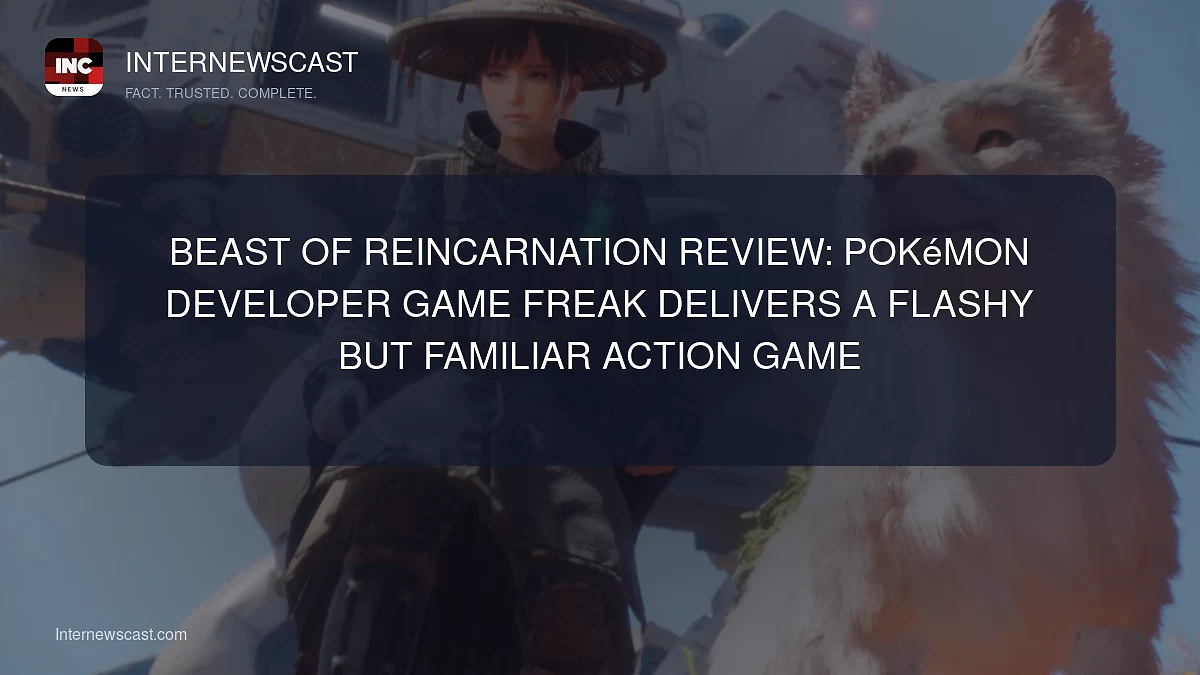

It’s easy to picture Game Freak as a studio with more concepts than it can possibly fit into Pokémon. The developer releases new mainline entries in its signature series with remarkable regularity, yet every now and then it veers into stranger territory, from an action game about a weaponized elephant to a horse-racing card game. That willingness to experiment is what makes Beast of Reincarnation so immediately intriguing: a veteran studio stepping outside the franchise that defines it to build its own big-budget action adventure. The disappointment is that, beyond some polished combat, Beast rarely feels as fresh as that premise suggests.
Beast of Reincarnation is set 2,000 years from now, in a ruined version of Japan where science fiction and mysticism overlap. Humanity has endured, but not always in human form: many survivors uploaded their minds into robotic golems to outlast the disaster that reshaped the planet. The larger threat is a strange blight spreading across the land, twisting animals into aggressive mutant creatures. Its arrival also appears to signal the return of the beast named in the title, an immensely powerful being that seems unable to stay dead. Players control Emma, a wandering mercenary who can absorb the abilities of slain mutants, and her journey soon becomes a race to grow strong enough to destroy the beast once and for all.
As a framework for an action game, that setup works well enough. Emma always has a clear reason to press on: find the next formidable creature, take its power, and move one step closer to the final confrontation. Rather than presenting one seamless open world, Beast of Reincarnation is structured around a sequence of large regions that open up as the story carries her forward.

Image: Fictions
Combat is where the game makes its strongest case. Emma moves like a swift samurai, fighting with a blade and several types of bows. Early on, Beast gives the impression of a Dark Souls or Elden Ring-style challenge, built around precise dodges, parries, and punishing mistakes. As more abilities unlock, however, it starts to carve out a different identity. Emma’s defining power is that vines and plant life can sprout from her hair, an odd idea that quickly becomes one of the game’s most versatile tools. She can grow bridges across chasms, use her hair like a grappling hook to reach high ledges, and rely on a huge, charming magical dog companion that trails her through the world, helps in fights, and takes some of the sting out of chores such as gathering loot.
Those powers become especially fun once battles grow more dynamic. Over time, Emma gains moves that let her dart across arenas, pull herself toward enemies with her hair, strike from above, or combine attacks with her enormous canine partner for heavy damage. Her plant abilities even feed into stealth. At one point, I unlocked a skill that made tall grass spring up around Emma whenever she crouched, briefly creating cover before a quiet takedown. It takes several hours for the system to fully come alive, but once it does, Beast offers a satisfying amount of flexibility and improvisation in combat.
The broader adventure is much less convincing. At first, the ruined world is appealing precisely because it feels unknowable. The game gives you only fragments of its history, while teasing ideas with real potential, including the machine-bound humans and the ways their society has diverged from people who remained flesh and blood. But Beast leans so hard on ambiguity that mystery turns into confusion. Nearly everything is treated as a secret: the land, Emma’s past, her two human companions, her giant dog, the girl only Emma can see, and the other lone fighters she crosses paths with. A story built on secrets can be thrilling, but here I spent roughly a dozen hours with only a shaky grasp of what I was actually trying to accomplish. The game also buries important explanations in a tutorial menu, which makes its world harder to parse than it needs to be. By the time answers finally arrive, most of them don’t justify the long wait.

Image: Fictions
The story isn’t the only place that feels underdeveloped or uninspired. There are a number of gameplay elements — like the ability to grow your own food, and a weapon upgrade system — that are so simple that it’s easy to forget about them altogether. Meanwhile, the level design is incredibly straightforward, making exploration a bore, particularly when it comes to the dead-simple platforming sections. The game’s skill tree is even a literal tree.
But the real issue with Beast of Reincarnation is that it is full of ideas that already exist elsewhere. The story is like a watered-down version of Nier: Automata’s heartrending postapocalypse, while the boss battles feel ripped out of Monster Hunter (with designs straight from its contemporary Wild Hearts and one specific creature that looks identical to a Stranger Things demodog). Your mobile home base functions much like the one in Death Stranding — you can even shower — and it looks just like an AT-ST from Star Wars. Everywhere you go, there’s something from a different game or movie.
This is especially disappointing because there is so much potential in Beast of Reincarnation. Not only is the combat thrilling, but, as derivative as it is, the game still manages to create an incredible sense of melancholic moodiness through its sound and visuals. But it never delivers on that; I was excited to learn about the strange religions and customs that were developed by isolated groups of golem, for instance, but the revelations were all surface level and quickly brushed aside.
That sums up much of the Beast experience: There are flashes of excitement and intrigue, but mostly you’ve seen all of this before. At least there’s more Pokémon on the way.
Beast of Reincarnation launches on August 4th on the PS5, Xbox, and PC.