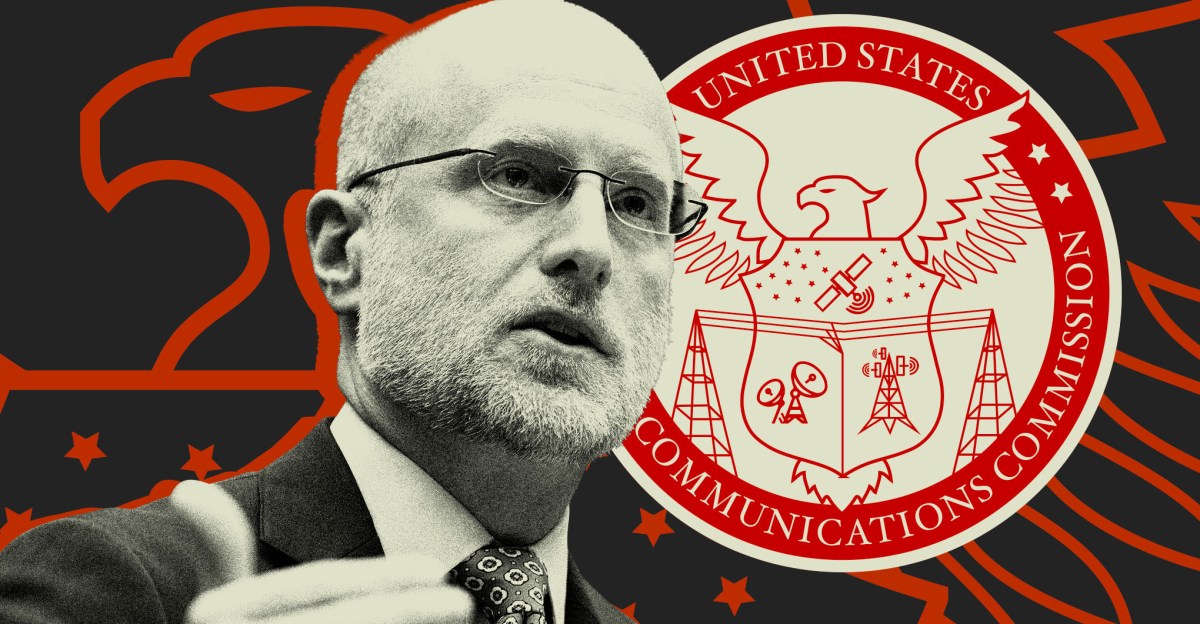
In a significant move, a bipartisan group of former Federal Communications Commissioners and staff members are urging a federal appeals court to force the Federal Communications Commission (FCC) to reconsider its News Distortion Policy. They argue that the policy, which they believe has been misused by Republican Chair Brendan Carr, should be repealed.
The petitioners approached the U.S. Court of Appeals for the District of Columbia on Tuesday, requesting the court to compel the FCC to vote on a petition seeking the policy’s repeal. This petition, submitted in November 2025 by the bipartisan group, followed Carr’s controversial use of the policy to pressure ABC into temporarily suspending comedian Jimmy Kimmel. Under current FCC rules, only the chair can bring such matters to the full commission for a vote, and Carr has resisted doing so while opposing the repeal. The petitioners are now asking the court to issue a writ of mandamus, which would force the FCC to take action. Their aim is to secure a response from the agency, requiring each of the three commissioners to publicly state their position on the policy, potentially paving the way for its removal.
Mark Fowler, a Republican who led the FCC in the 1980s, expressed concern over the policy’s current use, stating, “The News Distortion Policy is a loaded gun that Chairman Carr is using to threaten broadcasters. Until it is repealed, we will not have a free press.” Echoing this sentiment, Tom Wheeler, a Democratic chair from 2013 to 2017, warned that the policy could be misused to police perceived media bias and discourage broadcasters from covering controversial stories. The petitioners include notable figures like the Radio Television Digital News Association, former Republican FCC chairs Dennis Patrick and Alfred Sikes, and several other former senior leaders at the agency.
The News Distortion Policy, established in 1949, allows the FCC to take action against broadcasters that intentionally distort fact-based news reports. However, it does not apply to cable networks, online news outlets, or other media forms, as confirmed on the agency’s website. The policy’s application has historically been limited and cautious, thanks to certain legal guardrails that have ensured its prudent use over the years.
Under Carr’s leadership, however, the policy has experienced renewed attention. Carr has repeatedly threatened to invoke it against broadcasters he believes demonstrate political bias against President Donald Trump. This includes CBS, following Trump’s lawsuit over a 60 Minutes interview edit, and ABC, for airing a joke by Kimmel related to conservative activist Charlie Kirk. Carr also faced backlash for allegedly threatening broadcast licenses of stations critical of Trump’s actions in Iran, although he later denied any intentional threats. His actions have even drawn criticism from fellow Republicans, including Senator Ted Cruz, who likened Carr to a “mafioso” after the Kimmel incident.
But under Carr, the policy has seen a revival. The chair has threatened repeatedly to use it against broadcasters that he perceives as favoring political opponents or displaying a bias against President Donald Trump — including CBS, which Trump sued over its edit of a 60 Minutes interview with then-presidential candidate Kamala Harris, and ABC, which broadcast Kimmel making a joke related to conservative activist Charlie Kirk’s killing. Most recently, he appeared to threaten the broadcast licenses of stations that aired critical coverage of Trump’s war in Iran, though he later denied this was intentional. Carr’s invocation of the policy has drawn criticism even from Republicans like Sen. Ted Cruz (R-TX), who compared Carr to a “mafioso” after his Kimmel threat.
To rule in the petitioners’ favor, the DC circuit court would need to find that the FCC failed its duty to act, imposed an egregious delay, and no adequate alternative will remedy the matter. The petition argues that timing is of the essence — with midterm elections approaching, “this abuse of regulatory power to shape voter perception and control information the electorate has access to is a particularly urgent matter.”
If the court does order the FCC to take a vote, the petition seems likely to fail. Democratic Commissioner Anna Gomez has criticized the News Distortion Policy as “vague and ineffective,” but Carr has shot down the idea of repealing it. Republican Commissioner Olivia Trusty — the third and final member of the partially staffed FCC — may be reluctant to break from Carr on such a high-profile matter, and has said the policy “reflects a simple principle: a station cannot truly serve its community if it knowingly distorts the news about important events.”
Attorney Andrew Jay Schwartzman, who is bringing the petition alongside former Biden FCC nominee Gigi Sohn, and advocacy groups Protect Democracy and TechFreedom, acknowledges that the full commission very well may refuse to repeal the policy. But taking that step would at least open up a legal avenue that has so far been blocked. “That would be OK with us, because we can then appeal that denial,” Schwartzman said in a statement. “The problem here is that Brendan Carr is sitting on the petition.”
“When unlikely allies share an opinion, that opinion eclipses partisanship and ideology.”
The petitioners believe that a new review of the policy should overturn it. New Supreme Court opinions on the First Amendment have “called into question whether the Commission’s application of the policy is even constitutional,” the filing says. That includes SCOTUS’ decision in the NetChoice cases, which dealt with a pair of state laws that sought to limit social media content moderation, and where “a plurality of the Supreme Court opined there is no legitimate government interest — and therefore no permissible application under the First Amendment — in ‘correct[ing] the mix of speech’ in order to ‘better balance the speech market.’” according to the former FCC officials’ filing. “Yet this is precisely the interest that the Chairman, and the Commission he effectively controls, seek to advance with the news distortion policy.”
“When unlikely allies share an opinion, that opinion eclipses partisanship and ideology,” Chong, one of the former Republican commissioner petitioners, said in a statement. “You could not find a group of petitioners with more divergent political beliefs than this one, and yet, we all agree on one thing: The news distortion policy should be repealed.”