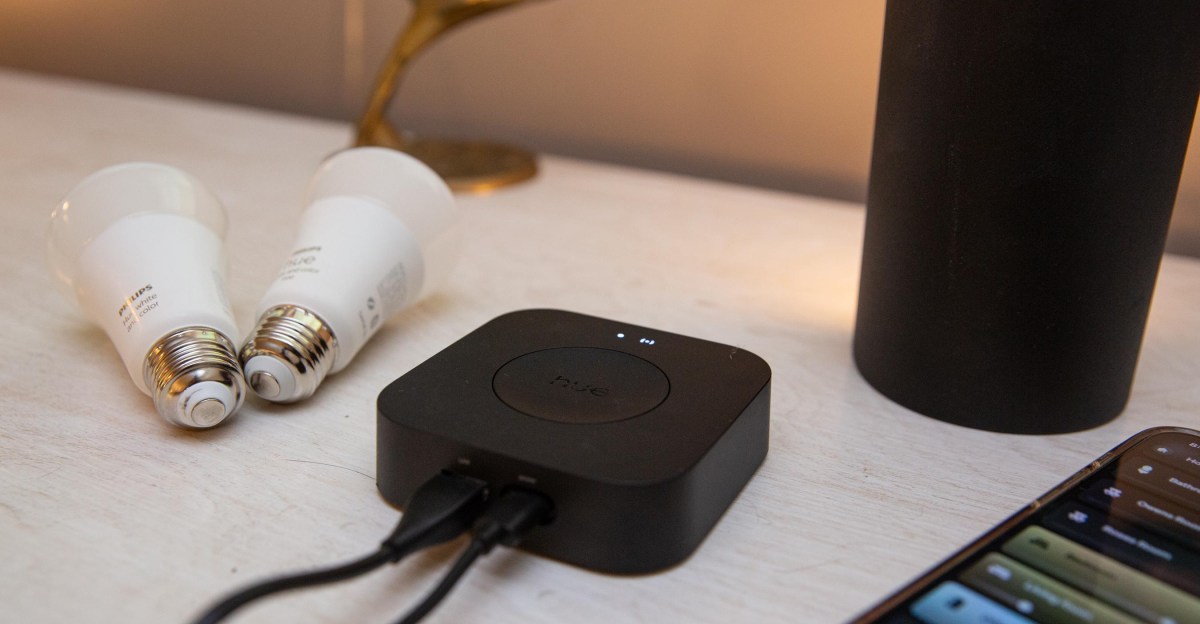

From the moment they hit the market, I’ve been a loyal enthusiast of Philips Hue smart lighting. Despite my ever-evolving smart home setup, these lights have remained a constant. When the Hue Bridge Pro was released last year, I wasn’t immediately convinced it was a necessary upgrade. Its standout function, MotionAware, which transforms lights into motion sensors, seemed useful but redundant since I already owned motion sensors. While I utilize two standard Hue bridges to support my numerous lights and gadgets, I didn’t feel compelled to switch to the Pro model for its increased device capacity. Although the promise of quicker response times due to enhanced processing power was tempting, it wasn’t enough to sway me.
Everything changed in April with the introduction of SpatialAware. This innovation intelligently maps the positions of lights in a room, allowing for a more nuanced distribution of colors and tones from Hue’s lighting scenes. Suddenly, my existing smart lights felt revitalized. Although MotionAware was initially the Pro’s headline feature, it was SpatialAware that ultimately convinced me to make the leap.
$99
The Good
- SpatialAware is genuinely transformative
- MotionAware works out of the box without additional hardware
- Supports more than 150 lights
- Faster, more capable, and more future-proof
The Bad
- Expensive
- MotionAware can be slow and doesn’t work for every room layout
- No weekend settings for motion detection
- SpatialAware is only on some scenes and isn’t compatible with zones
While a Hue light can function without a bridge, connecting it with one unlocks a plethora of advanced features, including dynamic lighting. The Bridge Pro, introduced last September, boasts a faster, more powerful design than the standard model. Equipped with a quad-core processor and 1GB of RAM, it ensures quicker response times for connected devices, supporting exclusive features like MotionAware and SpatialAware that are only available on the Pro.
For those deeply integrated into Hue’s ecosystem, the $140 Bridge Pro upgrade could be a substantial enhancement. It allows for the creation of up to four MotionAware zones, potentially eliminating the need to purchase standalone Hue motion sensors at $49 each. With the capacity to support over 150 lights and 50 accessories—three times the limit of the standard bridge—it’s invaluable for expansive setups. Additionally, it delivers performance up to five times faster. However, the price may be a deterrent, particularly in the US, where it carries a 40 percent premium compared to the UK/EU price of £89.99.
Despite the advent of the interoperability standard Matter, which facilitates the integration of different smart light brands, there are compelling reasons to remain loyal to a single brand. Proprietary features such as dynamic lighting, entertainment syncing, and the newly introduced MotionAware and SpatialAware for Hue cannot be utilized when mixing products from various manufacturers.
Still, the standard bridge delivers much of the same experience for less money. When the Pro was $98, it was an easier decision (and you can still find it at this price — for now), but at $140, it gets trickier. Here’s how the Bridge Pro’s headline features performed in my home.
MotionAware detects motion by sensing disruptions in Zigbee radio signals between Hue devices. In the app, it works like Hue’s standalone motion sensors, but it has specific requirements — and if you need to buy new hardware to meet them, it might be easier to buy a motion sensor.
The big requirement is three to four Hue lights in a room, and they have to be powered, so my Hue Table lamp in the bedroom was a no-go. I had to add an extra powered lamp to test it there. The bulbs also can’t be in a straight line, so my bathroom, which has a single vanity light with four Hue bulbs, was out of the picture.
With the right lights in place, the app walks you through leaving the room for a few seconds to calibrate, then lets you choose what happens when motion is detected: Turn the lights on and off, group with other sensors to control them, or send alerts. The last one is part of Hue Secure, Hue’s security system, and costs $1 a month or $10 a year. For this review, I focused on the free feature that controls the lights.
As with Hue’s motion sensors, when a MotionAware zone detects motion, you can choose to trigger different scenes or have the lights turn on to whatever setting they were last on. You can also have them turn off after a period without motion.
I set up MotionAware zones in the most-used areas of my home where I could install enough Hue lights: my bedroom, mudroom/laundry room, living room, and my daughter’s room. Within a day, I nixed three of those.
The bedrooms were a nonstarter, as there is no weekend option in the app. I shut it off after the first Saturday when the lights turned on at 6AM because I rolled over in bed. Hue’s hardware motion sensors also don’t have weekend settings, but there are workarounds — including adding them to other platforms that support weekend automations. Third-party support for MotionAware zones is currently sparse, but includes Home Assistant and the paid app iConnectHue.
1/4
In the mudroom/laundry room area, I had more success. The lights turned on reliably, but only once I was halfway down the hall. This was too late if I was passing through, but okay if I was doing something in the area. The layout here was also an issue; although I have four lights, they aren’t in ideal spots and are all on the ceiling. A light nearer each entrance would turn it on faster, but that isn’t possible in those rooms.
I also tried MotionAware in my office, setting up two lamps and one ceiling light. It was great at turning on the lights as I approached my desk, but because it’s motion-sensing rather than presence-sensing, it kept shutting them off while I was working. For something like an office, newer, more accurate mmWave presence sensing is a better solution, though Hue doesn’t offer it. I also had to add an extra motion sensor to catch one corner of the room. This had the advantage of bringing the sensor’s physical light sensor into the mix but emphasizes that MotionAware isn’t always a stand-alone solution.
I found MotionAware worked best in my living room, a large, open-plan area that’s always been a challenge to light. I dislike overhead lighting, so I set up a combination of ambient and task lights. In this space, I don’t need the lights to turn on instantly, and I actually like them to fade gently off if I’m sitting still for a while. Paired with SpatialAware, the lights in the room now feel appropriate and welcoming throughout the day.
Aside from the living room, I don’t see any reason to replace my motion sensors with MotionAware. It’s slower and less reliable, and it suffers from a failure point Hue users will be all too familiar with: If someone turns off the light at the switch, the feature won’t work.
But for new users, MotionAware makes more sense. It’s easy to set up, as it’s built into your bulb/bridge combo; no need to buy little white boxes to stick around the house that need their batteries replaced periodically.
It’s SpatialAware, the Bridge Pro’s other flagship feature, that is worth the upgrade if you’re an existing Hue user. Using the Bridge Pro’s advanced processing power and your phone’s AR capabilities, the Hue app can map the lights in a room and determine the best way to distribute the scene’s colors and effects across them. When I saw this in action at CES, I was impressed. While I wasn’t able to re-create anything quite as good as the hotel room demo in my own home, my lighting is noticeably better than before.
In the past, I rarely used Hue scenes outside the core scenes like read and energize, which just use tunable white lighting (and for those, you only need Hue’s white ambient bulbs, not its more expensive full-color ones). I just don’t find multicolored lighting all that compelling indoors, and when I’ve tried Hue’s more colorful scenes, I’ve been put off by one bulb being red or purple and another being green or orange. But with SpatialAware, I’ve found the scenes fit much better in my space, more like they were designed for it. Many made my living room — where I’ve got the largest selection of lights — a significantly prettier space.
For example, without SpatialAware, selecting a scene such as Woodland Toadstool would result in a weird display where one lamp was glowing red, another yellow, and the light strip was all orange. With SpatialAware, the color distribution across the bulbs is subtler, and the gradient lighting in my setup (two Wall Washers) provides the stronger pops of color in a more elegant way. The overall effect is more cohesive and natural. I suspect that if I had more gradient lights, it would be even better.
1/5
Some scenes didn’t show much difference, but most were noticeably better, to the point where I added a couple to my MotionAware zones, so they come on when motion is detected at certain times of day. My husband came home one night and commented on how nice the living room looked, and the only thing I’d changed was the lighting.
There’s room for improvement. Only some scenes have been updated to support SpatialAware, and the feature doesn’t work with zones — groups that can include lights in different rooms, such as Downstairs or Night Lights. So, if I want the same scene in my mudroom and living room, which are part of my downstairs zone in the Hue app, I have to set them both individually. And as mentioned, the effect is best in rooms with a lot of lights, in particular gradient lights that can display multiple colors at once. All of this gets expensive quickly.
I’ve recommended Hue for years for its high-quality lighting, rock-solid reliability, breadth of products, and strong track record. Other brands have cheaper bulbs and brighter colors, but most have less range, none dim as well, and Wi-Fi bulbs aren’t as reliable as a Zigbee mesh.
If you’re looking for super-bright colors and flashier RGB scenes, Govee, Nanoleaf, or Lifx may better fit your needs for less money. But for dependable everyday lighting, Hue has been and remains the gold standard. And the Bridge Pro is the first upgrade that’s really changed how I use Hue lights — SpatialAware took color-changing scenes from a novelty into a feature I prefer and now use every day.
For me, that’s the reason to buy the Bridge Pro, and if you’re an existing Hue user with a house full of lights, I strongly recommend it. But if you’re just starting out with Hue, the standard bridge remains a better value, offering access to all the core features for under $70. Unless you’re planning to buy a bunch of lights up front, you won’t see enough benefit from the Pro’s headline features to justify the extra cost.
Photos and video by Jennifer Pattison Tuohy / The Verge