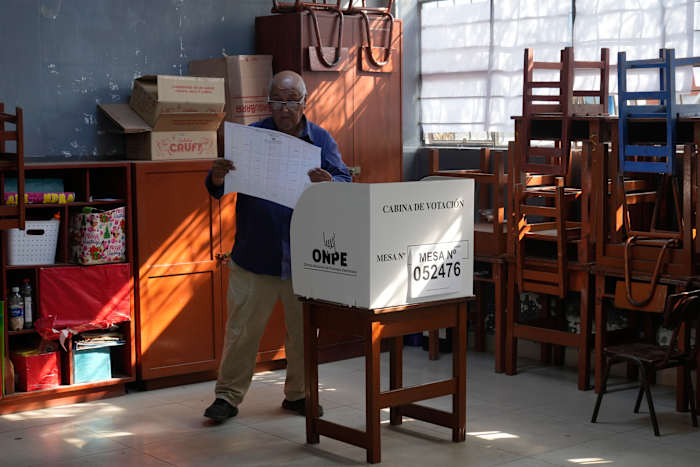


LIMA – The results of Peru’s presidential election, held on Sunday, remain uncertain as voters face delays due to significant logistical challenges. These issues prevented thousands, both within the country and abroad, from casting their votes.
In response to the complications, electoral officials have granted an extension, allowing more than 52,000 residents of Lima to vote on Monday. This extension also applies to Peruvians registered in Orlando, Florida, and Paterson, New Jersey, and was announced after the counting process commenced on Sunday evening.
Initially, authorities estimated that 63,300 individuals would be eligible to vote on Monday, but this figure was later adjusted downward.
In Peru, voting is compulsory for citizens aged 18 to 70, with non-compliance resulting in fines of up to $32.
The presidential race features a diverse array of 35 candidates, including a former minister, a comedian, and a political heiress, all competing to become the country’s ninth president in a decade.
This election occurs against a backdrop of rising violent crime and corruption, leading to widespread voter dissatisfaction. Many perceive the candidates as lacking integrity and the necessary qualifications for the presidency. In response to crime concerns, candidates have proposed various measures, such as constructing massive prisons, limiting prisoner food supplies, and reintroducing the death penalty for severe offenses.
Nurse Heidy Justiniano had not decided who to vote for while already in line outside a public school in Lima.
“There’s so much crime, so many robberies on every corner; a bus driver was killed. What matters most to us right now is safety, the lives of every person,” Justiniano, 33, said. “Politicians don’t always keep their promises. This time, we have to choose our president wisely so that he can improve Peru.”
More than 27 million people are registered to vote. Of those, about 1.2 million cast ballots abroad, mainly in the United States and Argentina.
A presidential candidate needs more than 50% of votes to win outright. However, a runoff in June is virtually assured given the deeply divided electorate and the pool of candidates, the largest in the Andean country’s history.
Voters are also being asked to choose the members of a bicameral Congress for the first time in more than 30 years, following recent legislative reforms that concentrate significant power in the new upper chamber.
Copyright 2026 The Associated Press. All rights reserved. This material may not be published, broadcast, rewritten or redistributed without permission.