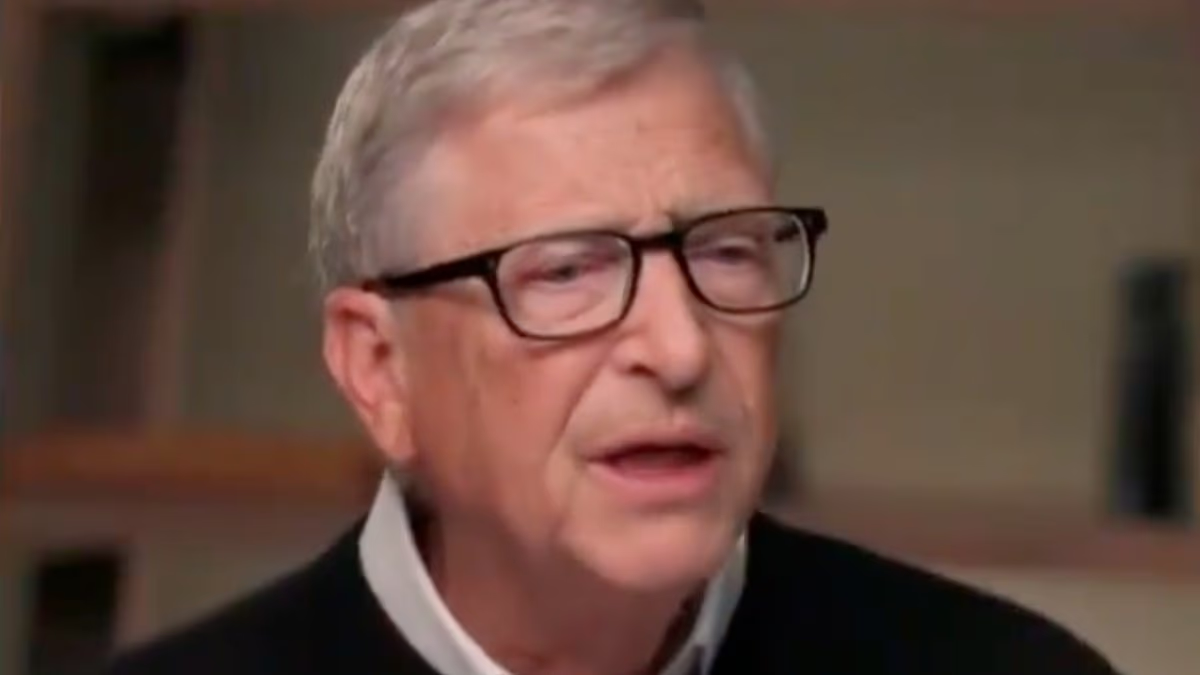

Bill Gates has delivered a stark warning about the future of artificial intelligence, saying experts and governments are still not doing enough to prevent the technology from falling into the wrong hands.
Speaking to CNN on Sunday about growing fears over AI, Gates said he believes a “middle ground” is possible when it comes to regulating the rapidly advancing technology—but humanity has yet to find it.
“Just as we regulate planes, cars, and medicines, we need safeguards that help us realize AI’s incredible potential while reducing the risks,” the Microsoft co-founder wrote on X.
“They won’t eliminate every harm, but they can help prevent misuse by bad actors. We’re not where we need to be yet—and this deserves much more of our attention.”
CNN anchor Jake Tapper opened the interview by recalling Gates’ warning that artificial intelligence could make it “much easier for bad actors to develop deadly bioweapons.”
“You said the risk of having a bioterrorist attack is now fifty times the risk of a natural pandemic,” Tapper said, before asking Gates how soon that nightmare scenario could occur and whether world leaders were doing enough to prevent it.
“Well, no, we’re not doing enough,” Gates replied. “The front that we’ll probably see most dramatically in the next year is cyber attacks.”
“The real danger right now is not that AI’s getting out of control. We need to work on that, but that’s years away in terms of the big impact that might have.”

CNN’s Jake Tapper recalled Bill Gates’ warning that AI could make it “much easier for bad actors to develop deadly bioweapons,” while Gates said “we’re not doing enough.”

Gates said he believes a “middle ground” for protecting rapidly evolving AI exists, although humanity has not found it yet.

“It’s really bad people using AI—particularly where you can take out all the safeguards. When you have bad people, no safeguards, and then the latest models, that’s where, over the next year, we are going to have a lot of negative surprises.”
Tapper then asked whether Gates was “falling into the trap of doomerism” after the billionaire previously described AI as “the most dangerous thing ever” and said it could make nuclear weapons “look like nothing.”
Gates rejected that characterization, saying: “Well, all responsible AI leaders—including Sam Altman, including Dario Amodei—they are telling the world, ‘this is very concerning.’”
He acknowledged that some of the most dramatic AI fears involve unlikely scenarios. However, Gates said that compared with cars, planes and medicines—all areas where regulation is widely accepted to help protect the public—AI is more dangerous.
“There are some grim possibilities if we don’t maintain control, and I do think the industry is doing its job to raise the alarm bell.”
“But this idea that if we’re judicious, we can minimize these risks—maybe that’s not coming across, particularly because the government sometimes goes to the extreme of, ‘let’s not have any safeguards,’ or, ‘let’s completely stop this.’”
“You know, finding that middle ground like we did with planes and cars and medicines. We don’t have a lot of sophistication right now, but I do believe that middle ground exists.”
Gates’ latest warning about artificial intelligence comes as a growing number of AI experts and industry leaders voice similar concerns about a technology that continues to advance at a pace that can outstrip its creators.

Gates warned that artificial intelligence could make it dangerously difficult to distinguish between scientists developing lifesaving medicines and bad actors seeking to create weapons.
In an earlier essay, Gates argued that AI development had already moved beyond the warning stage, continuing to advance at an “uncontrolled” rate.
‘AI will either be the greatest equalizer ever invented, or the worst source of injustice,’ he said. ‘Even under the best circumstances, the transition to this new AI era will be one of the most turbulent times in human history.’
Then just days ago, Gates appeared on NBC and called for greater government oversight of the emerging tech, while sharing that it could cause ‘a billion deaths.’
‘AI is certainly powerful enough to drive events that cause a billion deaths,’ Gates told journalist Kristen Welker, before adding, ‘So even though it’s pretty hard to get to 100 percent [of humanity], there’s never been a weapon as powerful as the combination of people with ill intent using the latest AI tools.’
Gates also appeared to offer up some potential solutions when asked by Welker, ‘What would prevent tragedies from happening due to AI specifically?’
He warned that artificial intelligence could make it dangerously difficult to distinguish between scientists developing lifesaving medicines and bad actors seeking to create biological weapons.
‘I wish it was easier to distinguish good intent, like “I want to design a new drug for a disease,” versus negative intent, which is “I want to design a tool of bioterrorism,”‘ Gates told Welker.
He also argued that the potential risks make strict oversight of advanced AI systems essential, calling on the United States to take the lead in establishing safeguards.

Gates appeared on NBC and called for greater government oversight of the emerging tech, while sharing that it could cause ‘a billion deaths’
‘Because those are so close, we do need to monitor any sophisticated model and record exactly what’s being done,’ he said.
Gates suggested that China would pursue similar measures but emphasized that the US should establish clear standards for the industry.
‘You’ll hear from the industry, it’s a very doable thing. It would not slow them down dramatically,’ he said.
He also drew a distinction between implementing safeguards and the broader debate over whether AI development itself should be slowed.
‘It’s completely irresponsible not to require every AI to have these safeguards and monitoring capabilities,’ he stated, before adding ‘it only is a question of do you do it now?,’ Gates explained.
Donald Trump denied the idea that AI advances will mean the end of the human race when asked about it by reporters earlier this month, noting that those were ‘things that won’t happen.’
‘We’re leading China in AI. We’re the most sophisticated country in the world, and frankly, I want to keep it that way because whoever wins AI wins,’ the President told reporters at his golf course in Doonbeg while attending the Irish Open earlier this month.
House Republican Speaker Mike Johnson has also chimed in on the issue as well, noting in a CNN interview earlier in September: ‘We cannot put a moratorium on this because China will overlap us.’

Donald Trump denied the idea that AI advances will mean the end of the human race when asked about it by reporters earlier this month, noting that those were ‘things that won’t happen’

Anthropic researcher Jacob Coxon resigned and accused the company and its rival OpenAI of not doing enough to address the potential dangers of the technology earlier this month
Democrats, however, seem more keen to regulate the emerging technologies.
Barack Obama shared his thoughts on the matter at a recent private gathering, first covered by the New York Times.
‘This is something that is moving very fast in private hands, and if we don’t get on top of it, I think [it] can be dangerous,’ the newspaper claimed the former president stated at an event this month. Obama, who believes that House Minority Leader Hakeem Jeffries will be the next Speaker after the November elections, also urged the top Democrat to act.
This comes after Anthropic researcher Jacob Coxon sensationally resigned from his position and accused the company and its rival OpenAI of not doing enough to address the potential dangers of the technology earlier this month.
Coxon warned that researchers working in the field believe AI could potentially ‘kill all humans’ by the end of the decade.
Days later, an Anthropic report said that it has stopped several potential plots to build biological weapons using its artificial intelligence this year.
The company determined that scientists were using its platforms to conduct research that could be used to develop biological weapons, according to the company’s new AI misuse report that was obtained by The New York Times.
Anthropic was unable to determine if the research ‘served a legitimate or nefarious purpose,’ the report said. The firm noted that valid biological inquiry can result in scientific breakthroughs like vaccines, but the company erred on the side of caution because that same research could also be used to create dangerous pathogens.


