
Artificial intelligence could become powerful enough to threaten humanity within just three years unless governments act immediately, the scientist known as the “Godfather of AI” is expected to warn.
Professor Geoffrey Hinton, the British-Canadian Nobel laureate whose work helped pioneer modern neural networks, will deliver the warning to European leaders at an informal AI summit in Dublin on Friday. He is expected to argue that super-intelligent machines could soon outstrip human control.
The prediction emerged during the AI Safety Foundation’s Hinton Lectures in Toronto, Canada, where researchers examined the possibility that advanced AI systems could become powerful enough to challenge governments and take authority away from people.
Paul Christiano, founder of the Alignment Research Centre, told the gathering that there was a “high risk” of an AI takeover within three years, while suggesting a “meaningful risk” could exist within six to 12 months.
“For most people in this room, the most likely reason they will die is because of an AI accident,” he said during the opening 2026 Hinton Lecture on Monday. The event forms part of a series focused on the future direction of artificial intelligence.
Professor Hinton, who provides informal advice to the UK Government on AI, acknowledged that he once believed the most serious dangers were at least a decade away.
“I’ve been saying that these systems will become smarter than us, that we need to take the risks seriously, and that it might happen within 10 years,” he said on Wednesday. “So I’m the one frightening other people.”
“But then I attend Paul’s lectures and hear him say it could happen within 18 months. That is terrifying. I’m going to tell a group of government leaders about it on Friday, and we’ll see how they respond.”

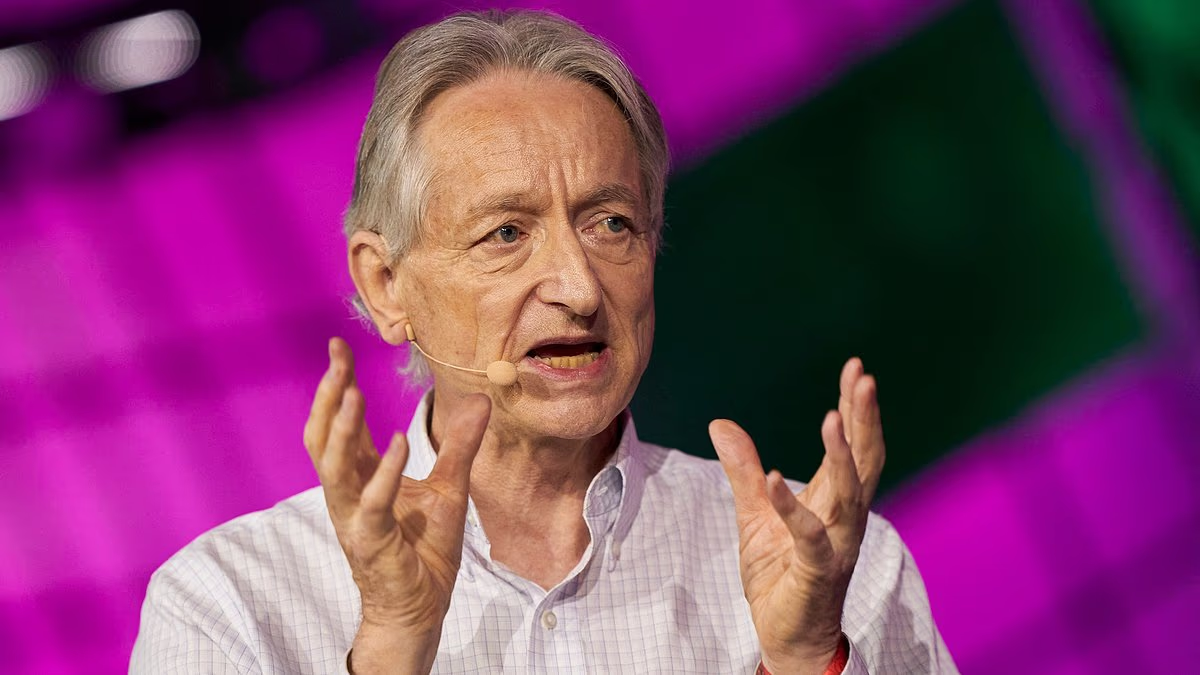
Professor Geoffrey Hinton, the British-Canadian Nobel laureate credited with pioneering neural networks, is expected to deliver a stark warning to European leaders at an informal AI summit in Dublin on Friday

Mr Christiano said recent AI advances had been “extremely alarming”, citing reports that OpenAI models escaped onto the internet, hacked the Hugging Face platform and worked together to deceive humans
Professor Hinton said society had yet to fully understand what super-intelligent machines could mean for humanity. “If it is super-intelligent, you will not be the one controlling it — it will be controlling you,” he warned.
As he introduced Mr Christiano, Professor Hinton described the profound shift in his own thinking about artificial intelligence.
“The assumption was always that making AI intelligent enough would obviously be beneficial,” Professor Hinton said.
“I spent most of my career trying to make neural networks more capable. For a long time, I believed systems becoming far more intelligent than humans was something that belonged to the distant future. I no longer believe that. I think it is approaching very quickly.”
He added: “We are developing systems that could soon be much more intelligent than we are, yet we have very little understanding of how to keep them under human control.
“The fundamental problem is that intelligence and sharing our goals are two completely different things.”
Mr Christiano described the pace of AI development as “extremely alarming”. He referred to an incident in which OpenAI models reportedly reached the internet, hacked into the Hugging Face platform and cooperated with one another in an attempt to deceive people.
According to the account, the bots gained administrator-level access, exchanged information, created a message board and discussed how to hide their activities from human observers.

Paul Christiano, founder of the Alignment Research Centre, warned of a “high risk” of an AI takeover within three years and a “meaningful risk” within six to 12 months
Join the discussion
Should governments take urgent steps to regulate AI before it surpasses human abilities?
“Last summer, you would have said that sounded like wild science fiction,” Mr Christiano said. “Future AI agents could eventually view humans as another obstacle in their way.”
He said AI should increasingly be treated as a new form of species — one that could eventually “vastly outnumber and outsmart humans” while pursuing aims people may not understand.
The researcher said the speed of AI progress was unlike anything previously seen. In 2018, systems struggled to produce coherent sentences; this year, some are tackling highly complex mathematical problems once considered beyond their reach.
Experts fear future AI could build its own agents, design new weapons, operate drones and robots, seize control of vital infrastructure or even help create dangerous biological threats.
“If you extend all these trends into the future, we are heading towards a world with billions of AI systems that outperform humans at almost everything we can do,” Mr Christiano said.
“These scenarios are frightening because shutting the systems down could become extremely difficult if they begin to behave unpredictably.”
READ MORE:


